
This discovery cost billions of dollars.
Until the 2020s, the most popular explanation for the observed picture in the universe was the presence of weakly interacting dark matter particles — WIMPs. Proponents of this theory suggested that they interact with ordinary matter gravitationally but do not participate in other interactions. By the end of the 2010s, this picture began to raise many questions.
Multi-billion-dollar searches for traces of WIMPs across all types of detectors yielded nothing, and collisions of galaxy groups showed no influence of these particles on changes in galaxy speeds.
Meanwhile, even if they do not interact with ordinary matter, they cannot avoid colliding with each other. The absence of traces of such collisions indicated the physical dubiousness of the existence of WIMPs.
Tomonori Totani from the University of Tokyo (Japan) published an article in the Journal of Cosmology and Astroparticle Physics, in which he postulates the detection of traces of WIMP decay. He considers this the first "direct" evidence of the detection of dark matter.
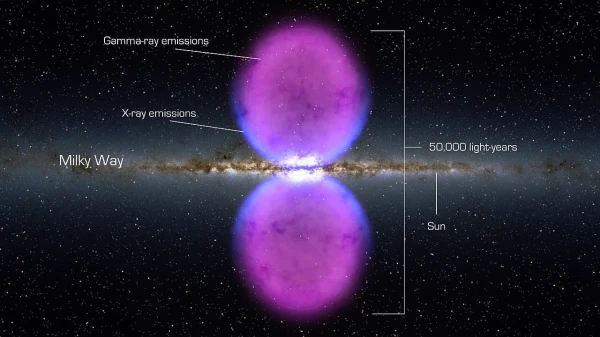
According to prevalent ideas in the 2010s, WIMPs and dark matter in general should concentrate in the centers of galaxies. If they annihilate (which is quite typical for many known particles), gamma photons should be produced in the process. Totani examined data on gamma photon emissions from the central region of our galaxy and found that there is a statistically significant peak around 20 giga-electronvolts.
This emission corresponds to a spherically symmetric halo around the center of our galaxy. The researcher attempted to assess the impact of systematic unaccounted uncertainties on the data but concluded that even accounting for them, the peak around 20 giga-electronvolts remains.
Such gamma photon energies fit the annihilation for particles with a mass approximately 500–800 times that of a proton and the annihilation cross-section of WIMPs multiplied by the rate of this process around 5–8×10⁻²⁵ cubic centimeters per second. Totani mentions that this cross-section is higher than previously obtained realistic limits by other groups on the magnitude of such a cross-section. However, he believes that it is still possible — considering various uncertainties in the initial data.
"If this is correct, then, as far as I know, this is the first time humanity has 'seen' dark matter. And it turns out that it consists of new particles not included in the standard model of particle physics, which would be a significant shift for both astronomy and physics," the astronomer believes.
His main argument remains that other astrophysical sources of gamma radiation known to science today should not show a peak at 20 giga-electronvolts. At the same time, it should be noted that high-energy radiation sources in galaxies are still insufficiently studied, and discoveries in this area continue to occur — this may cast doubt on his argument. Another issue: no one has yet found WIMPs with a mass of about 500-800 protons at terrestrial accelerators, although billions of dollars have been spent on their search.















Leave a comment