
Propaganda of this kind had already preceded the invasion of Ukraine.
The highest political leadership of Russia is involved in a systematic campaign to distort the history of Finland and label Finns as Nazis. The campaign began in 2019 and shows alarming parallels with Russia's actions regarding Ukraine. This is stated in a recently published report by Swedish researcher Patrick Oksanen.
According to the report, Russian Foreign Minister Sergey Lavrov, the spokesperson for the Foreign Ministry Maria Zakharova, and President Vladimir Putin's advisor Vladimir Medinsky are coordinating the dissemination of historical fabrications about Finland. The campaign has significantly intensified this year.
August 2025 was particularly active, when high-ranking Russian politicians made several statements over a few weeks. The campaign intensified after President Alexander Stubb's visit to the White House.
- According to Russian narratives, Finland is responsible for major war crimes and "genocide" in Russian Karelia. Additionally, it is attributed with a long-standing "Russophobia," Oksanen writes in his report.
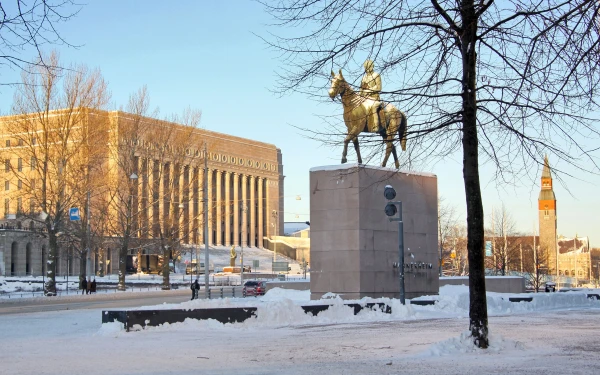
In early August, the Z symbol appeared on a monument to Finnish soldiers in Karelia, and on social media, the monument was referred to as the "monument to Finnish Nazis." At the cemetery of the victims of Stalin's repressions in Sandarmokh, Russian activists disrupted a memorial event, insulting Finnish and Swedish diplomats.
On August 19, Foreign Minister Lavrov stated in an interview with Russian state media that Finland fought on the side of Nazi Germany and that in 1944, Finland signed an agreement on "eternal neutrality," which it violated by joining NATO.
On the same day, President Vladimir Putin's advisor Vladimir Medinsky made an even harsher claim.
- Medinsky claimed that Finland took pride in killing women and children in Leningrad during World War II, the report states.
The spokesperson for the Foreign Ministry Maria Zakharova was also actively involved in the campaign. In August, she linked Finland to Nazism during World War II in her statements and later called President Stubb an "irresponsible Russophobe."
From 1941 to 1944, Finland did indeed participate in World War II on the side of Germany against the Soviet Union. This period is known as the Continuation War. However, Finland was officially not part of the Axis powers and did not sign the Tripartite Pact. Cooperation with Germany was largely driven by the desire to regain territories lost during the Winter War of 1939–1940.
Before the invasion of Ukraine, Russia employed similar methods of information influence. According to Oksanen, the Russian attack on the history of Finland follows the same pattern as in the case of Ukraine before the start of the full-scale war.
- Russia's influence campaign against Finland follows similar models to the narratives about "Nazi" Ukraine and the Baltic states, the report states.
However, the difference is that Finland's national identity is not questioned in the same way as Ukraine's.
According to the report published by the Swedish Psychological Defense Agency, Russia's goal is to undermine Finland's reputation both in the eyes of Russians and internationally. The campaign may also create a visible legal basis for future claims for compensation or territorial demands.
The Russian strategy even has Orwellian traits, believes researcher Oksanen. In George Orwell's novel "1984," the slogan of the ruling party was "who controls the past controls the future."
How Helsinki Could Respond to Hybrid Attacks
The report proposes various ways to counter Russian hybrid influence. Finland, like other Nordic and Baltic countries, is recommended to respond quickly to the most common false narratives, relying on facts and doing so in different languages.
Legal arguments should be used to respond to genocide accusations. UNESCO and OSCE resources can be utilized to protect historical heritage. Diplomatic statements should be coordinated with other countries.
According to the report, the most effective response to Russia's aggressive historical policy would be to develop the education system, support popular culture, scientific research, and educational work among the population.









Leave a comment