
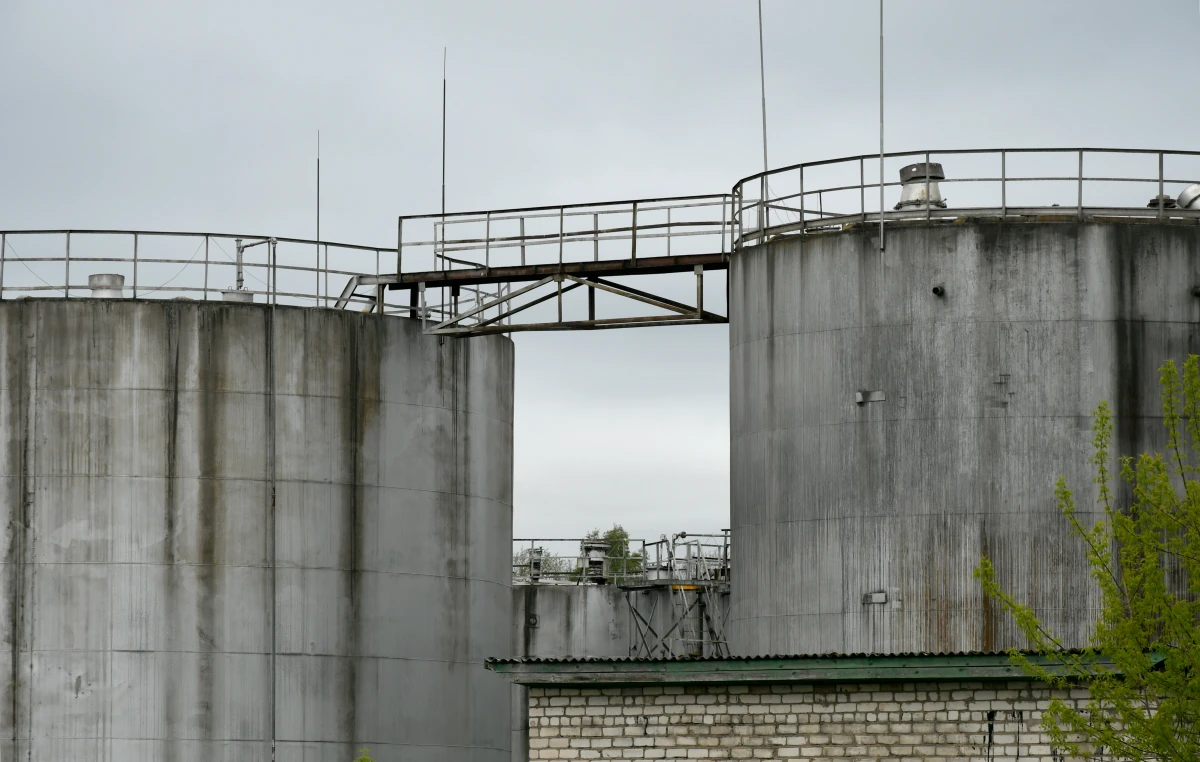
The crash of two combat drones at an oil depot in Rezekne did not lead to a large-scale disaster, but the consequences for Latvian politics turned out to be much more serious. After the incident, the defense minister resigned, and the coalition effectively entered into an open conflict.
The incident involving two combat drones that crashed at an oil depot in Rezekne has become not only a matter of security but also the cause of one of the most serious political crises in recent months in Latvia, writes the publication Ir.
Although the incident did not result in human casualties or a large-scale technological disaster, the consequences quickly extended far beyond Latgale. Following the event, Defense Minister Andris Spruds announced his resignation, and an open conflict began within the ruling coalition.
Colonel Raivis Melnis, a representative of the Ministry of Defense in Ukraine, responded to the post of Defense Minister. His experience is related to the real conditions of modern warfare, where drones have long become one of the main threats.
The main question now is whether this crisis will lead to the downfall of the entire government. An answer may emerge in the coming days.
Military analyst Martins Verdins believes that such incidents are gradually becoming the "new normal." According to him, modern air defense systems cannot guarantee 100% protection against drones.
This is an important psychological moment: even developed countries cannot completely close their airspace to small drones, especially when it comes to low-altitude flights.
At the same time, the expert emphasizes that acknowledging this reality does not mean abandoning the development of defense.
Former long-time State Secretary of the Ministry of Defense Janis Garisons explains that modern drones are specifically designed to be as inconspicuous as possible. Many of them are made not from metal but from materials that are less detectable by traditional radars.
According to Verdins, a significant portion of existing detection systems was created in the last century and is oriented towards other types of aerial targets.
There are also specific questions regarding the acoustic detection system. Analysts suggest that the sensor network may not be dense enough and does not allow for accurate determination of the direction, speed, and coordinates of drones over a large area.
This means that services may simply not have enough time to react.
Experts are also discussing whether the drones were intentionally directed towards the oil depot in Rezekne. They are not ready to completely rule out such a possibility.
However, a more likely version is that Ukrainian drones, flying to targets based on GPS coordinates, were diverted by electronic warfare means. This involves technology that creates a false navigation signal imitating a satellite system.
The incident once again demonstrated how close the war has approached the borders of the Baltic states — even if the drones themselves were not aimed at Latvia.
Now the consequences of this case will be discussed not only by the military but also by politicians: the crisis surrounding the Ministry of Defense has already begun to change the balance of power within the government.














Leave a comment