
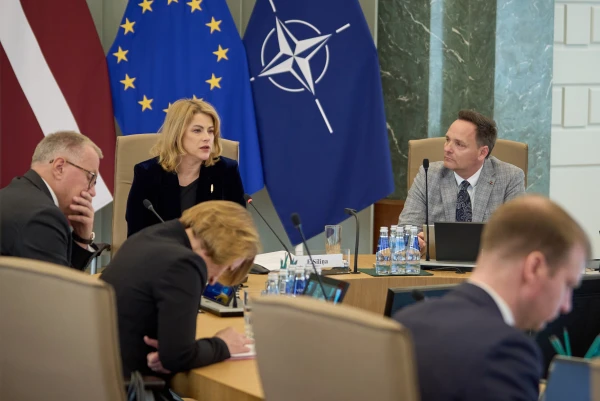
It is quite possible that later both the current prime minister and other ruling politicians will bitterly regret that... they did not leave in time and thus drank the bitter cup to the dregs... But this will apparently be after the elections when they see the terrible results for them. For now... it seems that fate is throwing them one trial after another, and they are clearly failing all the exams...
In just the last two to three weeks, the government has faced four challenges. Let's start in order.
The Ministry of Economics starts and... loses
The first challenge - due to the conflict in the Persian Gulf, fuel prices - primarily diesel - began to rise sharply, creating a threat of a sharp inflation spike. The Ministry of Economics' initial reaction was intuitively correct - to propose a flexible plan for reducing the excise tax: depending on the actual cost of diesel at a specific time. The goal was to "contain" the price of a liter of diesel fuel at 1.80 euros. Economists have already calculated that if the price exceeds this figure, inflation will inevitably rise. The Ministry of Economics presented the government with three options for reducing the excise tax - the higher the fuel price, the greater the percentage decrease in the excise rate. Three rates were proposed - 15%, 25%, and 35%. The highest rate applies if the price of diesel exceeds 2.3 euros per liter. It's all simple and logical, and most importantly - effective.
But it was not to be! The Ministry of Finance was categorically against the Ministry of Economics' proposal, insisting on adopting a "fiscally neutral solution." In simple terms, this means that the lost revenue in the budget from the reduction of the excise tax is fully compensated by a general increase in fuel prices. The explanation is simple: the 2026 budget has already been adopted with a maximum allowable deficit, the national debt is rapidly growing, and allowing an even greater hole in the budget is extremely dangerous.
Economics Minister Viktor Valainis (Union of Greens and Farmers) gave in - apparently, he figured it was better to reduce prices even a little than to continue arguing and not make a decision.
As a result, when you read this issue of the newspaper, the price for a liter of diesel is expected to decrease by 7-8 cents. This is better than it was, but even close to the desired price of 1.80 euros per liter. And thus inflation will begin to rise sharply - it is clear that the government will soon have to return to the issue of reducing the excise tax. Couldn’t everything have been resolved right away?!
And while it is clear that the main blow from rising fuel prices hits freight carriers, perhaps it was worth considering targeted subsidies for diesel for trucks delivering products to stores? If the authorities really want to prevent a new wave of inflation!
Early warning system
The government's inability to make quick and effective decisions is also evidenced by the story of another "arrival" of a drone to us. Once again, the authorities were confused and did not know how to act correctly - whether to warn the population and if so, at what moment. Algorithms have not been developed, officials are confused in their statements. In the end, Defense Minister Andris Spruds concluded that the early warning system should have been activated.
One of the opposition politicians logically concluded that if the appearance of one drone in our territory causes such chaos, what would happen if, God forbid, two, ten, or a hundred drones flew in?! It’s terrifying to even imagine!
IT corruption
Just as the ruling party was recovering from the "invasion" of the drone, a grand corruption scandal broke out - dozens of individuals - officials and entrepreneurs - were detained as part of the European Prosecutor's investigation into possible corruption schemes in the IT sector. In simple terms, crafty representatives of the information technology business created organized criminal groups with the aim of monopolizing all government contracts for IT services, including vote counting in elections! The minister responsible for state policy in the IT sector, Raimonds Čudars, of the Smart Administration and Regional Development, of course, did not even think of resigning - he still looks bewildered and confused.
Fortunately, experienced politician Rinkēvičs quickly oriented himself and effectively forced the deputies to legally establish that the vote counting in the upcoming elections to the Saeima on October 3, 2026, will be done manually! The head of state logically suggested that otherwise, many voters would not come to the elections at all, losing all faith in a fair election outcome. Moreover, there is already an objective risk of "incorrect" vote counting.
But the main question remains unanswered - how do the authorities plan to restore order in the procurement system for IT services, without which normal state functioning is practically impossible today (electronic signature, document exchange, income declaration, elections..)?
Where to get 150 million?
However, even all the aforementioned challenges pale in comparison to the situation with our national airline. Rumor has it that the "moment of truth" is approaching, and to prevent a catastrophe (financial, of course), the ruling party will soon need to address the issue of state support. For airBaltic to function, at least 150 million needs to be urgently found. And, of course, the government must come up with a legally correct way to inject state funds into the airline - that is, for Brussels to accept such a subsidy.
It should be noted that the situation is exacerbated by the geopolitical crisis, which has already led to a decrease in bond prices and an increase in aviation fuel costs.
It is unlikely that the ruling party will dare... not to save airBaltic, as this could lead to a serious economic downturn and reputational costs. Moreover, de jure, the Latvian state still owns the controlling stake in this company, and thus the responsibility lies with the government.
In general, one cannot envy the government of Siliņš... And everyone working in it risks becoming political suicides...



Leave a comment