
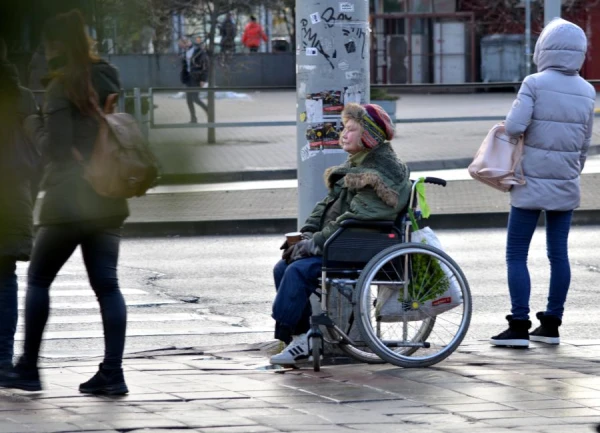
Disability status in Latvia only partially achieves its goal, while the support system is fragmented and uneven, states the State Audit, as reported by LETA.
Auditors point out that no institution in Latvia assesses the overall needs of a person with a disability — in terms of health, social aspects, mobility, and daily functioning. Therefore, obtaining support largely depends on the knowledge of the individual or their relatives and their ability to navigate the fragmented system.
In 2024, there were more than 221,000 people with disabilities in Latvia, and since 2018, their number has increased by more than 15%.
In 2024, the state allocated at least 1.039 billion euros for disability assessment and support, which accounts for 6.4% of all state expenditures, while local governments contributed at least another 20 million euros. A significant portion of these funds is spent on pensions and benefits, while a smaller amount is allocated for services that help cope with daily challenges, including care, transportation, rehabilitation, and housing adaptation.
The audit also revealed that disability assessments are generally conducted in accordance with regulations; however, the process itself is organized inefficiently. For example, referrals for assessments are still processed on paper, and it will only be possible to prepare them in the e-veselība system by 2029.
Furthermore, the State Commission of Physicians for Health and Work Capacity Assessment (GKVET) does not have access to data from other institutions regarding conducted examinations, technical aids, received care, or rehabilitation, so the collection of information is primarily handled by family doctors, which increases the administrative burden.
The State Audit emphasizes that the medical approach still dominates in defining disability, and the transition to assessing functional limitations and activity according to the World Health Organization's classification is being delayed — the new methodology is planned to be introduced only by 2030.
Auditors also point out issues with GKVET's resources — about 60% of experts work under overload, and decisions are not always made on time.
The situation is further complicated by the function assigned to GKVET of extending sick leaves after 26 weeks, which is essentially a task for the healthcare system. Performing this function requires about four expert physician positions annually. According to auditors' estimates, transferring this function to the Ministry of Health could reduce decision-making delays by nearly 46%. The State Audit considers it necessary to review both the number of positions and the functions assigned to the commission to ensure that disability provision is sustainable and timely.
Overall, the State Audit characterizes the support system as fragmented and uneven, especially at the local government level, where the availability and volume of services significantly depend on the place of residence.
Auditors remind that in December 2024, a law established a minimum set of social services that must be fully implemented by 2029. However, by 2025, only two out of seven services provided for people with functional impairments will be available in all local governments.
For example, the group home (apartment) service for people with mental impairments is currently available only in 38 local governments.
A serious issue highlighted in the report is care support — it is fragmented, insufficient, and difficult to administer, as the same need is met by different tools, none of which are adequate.
The State Audit reports that 63.6% of children and 83.2% of adults with very severe functional impairments who receive state care benefits do not use care services from local governments. Moreover, the amount of state benefits does not even cover the average cost of services, exceeding it by a minimum of 220 euros.
As noted by the State Audit, the Ministry of Welfare (MW) proposes only an increase in care benefits, which is planned for 2030, as a solution. However, auditors estimate that this will not significantly improve the situation, as some people will still be unable to access the necessary services in the required volume. The State Audit emphasizes that the funds planned for increasing benefits should primarily be directed towards developing care services themselves.
Auditors also point out deficiencies in transportation support — it is fragmented and insufficiently targeted. The state benefit of 105 euros every six months compensates only a small part of the actual transportation costs, and the vehicle adaptation service is too limited — it is mainly intended for those who drive the vehicle themselves. Additionally, the procedure for obtaining a card to use disabled parking spaces is inconvenient: it is issued by the Road Traffic Safety Directorate, although all necessary information is available to GKVET.
The State Audit reports that the Ministry of Welfare has been given nine recommendations to ensure that disability status in the future can be used as a basis for targeted support. Among other things, it is suggested to improve information exchange, strengthen GKVET's resources, and better orient state and municipal support towards the real needs of individuals rather than formal criteria.













Leave a comment