
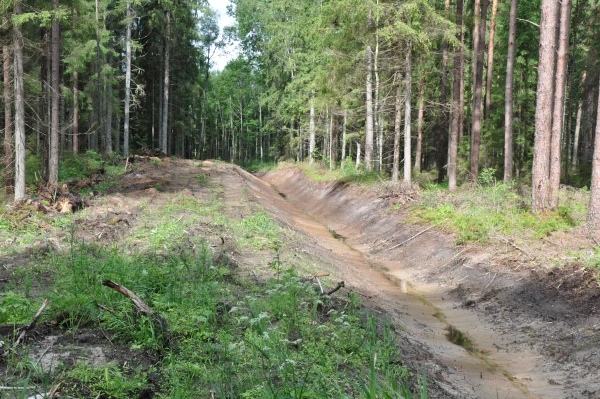
Heavy New Year's snowfalls promise us an increased level of spring waters in the 2026 season. The Ministry of Agriculture, led by Armands Krauze, intends to complete the melioration policy program by 2027 at a rapid pace. The document package must be approved by January 15.
Who is to blame?
The natural conditions of Latvia are characterized by increased soil moisture, with the amount of moisture added significantly exceeding evaporation. In the country, melioration is carried out on 2.4 million hectares, of which 1.6 million hectares are agricultural land, and another 800,000 hectares are forested. The domestic melioration system boasts 14,000 km of drainage ditches, 435 km of protective dams, and 40 pumping stations.
Unfortunately, in recent years, this sector has not improved: "both the COVID-19 pandemic and the military actions initiated by the Russian Federation in Ukraine have also affected the planning and implementation of melioration policy in Latvia... including the rising costs of construction." In other words, Putin and COVID are to blame for the emergence of new swamps.
Moreover, last year, an additional funding of 486,486 euros was required for preventive flood control measures. Local floods in the Daugava basin posed a particular threat to Jekabpils and the surrounding area; 6 pumping stations were operated around the clock, resulting in unplanned energy consumption.
What is being done?
Nevertheless, the Ministry of Agriculture states that "most of... the measures are either fully completed or ongoing." By December of last year, a total of 45 applications for project funding amounting to over 12 million euros had been submitted. The most applications were for projects aimed at restoring state significance melioration systems — a total of 36 projects worth more than 11 million euros.
Local governments are also actively utilizing support opportunities, with 9 investment projects announced, requiring a total of more than 800,000 euros. With the funds from the European Recovery and Resilience Facility, 21 flood protection projects were built last year — attracting more than 32.9 million euros.
National science has also contributed — in 2025, research conducted by the University of Latvia in biosciences and technology on reducing flood risk and monitoring surface and groundwater on agricultural land was completed. The university from Jelgava will also examine water quality in ditches. This year, the Ministry of Smart Administration and Regional Development, together with 18 partner organizations, is implementing a management plan for the river basins of the Republic of Latvia. Under the EU funding line, studies on climate change and the cycle of nutrients for plants will continue until 2028.
Labor Reserves
It is expected that within the year, 35 bachelor's degrees in professional programs "Environment and Water Management," 24 master's degrees in academic programs, and 8 PhDs in "Environmental Engineering" will be prepared in Latvia.
Interestingly, specialists who will implement scientific achievements on the ground are being trained on a much smaller scale — 5 melioration construction technicians are studying at the Smiltene Technical School and 4 at the Saldus Technical School.
Meanwhile, private entities can now also gain knowledge in the field of water resources from the state — 126 specialists in hydraulic structures are certified annually. The Latvian Society of Meliorators and the Silava Institute of Forestry will participate in the programs.






Leave a comment