
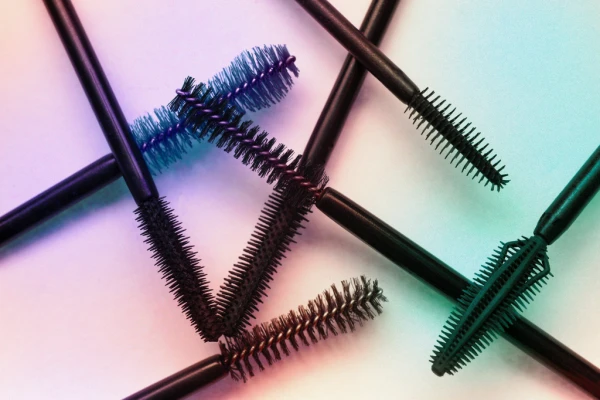
What do you pay attention to when choosing mascara? Surely, to the effect it promises. And few think about the shape of the brush. Although it largely determines how well the mascara separates, coats, lengthens, and adds volume to the lashes. To be specific, we discuss each type of brush separately and highlight their advantages.
Classic Straight Brush
The most universal option. The straight brush evenly coats the lashes, separates them well, and is suitable for everyday makeup. Don’t expect noticeable volume or curl — that’s for other options. The straight brush is convenient for both upper and lower lashes and is especially good if you naturally have good lash length. If you need a slightly more expressive effect, choose a version with dense bristles. A silicone brush additionally helps to avoid clumps and stickiness.
Oval Brush with Fluffy Bristles
This option is perfect if you have short, thin, and sparse lashes but need to add length and volume. Thanks to the fluffy bristles, the brush picks up more mascara and distributes it evenly along the entire length. The lashes visually become thicker, curlier, and longer. By the way, when layering mascara with such a brush, you can create an evening look without complicated eye makeup techniques.
Ball-Shaped Tip
The brush with a ball tip is designed for precise work with lashes that are difficult to coat with a regular brush. The round tip acts as a mini-comb: it easily grabs the shortest and thinnest hairs (even baby hairs), including lashes in the inner corners of the eyes and on the lower lid. The mascara is distributed evenly along the entire length. The ball-shaped tip on the brush is especially useful if you want to achieve an open-eyed effect.
Curved Brush
It is designed to mimic the natural shape of the lashes and gently curl them during the application of mascara. It lifts the lashes from the roots, helps to coat them evenly along the entire length, including the corners of the eyes, and creates the effect of a more open, expressive gaze. The curved brush is particularly convenient when there is no time for additional makeup steps: the brush partially replaces the curler and allows for a quicker neat result. The final effect depends on the type of bristles. A fluffy curved brush adds volume along with the curl, while a silicone one emphasizes curling and length.
Hourglass
The brush in the shape of an "hourglass," often referred to as "3 in 1." It combines several effects: curls the lashes, lengthens them, and adds volume. The bristles of different lengths distribute the mascara evenly across the lashes without the "spider legs" effect (read — clumping). When rotating the brush during application, the result becomes even neater and more expressive, so keep this life hack in mind.
Thin Brush with Sparse Bristles
It handles the thinnest and almost invisible hairs. One could say it provides precision work when coating the lashes. There’s no clumping effect, and curling the lashes won’t be possible either. However, separating and coating from roots to tips is quite achievable. A thin brush is perfect if you prefer a "no-makeup" look.
Triangle
Visually, the brush indeed resembles a triangle: it tapers towards the tip. It is great for girls with thin and sparse lashes. Usually, a triangular brush has fluffy and elastic bristles that coat the hairs evenly and finely. There will be no heavy or clumping effect. So choose mascara with a triangular brush if you need to create a maximally natural look.











Leave a comment