
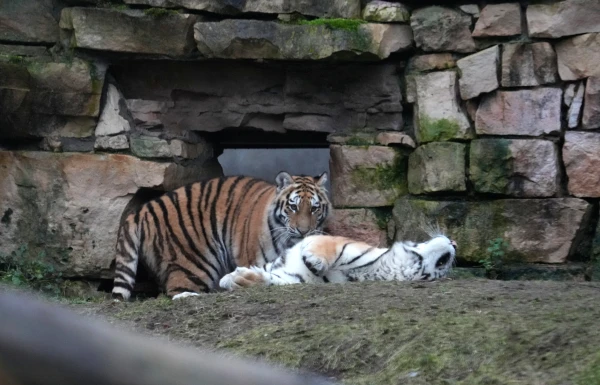
Visitors to one of the oldest zoos in Europe – which turns 114 this year – have recently experienced feelings of disappointment and sadness. Especially in comparison with similar establishments in the West, as well as the impressions we took away from the nursery in Mezaparks relatively recently, in the early 21st century.
Take Me to the "Himalayas"
Meanwhile, we are dealing with a commercial enterprise – a limited liability company – owned by the Riga municipality. The Executive Director of Riga, Janis Lange, issued document No. RD-25-236-dv – on the implementation of the long-term development concept "Himalayas" over the next 10 years.
Referring to the decision of the Riga City Council dated March 30, 2022, which, under the leadership of Mayor Martins Stakis, supported the Masterplan 2035, and established a "project management group to develop an action plan for the implementation of the concept and the development of other necessary documents, attracting external funding," the official outlined the amounts required for the development of the zoo. It was planned to create a wonderful, new world:
-
Stage 1 "Himalayas/Souvenir Shop" – 1,930,000 euros;
-
Stage 2 "Africa" – 11,364,000 euros;
-
Stage 3 "Australia/Parking/Second Entrance" – 3,570,990 euros;
-
Stage 4 "Invertebrates" – 3,237,300 euros;
-
Stage 5 "Eurasia/Restaurant" – 8,137,760 euros;
-
Stage 6 "South America/Lake Pavilion" – 4,102,600 euros;
-
Stage 7 "Southeast Asia/World Farm" – 9,939,665 euros.
In total, the overall costs were expected to amount to 42.3 million euros, and with external funding – 54,005,029 euros, of which project management was to account for 3,034,051 euros and loan interest payments – 8,688,163 euros.
All this was supposed to ensure, in accordance with the Riga Development Program until 2027, "the recovery of the tourism industry and reduce seasonality..." It was planned to increase the added value of services in the hospitality sector of the capital.
Meanwhile, the project clock is already ticking, and the deadline for the introduction of Stage 1, i.e. "Himalayas," is already quite foreseeable – December 31, 2026. There is a year to achieve this, which is why "the indicative amount of the Project has been updated to 7,500,000 euros."
Giraffes Should Bring Profit
"The priority of the Society during this period is to achieve budget balance," – this is how the tasks of the municipal LLC are described in Janis Lange's letter. This is in the context of how bleak the Riga Zoo looks – at any time of the year – since, in theory, the primary goal of such an establishment should be the welfare of its diverse animal inhabitants, convenience for visitors, and a scientific-educational profile.
Nevertheless, in the mid-term strategy of the Zoo until 2026, the main emphasis is placed on ensuring "an annual... positive profit indicator." Against this background, there is a need for "improving efficiency, ensuring cost savings, and human resources." Of course, the "public good effect" is also mentioned – education, biodiversity, tourism.
"Moreover, the implementation of the Project is strategically important for the Society and the state interests of Latvia... in accordance with the standards of the European Association of Zoos and Aquariums, the International Union for Conservation of Nature and Natural Resources, and the protection of habitats in the European Union."
The Zoo, among other things, is an economic factor – "attracts international cooperation projects and makes a measurable contribution to the economies of Riga and Latvia... positioning Riga and the state as a long-term, science-based, and innovation-oriented society."
People Subsidize Animals
"Unfortunately, the planned net turnover for 2025 has not been achieved," – in every financial document, one must read what is written in small letters at the bottom of the page. In Janis Lange's paper, which directly concerns the financial interests of the residents of Riga, it can be learned, in particular, that the forecast for the past year – 6,228,312 euros, which was supposed to ensure a positive net profit margin, was not achieved. By the end of 2025, only 5,516,222 euros were obtained. Moreover, the amount of subsidies from the Riga municipality, calculated at up to 30.3% of the total finances of the Zoo, increased to 32.6%.
As for project investments, according to the aforementioned programs, there was a complete failure – instead of 951,019 euros, only 254,866 euros were obtained.
Furthermore, the zoological LLC indicates that the costs for design, construction work, equipment, author and construction supervision, and reserves, since 2022, have increased "more than four times." "The preliminary study without a ready design solution (1.93 million euros) did not include the current exhibition and the number of individuals, as well as the war-induced increase in materials/energy, inflation and wages, the rise in bank financing, and additional technological solutions, as well as the full basket of end-to-end payments."
"The total costs of implementing the Concept may increase to as much as 125 million euros, which is 2.9 times more than originally planned," the document notes. "It is significant that attracting borrowed funds will further increase costs."
Visitors Will Increase by a Quarter
The city plans such a positive effect from the restructuring of the Zoo, estimating 360,000 to 420,000 visitors per year, with an average ticket price of 13-15 euros. This, by the way, is not much less than at the Vienna Zoo, managed by a private foundation, which has an incomparably larger exhibition and comfort for the public.
At present, the notorious business indicators, which are supposedly supposed to be a guiding star for the local Zoo, unfortunately, are limping. With a slight increase in municipal subsidies, about 60,000 euros from 2021 to 2025, and a slightly reduced state subsidy (from 539,317 euros to 538,483 euros), a loss of 93,718 euros was recorded in the past year. Moreover, notably, despite external crisis factors in 2023, there was a profit of 106,298 euros.
Against this background, the zoological LLC announced in message No. 01-06-n/59 a credit project for an amount of 5,900,000 euros, which is planned to be signed with the American-owned Citadele banka, with interest payments over 20 years.
King of Beasts
The current head of the Zoo is Janis Rudzitis. His previous positions include expert, senior customs expert at the State Revenue Service; director of the Latvian Nature Conservation Fund; administrative director of the State Agency for Digital Development. The salary of the chairman of the board in 2024 was 55,575.72 euros.







Leave a comment