
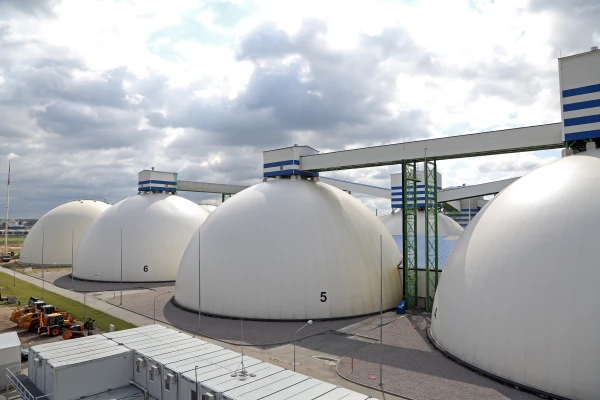
The government discussed the possibility of applying a sanctions exception for LLC "Riga fertilizer terminal" (RFT) and resuming its operations at a closed meeting in August, reports the magazine Ir, writes LETA.
Although the decision did not receive the "green light", two representatives of the Union of Greens and Farmers (SZF) — Minister of Economics Viktor Valainis and Minister of Agriculture Armands Krauze — spoke in defense of resuming the terminal's operations, the publication notes.
According to Ir, back in February, RFT appealed to the Financial Intelligence Service requesting permission to resume operations.
To this end, despite one of the co-owners of the enterprise — Russian citizen Dmitry Mazepin — still being under sanctions, the company proposed to create a so-called "fireproof barrier" to unblock funds and resources, as well as to resume the provision of services.
The implementation of the "fireproof barrier" would mean that neither Mazepin nor his Cypriot company "Tammulogis", owned through intermediaries, would be able to benefit from the terminal, while RFT itself could continue operations. Formally, it would still be considered a sanctioned entity, but most restrictions, such as asset freezes, would not apply to it.
This is exactly what RFT promised. Additionally, the minority co-owner of the terminal — "Riga Port Group", owned by the families of Ainars Slesers (Latvia first) and Andis Škēle, provided assurance that the company's profits would be directed to cover past losses, and any remaining funds would either be undistributed or invested in development, writes Ir.
The proposed "fireproof barrier" is a legal solution that requires government approval. The European Commission's rules allow for such barriers in strategically important sectors to protect the interests of European companies. Since November 22, 2022, RFT has been recognized as a commercial enterprise of national security importance, thus theoretically eligible for such an exception.
After RFT's appeal, the Financial Intelligence Service prepared a proposal for the application of a sanctions exception, outlining a number of conditions and risks.
As Ir discovered, the service had concerns about plans to continue cooperation with Russia. Despite assurances that the terminal would focus on transshipping fertilizers from Kazakhstan, Uzbekistan, and Scandinavia, the company stated outright that it could not completely abandon cargo from Russia and Belarus, as this was "not justified either economically or legally".
Although RFT committed to only transshipping cargo not subject to sanctions, the service deemed that the risk of sanctions violations in trade with Russia and Belarus remains elevated. Therefore, it was suggested to assess whether such activities align with Latvia's foreign policy and economic security.
There were also doubts about whether Mazepin could truly lose control over the enterprise. The mere prohibition on "Tammulogis" exercising voting rights does not exclude the possibility of influence. The company has the right to appoint two of the four members of the enterprise's board, including the chairperson, who has a decisive vote in the event of a tie.
Moreover, although the shareholders' agreement provides for a four-member board, the service established that the board is currently effectively dissolved, and "Tammulogis" may seek recourse in court. There is already an ongoing arbitration case in the Swiss Arbitration Centre regarding a possible breach of the shareholders' agreement.
If the government had decided to allow the creation of the "fireproof barrier", the Financial Intelligence Service proposed to impose additional conditions: a ban on changing shares and authorized capital, conducting and receiving payments only cashless through a Latvian bank, quarterly reporting on all operations, as well as a semi-annual independent audit of compliance with sanctions and mandatory reporting to the government on any court decisions.
The issue was discussed by the Cabinet of Ministers on August 12. In a closed part of the meeting, it was decided not to exempt the enterprise from sanctions. Only the ministers from SZF — Valainis and Krauze — expressed special opinions.
Valainis believed that conditions could be introduced to allow the terminal to resume operations, while Krauze stated that "Latvian farmers need cheaper fertilizers from countries like Kazakhstan, Uzbekistan, Azerbaijan, and others that could supply enterprises operating in Latvian ports," reports Ir.
As Valainis emphasized, his interest as a minister is to achieve the resumption of operations of such enterprises, as they have a significant impact on the development of the economy. According to Ir, Valainis speaks in the plural because RFT is not the only terminal where the controlling stake is held by Mazepin's firm. The same status applies to LLC "Ventamonjaks" in Ventspils, among the co-owners of which, through intermediaries, is also the son-in-law of the Ventspils City Council deputy and former mayor Aivars Lembergs (SZF) Janis Austrins.
Valainis had already noted last summer in an interview with Ir that discussions were ongoing regarding the resumption of operations of both enterprises.
"These are two strategically significant assets controlled by a Russian citizen under sanctions: one in Ventspils, the other in Riga. They are important players in the business," he stated.
Similar discussions began back in 2022 at the initiative of then-Minister of Economics Ilze Indrikson (National Alliance).
Earlier, LETA reported that according to Firmas.lv, the beneficiary of RFT is Dmitry Mazepin, who owns 51% through the Cypriot company "Tammulogis Limited".
The remaining 49% belongs to JSC "Riga Port Group", owned by "Multi Capital Holdings", with the ultimate beneficiaries being the families of former Prime Minister Andis Škēle and Saeima deputy Ainars Slesers.
On November 1 last year, the Financial Intelligence Service allowed the unblocking of sanctioned fertilizers stored at the RFT terminal to prevent a potential environmental threat. An auction was initially planned, but it did not take place.
On March 5 of this year, a decision was made to sell the ammonium nitrate located at the terminal to a Latvian enterprise not subject to sanctions. The goal was also to prevent environmental risk.
All funds received from the sale were frozen in Latvian banks in accordance with the sanctions regime.
The service reminded that the fertilizers were frozen under EU sanctions imposed in March 2022 in response to Russia's military aggression against Ukraine.
The sanctioned entity — Russian citizen Mazepin — indirectly controls both RFT and the owners of the fertilizers stored at the terminal. As a result, the terminal's economic activities were suspended, and the company was instructed to ensure the safe storage of fertilizers until their removal.


Leave a comment