
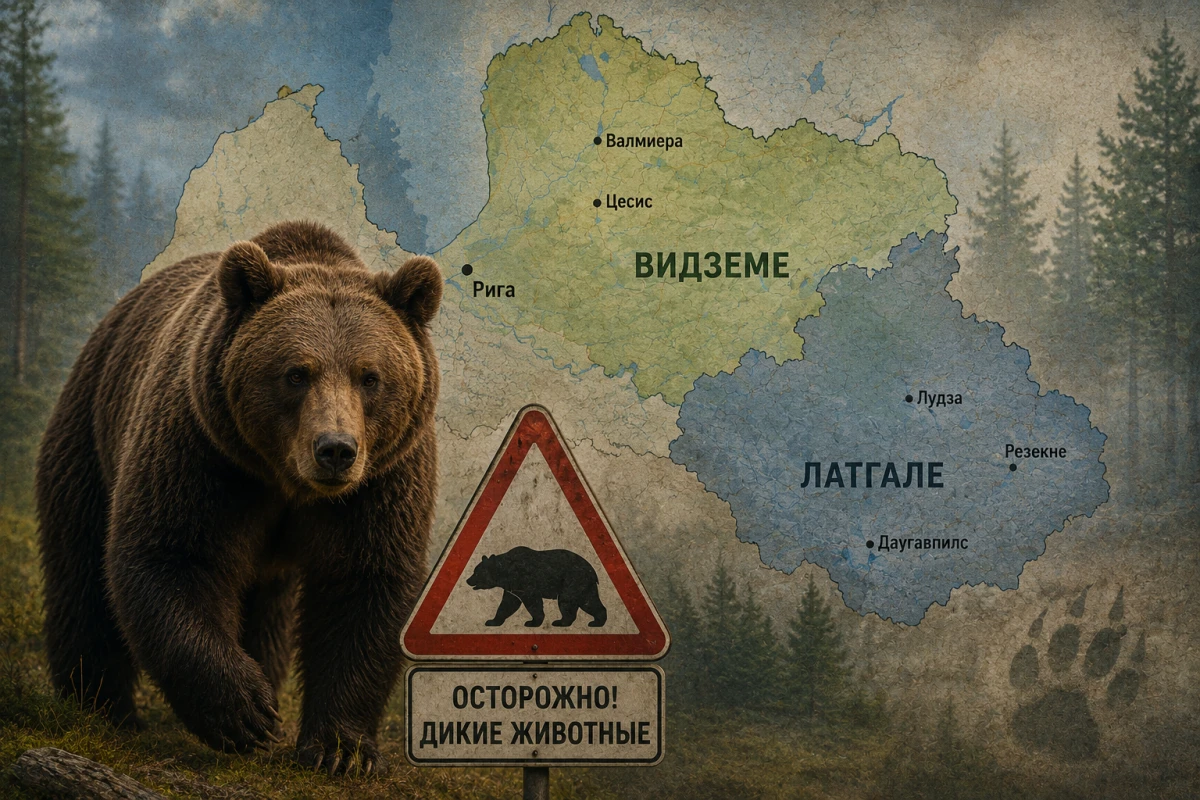
The number of bears in Latvia has increased from a few individuals to nearly two hundred over the past two decades. Animals are increasingly spotted near populated areas, intensifying the discussion on how the country can coexist with the largest predator in Europe.
The growth of the brown bear population in Latvia has once again become the focus of public attention. This is due to the increasing reports of animals appearing near residential houses and in populated areas, writes LETA, citing Ir.
Against this backdrop, the debate in society has intensified over whether to allow bear hunting or to focus on measures for peaceful coexistence between humans and predators.
Currently, two opposing initiatives are registered on the public initiative portal ManaBalss.lv — one advocates for the possibility of regulating the bear population through hunting, while the other demands to maintain the existing protection for animals. So far, neither has gathered the necessary number of signatures to be submitted to the Saeima.
Meanwhile, specialists confirm that the bear population is indeed growing. According to Guna Bagrade, the head of bear population monitoring at the Latvian State Forest Research Institute "Silava," there were fewer than ten bears in the country in the early 2000s. Last year, their number reached at least 190 individuals.
This means that bears have ceased to be occasional visitors coming from neighboring countries. Now they permanently inhabit Latvia and successfully reproduce.
"Previously, bears only wandered into Latvia; now they are born here," specialists note.
The highest concentration of animals is observed in Latgale and Vidzeme. In some parishes, specialists record several bears at the same time.
What is important to know: the appearance of a bear near a house does not necessarily mean a threat to humans. According to experts, animals most often end up near populated areas during movements or in search of food.
Experts also remind that the brown bear is a natural part of Latvian nature. This species has inhabited the territory of the country since the post-glacial period and is considered a local representative of the fauna.
Estonia is often cited as an example of successful coexistence between humans and bears. There are about a thousand bears living there; however, over many years, only a few cases of attacks on humans have been recorded.
Experts emphasize that the main risk arises not from the aggressiveness of the animals but from the improper behavior of people, attempts to approach the bear, or attracting it with food sources.
As the population grows, encounters between humans and bears are likely to occur more frequently. Therefore, the discussion on how to ensure the safety of residents while simultaneously preserving the protected species will become even more relevant in the coming years.














Leave a comment