
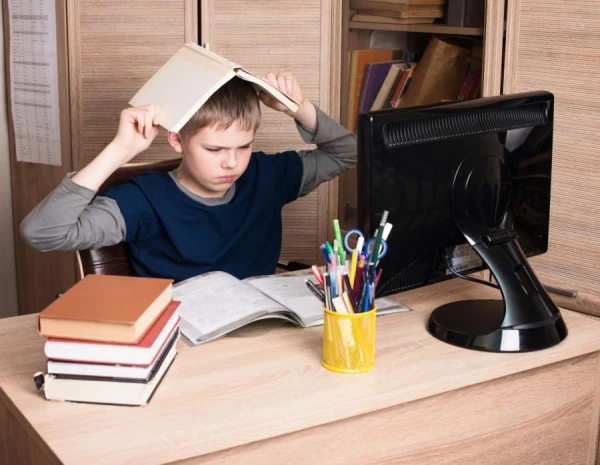
On Thursday, the Saeima adopted amendments to the Education Law, which provide for significant restrictions on the availability of distance learning at the primary education level — for students in grades 1 to 6, reports LETA.
The aim of the amendments is to clarify forms of education and improve the quality of the education received. The changes provide for the replacement of distance learning with in-person learning on a part-time basis, while simultaneously introducing blended learning. The Saeima's Education, Culture and Science Commission notes that this will allow for flexible organization of the educational process, combining various educational tools and methods, including elements of distance learning and online classes. This regulation will also expand the opportunities for ensuring quality in-person education, emphasizes the commission.
The procedure for organizing and implementing blended learning will be established by the Cabinet of Ministers.
The amendments also clarify inclusive education with the aim of expanding the participation of each student, as well as education under parental guidance, the procedure and conditions of which will be determined by the Cabinet of Ministers.
At the same time, the amendments provide for stricter and clearer rules for the form of distance learning. Distance learning or home schooling for students in grades 1 to 6 will be allowed only for one year and only if there is an assessment from the local government. This assessment must identify special circumstances under which this format of education is in the best interests of the child. These may include social, medical, territorial, or other significant reasons for which the local government must provide a conclusion.
Local governments will also be able to extend the validity of the issued assessment. It is expected that the criteria and procedure for conducting the local government assessment will be established by the Cabinet of Ministers.
Children permanently residing abroad, as well as students who have already turned 18 but have not received basic education, will also be able to study remotely.
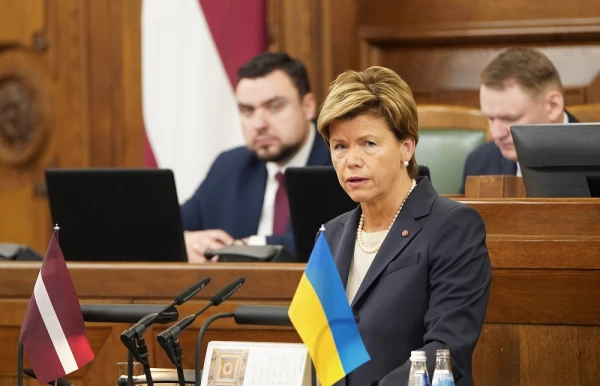
"Although distance learning has several advantages that make it appealing to many students and parents — such as flexibility in time and place of learning — the quality of education received often suffers, as confirmed by the results of centralized exams," explained the necessity of the changes the chairperson of the Saeima's Education, Culture and Science Commission, Agita Zarinya-Sture.
As noted by the Saeima Press Service, the exam results for students studying remotely are significantly lower. In distance learning schools, 84% of all students taking the math exam score below the national average. There are schools where even 38% of exam takers do not achieve a score of 10%. Additionally, 69% of students taking the Latvian language exam and 63% taking the English exam among those studying remotely score below the national average, according to information gathered in the annotation to the draft law.
In-person learning is of great importance as it provides more opportunities for direct support from teachers, note the authors of the amendments. In distance learning, children also find it more difficult to fully develop social skills — interacting with peers, as well as with teachers and other school staff, which contributes to the formation of communication, collaboration, and empathy skills. Furthermore, in school, children are in a structured environment with an established daily routine, which promotes the development of discipline and time management skills, as well as guarantees physical activity — physical education classes that contribute to physical development and health, emphasize the authors of the changes.
According to data available to the Ministry of Education and Science for 2024, 3,500 students were studying remotely at the primary education level, and a total of 12,800 students across all levels.
The criteria and procedure by which schools will be able to implement distance learning will be determined by the Cabinet of Ministers. This will include requirements for the technical environment, preparation of educational materials, regular daily activities of students, and support for learners, with the definition of the share of direct contact and quality requirements. Criteria will also be established for the work of educators and for providing feedback to students and their parents.
The Cabinet of Ministers has been tasked with establishing requirements for distance learning programs in the Latvian language, history and culture of Latvia, as well as natural sciences and geography of Latvia for those students residing abroad.
The transition to the new regulation of distance learning will occur gradually. The new norms regarding the 1st grade will come into effect starting from the new school year. From September 1, 2027, the new regulation will also apply to 2nd and 4th grades, from September 1, 2028 — to 3rd and 5th grades, and from September 1, 2029 — to the 6th grade.








Leave a comment