
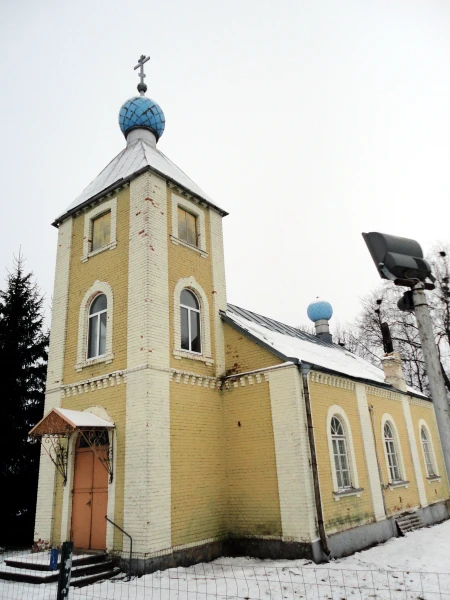
In the book "Color Triodion," published in Moscow in 1909, there is a record that it was acquired for the Malyutkinskaya Old Believer Community, and on page 353, there is an imprint of a seal with the inscription "Malyutkinskaya Old Believer Community of the Fedoseevsky Interpretation." This refers to one of the oldest parishes in Daugavpils – the Malyutkinsko-Yudov community.
Origins
Old Belief in Latvia has existed for about 300 years, but very few documents have survived that testify to the times when the first settlements of Old Believers appeared on the land that provided refuge to people who did not wish to change their faith. The author realized this while gathering information about one of the oldest Old Believer temples in Latgale – the Malyutkinsko-Yudov Church, which has been around for almost two centuries. Previously, this community adhered to the Fedoseevsky interpretation, which was based on several requirements:
-
denial of marriage;
-
food purchased at the market is considered defiled and must be purified with prayer;
-
refusal to pray for the tsar.
However, after the Old Believer Councils of 1909 and 1912, this community adopted the Pomor-marriage direction, which is traditional for today's Old Belief in Latvia.
In venerable times, the prayer house of the Malyutkinsko-Yudov community was a wooden structure that lasted until the late 1930s. It was located on the banks of the Dvina-Daugava River – in a flood zone, so the severe floods that occurred in 1922, 1931, and 1937 significantly damaged the wooden building of the prayer house, leaving it in an emergency state. At that time, the community council decided to build a new temple.
As church records from those years indicate, the stone foundation of the prayer house had sunk into the ground, and the lower logs of the wooden structure had rotted. Therefore, it was decided not to restore the existing building but to construct a new temple.
Brick by Brick
The plot of land where the dilapidated and distressed prayer house stood was purchased from the state for 700 lats. A project for the temple with a high bell tower and ten windows was developed and submitted for approval to the architectural commission. Construction was planned to begin in 1937 and to be completed two years later. But these plans were not destined to come to fruition – there was a catastrophic lack of funds. And one cannot fail to give credit to the then-chairman of the community, Foka Polgin, who managed to start the construction – he found donors and created various commissions that began to purchase building materials.
However, soon news came that, for reasons unknown, the project had been rejected for approval. Foka Polgin gathered the community council and, with their support, sought help from the well-known Old Believer figure Ivan Zavaloko. The text of this document has been preserved: "The Council of the Malyutkinskaya Old Believer Community appeals to you as the only and zealous figure and defender of Old Belief. Our project for the temple under construction was sent to the Ministry on September 7, 1937. There was a meeting in the Ministry, and our project was not accepted by the commission, and we received it back. But the reason was not indicated to us. In this case, esteemed I. N. Zavaloko, we ask you to share our spiritual burden. Please find out the reason for the cancellation of our project."
Ivan Zavaloko fulfilled the request of his fellow believers and found out the reason for the rejection – according to some sources, it was because the request for the construction of the temple had not been "greased" with a bribe. However, now, after the appeal of I. N. Zavaloko, the project (after minor changes and simplifications) was reconsidered and approved.
However, even after the start of work, the construction of the temple progressed slowly. There was a shortage of both money and building materials. Therefore, at the initiative of Foka Polgin, the community council decided to appeal to the Latvian government. However, it took three attempts: first for financial assistance, then to secure an audience with the official overseeing such projects, and a third time to request permission to purchase 94,000 bricks from the Jelgava factory at a lower price.
How the community's requests were fulfilled remains unknown, but history has preserved important facts: the President of Latvia, Karlis Ulmanis, donated 500 lats for the construction of the temple, and by 1938, 80,000 bricks had been purchased, although not in Jelgava, but in Dvinsk. It was decided to modify the project: to reduce the length of the building by 4 meters and the width by 1.5 meters. The local government of the town of Griva (which included Yudovka), which then existed separately from Dvinsk, allocated 1,000 lats.
This was truly a people's construction: each parishioner worked on the site from 3 to 20 days. The construction of the temple began only in 1939 and was completed in early 1942. And although due to the lack of the full amount of money it remained unplastered on the outside, without an insulated ceiling and unfinished choir (upper prayer platforms), it rose above the then one-story Yudovka with its brick bell tower. The first mentor here was Andrei Nikolaev. By that time, the community had 470 parishioners. And let it be rewarded!
Like any building, the temple deteriorates over the years and thus requires constant care. However, among the significant number of current parishioners, there are very few wealthy people – mostly pensioners live in Yudovka. Their donations are clearly insufficient to renovate the building. Nevertheless, kind people emerged, thanks to whom the temple has already been significantly renovated in our time.
The well-known Daugavpils artist Petr Khudobchenok developed sketches for painting the exterior walls, and the head of a local construction company, Alexander Yakimets, allocated paving slabs for laying the area in front of the temple entrance. Entrepreneurs brothers Oleg and Gennady Balyshev made metal gates. Parishioner Ivan Rybnnikov, who worked as the director of the household services plant, provided equipment for the repair of the temple and the installation of the fence. Entrepreneur Petr Savostyanov donated 70 meters of metal mesh for the fence. Local residents actively participated in the restoration of the temple – the parents of those children who were baptized in this temple.
But the most significant help came from Alexey Beinar, who worked as the director of a vocational construction school shortly before retiring: he allocated a group of students for painting the walls, repairing the entire building, tables, benches, window frames, and door frames, restoring the foundation, and pouring concrete slabs around the premises. The guys worked on this project all summer, gaining not only practical experience but also connecting with the spirituality of existence.
Thus, the local people, out of completely selfless motives, only out of understanding the necessity of performing a God-pleasing deed, helped their temple not only to preserve ancient traditions but also to acquire a new appearance.








Leave a comment