
In the run-up to Christmas and New Year, the streets of central Riga finally look beautiful – both the city authorities and commercial structures have made an effort: festive trees, the glow of lights dispelling the December darkness...
However, a little further from the center and the parks, where Riga residents and guests of the capital love to stroll, and before your eyes are the "beauties" of a different kind. Let's figure out what this "alternative art" is and why it remains unpunished.
"Gallery" on the Poles
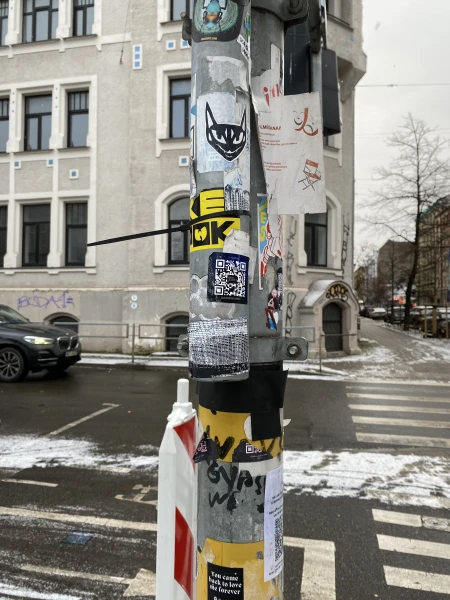
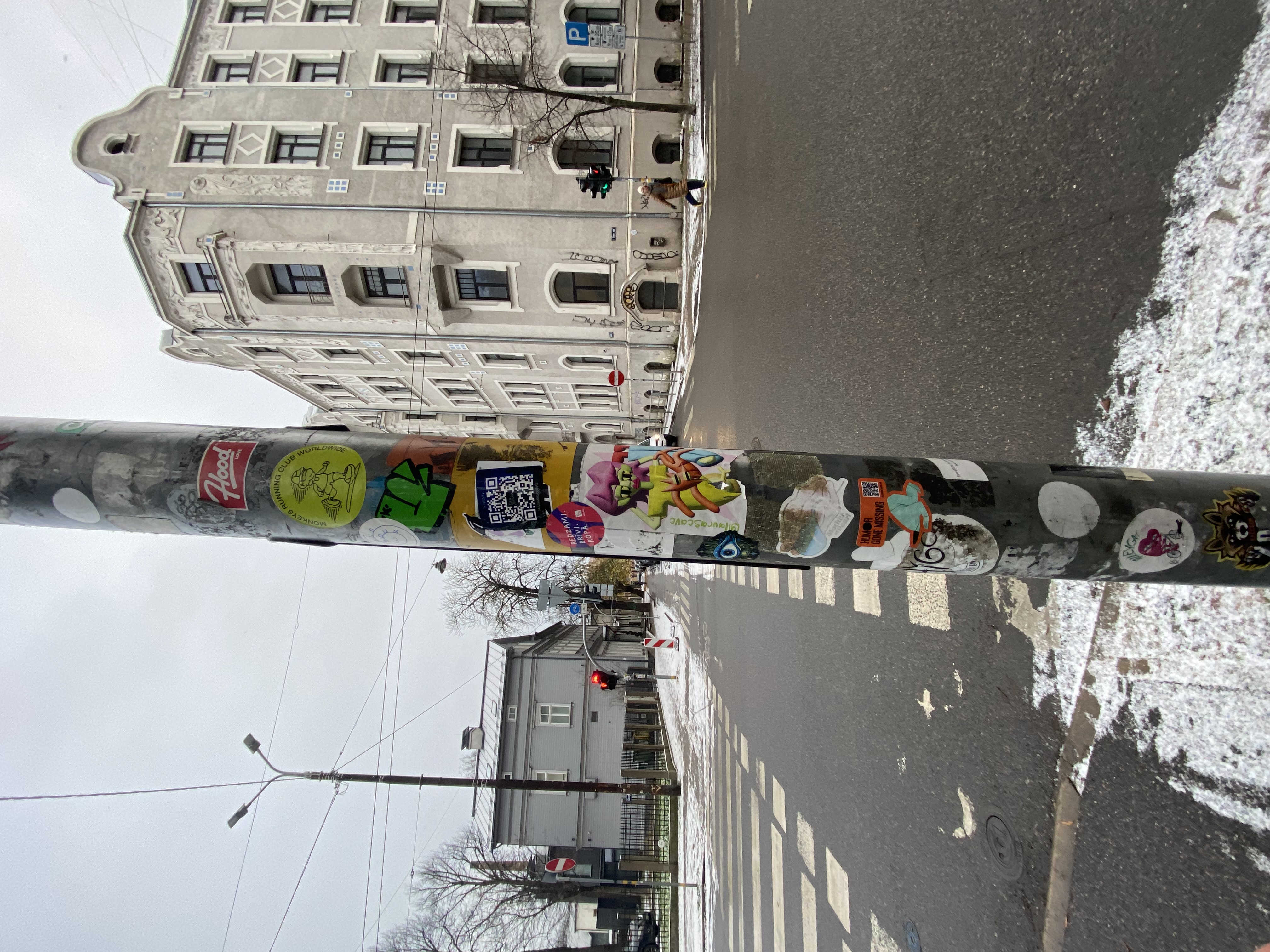
"Alternative art" in this case refers to the huge number of stickers that cover lamp posts, transformer cabinets, traffic light poles, road signs, etc. In some places, for example, on Skolas, Baznicas, and the nearby streets, some poles and traffic light stands are not just covered from top to bottom, but in several layers.

Some outdated announcements still adorned the streets – about a Banksy exhibition, a November protest, and more. On top of these are calls to become vegans, invitations to learn about Bitcoin transactions, and others. Nearby is a sweet note with a heart and a promise that "everything will be fine".
On the traffic light pole near the Ombudsman’s office, there was a glossy sticker saying "Latvia Wants Active Youth, and Active Youth Wants Freedom", and about a block away — ominous warnings like "Big Brother is Watching You" and "Your Socket is an VVD Agent" (VVD – State Security Service).

From time to time, abstractions caught my eye: despite my best efforts and careful examination, I remained in the dark about what exactly was depicted on them and, accordingly, for what purpose they were stuck. There was also a considerable amount of advertising; to find out what exactly was being advertised, one could simply point their phone camera at the QR code placed right on the sticker.
A Lot of Mess, Little Investigation...
I will be frank: the improvised tour impressed me less than it raised questions. The main one was this: does the local government see such "art" on urban infrastructure objects as a violation (for example, vandalism)? If it does, does it take any measures to prevent this phenomenon? And if this is a violation, what punishment is provided for such actions?
Answers from the project coordinator of the external communications department of the Riga City Council, Mārtiņš Vilemnsons:
– The placement of stickers can be classified as both unauthorized advertising placement and intentional property damage. Each such case is considered separately.
For example, if someone places stickers indicating an event at a specific time and place, the Riga municipal police, based on the Mandatory Regulations of the Riga City Council No. RD-23-201 "On the Procedure for Placing Advertisements, Advertising Objects, and Other Informational Materials, as well as Using Poster Poles and Stands in Riga", has the right to initiate an administrative offense case.
For this violation, individuals receive a warning or a fine ranging from 20 to 350 euros, while legal entities receive a warning or a fine from 100 to 1400 euros.
If the property owner (traffic light, pole, transformer cabinet, or other object) reports intentional property damage to the State Police, the State Police, after assessing the circumstances, has the right to initiate a criminal case under Article 185, Part 1 of the Criminal Law. However, since calls regarding such cases to the Riga municipal police are relatively rare, separate statistics are not maintained.
Comments from Gita Grjibovska, a specialist in the public relations department of the State Police:
– If it concerns stickers with neutral content that may spoil the appearance of the object or lead to its damage, the police need a report from the affected party – in this case, from the local government – to pursue the offender. However, if the police receive a report about stickers/posters whose content indicates a possible criminal offense, for example, if they contain calls to commit a crime or incite hatred, special attention is paid to such cases.
For instance, in the summer, law enforcement officers detained a man who was putting up posters around the city reading "Benjamin Netanyahu Wanted/"Биньямин Нетаньяху в розыске".
An administrative offense process was initiated in this case: Article 11, Part 1 of the Law "On Administrative Violations in the Field of Governance, Public Order, and the Use of the State Language": "For violations in the field of governance, public order, and the use of the state language", and the "poster putter" was held accountable.
No other similar cases have been registered recently in the center of Riga.
This article provides for punishment for individuals – from a warning to a fine of up to 500 euros; for legal entities – up to a fine of 5000 euros.
Are the Owners Satisfied?
The only question that remains unanswered is why municipal services, which are responsible for the aforementioned lamp posts, traffic light poles, road signs, etc., treat the condition of the urban infrastructure objects entrusted to their care with such stoic indifference? Why don’t they put an end to this? Take, for example, the clearly unauthorized advertising: it doesn’t even require titanic efforts; as mentioned above, it’s enough to point a camera at the QR code, and it immediately becomes clear who is advertising what....
But even if there is no advertising at all, the fact remains: it all looks very untidy and, to put it bluntly, does not beautify the streets. And if the responsible services do not consider it necessary to report this to the police (although, in my opinion, the situation sometimes fully deserves it), then at least sending workers with buckets of water and brushes once a month to tidy up would not be superfluous...











Leave a comment