
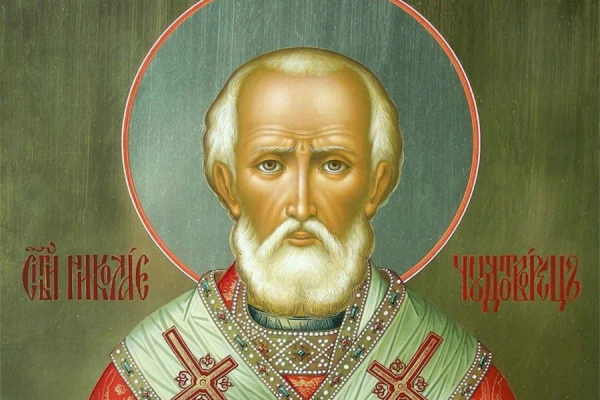
He is considered the patron of sailors, travelers, creative people, and craftsmen. Saint Nicholas the Wonderworker is always ready to help those in need.
It is unlikely that there is a person who does not know this name. On December 19, even those who rarely visit church and do not believe much in miracles come to the temples.
Some turn to him with requests for help, while others simply light candles, thinking that next time they will ask the saint for support. And now — they simply thank him for the help already received.
Saint Nicholas the Wonderworker is considered the patron of orphans. He helps the poor, the sick, and protects travelers, sailors, soldiers, and farmers.
Saint Nicholas the Wonderworker is honored with three holidays that are celebrated in summer, autumn, and winter.
Nicholas the Summer (Veshny) — an event related to the transfer of the saint's relics from Myra of Lycia to the Italian city of Bari, is celebrated on May 22.
Nicholas the Autumn — the date dedicated to the saint's birth falls on August 11.
Nicholas the Winter — the day of the death of Saint Nicholas the Wonderworker is on December 19.
Nicholas the Winter has long been celebrated on a grand scale. This date is associated with rituals and traditions that have come down from the depths of the ages. The image of Nicholas the Good is associated with the hero of Russian folk tales — Father Frost, who is considered the main winter wizard.
Where He Comes From
It is known that the saint known as Nicholas the Wonderworker lived in the 3rd-4th centuries. According to writings, he was born around the year 270 and died around 345 (the exact date is unknown).
His parents, wealthy and respected people, were held in high esteem among their fellow townspeople in the city of Patara, located in Asia Minor.
For a long time, they were considered childless. The couple's unceasing prayers to God ended in a miracle — the birth of a child.
This event is considered one of the miracles associated with Saint Nicholas the Wonderworker, of which there will be many in his life.
According to writings, Saint Nicholas the Wonderworker had command over earthly and marine elements. He descended from heaven to earth, walking on fire, water, and air.
Saint Nicholas the Wonderworker lived a long life. After his death, his relics found rest in the cathedral church of Myra of Lycia, where he served as archbishop. Later, they were transferred to the Italian city of Bari.
From the moment of his birth, it was evident that a child with extraordinary abilities had come into the world. He began to learn early, reading sacred books and prayers. As he grew older, he decided to dedicate himself to God.
Why Saint Nicholas is Called the Wonderworker
The life of the saint recounts how one day Nicholas the Wonderworker was able to resurrect a sailor. This happened at sea during a storm. The poor man, who was on the mast, lost his grip and fell onto the deck, where he died from his injuries.
The young priest, who was Nicholas the Good, began to read prayers over the lifeless body, addressing God. A miracle occurred: the sailor opened his eyes and, as if nothing had happened, stood up.
There is another amazing story associated with three young sisters. Not knowing how to feed their large family, their father made a terrible decision — to make his daughters into prostitutes so they could bring money into the house. When Nicholas the Wonderworker learned of this, he secretly threw a bag of gold coins through the window of the poor parishioner at night.
Thus, he saved the girls from sin. The joyful father did not know whom to thank for the salvation — himself or his daughters. The girls found good suitors, got married, had children, and lived happily.
It was believed that the tradition of giving gifts at Christmas, and later at New Year, was invented by Nicholas the Good. Initially, gifts were given to children, and later they began to be presented to adults as well.
What to Do on December 19
On the day of Saint Nicholas the Wonderworker, it is essential to visit the church, where solemn services (liturgies) take place at this time.
In the church, standing before the icon of Nicholas the Good, people pray to the saint, thanking him for his help. They ask for healing from illnesses, support in new endeavors, and financial well-being.
It is believed that the saint helps to successfully get married, contributes to raising children, good trade, well-being during travels, and deliverance from bad habits.











Leave a comment