
With the neighbor upstairs, we communicate like modern people, through social networks. "Have you received the apartment bill yet?" he wrote to me in a messenger. "Yes." "Why is it so much?" my compatriot asked in confusion. "Sometimes you need to attend meetings!" I replied, accompanying my statement with a silly yellow face.
How we helped the construction industry
Indeed, it was hard not to notice the increase of 63.45 euros. The last, "summer" bill, to which heating had not yet been added, turned out to be higher than last year's January amount. This is because in the column "savings for future repair work," instead of 0.5 euros per square meter, there were 2 euros. Calculating for 42.3 square meters of a two-room apartment, this made up the difference.
The residents' meeting, which our wonderful neighbor neglected to attend, was missed by about 60% of the residents of our more than 100-apartment building, located in a horseshoe shape between three streets of what is commonly referred to as the quiet Center, or even the embassy district. Judging by the numbers of the cars parked in the yard, there are among us citizens from friendly Baltic republics and refugees from the allied, warring state. They likely did not attend the people's council either. Also, three individuals from South Asia, who entered just before me through the barrier, politely closed it — dropping it with all their might onto the roof of my car, similarly. The old housing stock of Riga is largely inhabited by tenants, and the owners are likely not even in the country. They are sunbathing on beaches, rentiers!
One way or another, according to current legislation, a third of the apartment owners turned out to be legally quite enough to make that fateful decision to increase payments to the reserve fund. The declared goal is to start facade repairs on the building, which will be 100 years old in a year. Some time ago, another letter of happiness arrived — in fulfillment of the decision, a work schedule was drawn up. But it was not attached. After requesting it from the Department of Municipal Property of the State City of Riga, I received a colorful table that extended to 2029, i.e., the end of the current municipality's term. All this time, increased payments will continue, and it is quite likely that they may also include loan repayments if one is taken out. For approximate calculations, the exterior painting of the building will cost around half a million.
The document I received contained a note regarding the non-disclosure of personal data, in accordance with EU regulations. Therefore, I can only indicate that a respected, universally certified architectural company has already been found, which will conduct author supervision, ensuring proper compliance with the color passport. Among the apartment owners, there are also four proactive individuals ready to oversee the process. Well, for the rest of us, it remains to keep an eye on them...
If you don’t renovate, we will raise the tax!
This is exactly the alternative presented to the residents of our house, previously owned by the municipality, by representatives of the municipal SIA Rīgas namu pārvaldnieks. The regulations of the Commission for the Development and Quality of the Urban Environment of the Riga City Council state that "degrading building environments" can indeed be subject to an increased property tax rate of up to 3% of the cadastral value, which for our building could amount to 1,000–3,000 euros per year, depending on the area (there are both two-room and four-room apartments).
The aforementioned municipal structure positions itself as a "collegial institution," headed by the director of the municipal property department, Vladimir Ozolins, and includes two dozen various officials, including the deputy head of the municipal police. There are also 7 elected members of the Riga City Council, including your author.
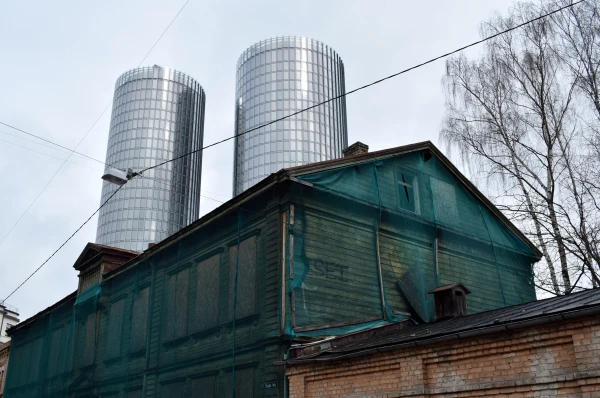
What is most amusing is that our house is not on the list of "degrading" buildings. So to speak, they started repairs and peeling the skin off the residents in advance. In total, by the end of 2025, there are 168 such houses in Riga, of which 74 have already been classified under the 3% tax, and 94 are in the evaluation process.
The pace at which "renovated buildings" appear in Riga is slow — only 11 in a year. The geography is extensive — from Greciņieku to Latgale. It even includes a street previously unknown to me, Vilhelma Kreslera, named after a Riga city gardener in the picturesque area of Dzegužkalns. Nearby, there is also Grodņas Street, it is even strange that it survived during the renaming period, as it clearly relates to the "aggressor state."
They started painting the facade but went down to the basement
Of course, the commission is not made up of beasts, but gentlemen — so they can understand the situation and not immediately impose the 3% rate, as happened in the house on Matisa Street. There, it was "noted that before facade work, it is necessary to first carry out work to strengthen the basement." The actions were classified as emergency, and they will be carried out in 2026, and they will also tackle the balconies and roof within the courtyard. "The facade work could not take place earlier than 2028," the proactive residents honestly wrote to the commission. And they agreed on a new schedule. In total, 30% of the houses in Riga are behind the established schedule for repairs.
It also happens, as in the building on Piebalgas Street, in the Teika district: they chose as a priority — tasks for repairing chimneys and strengthening the basement ceiling. For their part, the residents of the house on Hapsalas Street, located in Sarkandaugava, began renovations, eliminating cracks in the facade, and then will also tackle the windows.
Where do all these large-scale actions get their funding? Of course, part of the residents contribute from the accumulated repair fund. But, as the commission's data indicate, a solution is welcomed, for example, from the house on Ropažu Street, "to apply for the Altum program to conduct a comprehensive restoration of the building." And then an additional amount will definitely appear in the bills — for decades. Children and grandchildren will pay for what the owners of the 2020s decided. However, of course, the latter will not pay the increased tax — because if they are ready to get involved in the "state" (the Altum structure is autonomous, although under the supervision of the Ministry of Finance) financing scheme, they receive an 18–30 month discount on property taxation. And the city can help — you just need to apply for a competition, and then win it.
All this, however, solves the problem as much as carrying water with a sieve. The aggressive weather conditions of our region are likely to create spots, cracks, and mold on the new paint within a few years. Meanwhile, the foundations, communications, stairs, and asphalt in the yards remain the same as they were before the renovation. This is what should be thought about first when entering into long-term projects with interest financing. And for starters, it is still necessary to attend the homeowners' meetings, so as not to be surprised later that everything was decided without you.









Leave a comment