
Anton Frolov-Bagreyev revolutionized winemaking.
Over the past 90 years, "Soviet Champagne" has become one of the most famous brands, first in the USSR and then in Russia. Behind the success of this sparkling wine was Anton Frolov-Bagreyev, a native of the Russian Empire and a chemist. He witnessed all the historical upheavals of the 20th century, faced persecution for his political views, and was nearly shot during the Civil War. Thanks to his technology, sparkling wine ceased to be perceived as a drink for the elite and became accessible to the general public.
The son of a government official and a revolutionary
The popularity of champagne among the upper classes of the Russian Empire was explained by the fashion for all things European: by the early 19th century, sparkling wine had become an integral element of the noble table. The inaccessibility of the drink served as a way to emphasize superiority for the elite — and a cause for anger among the lower classes. During riots, from the Pugachev Rebellion in the 1770s to the Odessa pogrom of 1905, barrels of wine were stolen from noble cellars or smashed in a fit of discontent.
Alongside the importation, domestic production also developed in the Russian Empire. In 1871, a decision was made to plant vineyards in the royal estate of Abrau-Dyurso on Lake Abrau in what is now the Krasnodar region. By 1877, the first harvest was ready. On December 24 of the same year, Anton Frolov-Bagreyev was born in Tobolsk to the family of the governor of the provincial ministry of state property — a man who was to become a key figure in Russian winemaking.
Almost nothing is known about Anton Frolov-Bagreyev's mother. According to one version, she came from serfs; according to another, she simply devoted herself entirely to household duties and raising her son. The future winemaker's father began his career as a simple land surveyor but advanced in service due to his diligence. His appointment as a ministerial manager allowed him to transfer his son to the prestigious Larin Gymnasium in St. Petersburg. After studying there, Anton enrolled in the Faculty of Physics and Mathematics at St. Petersburg University and graduated with honors from its natural sciences department in 1902. At that time, the young chemist decided to dedicate himself to winemaking.
One of Frolov-Bagreyev's mentors during his university years was the great scientist Dmitry Mendeleev, the creator of the periodic table of chemical elements. He wrote a recommendation letter for his protégé, opening the opportunity for him to intern in Europe. For the next three years, Frolov-Bagreyev studied yeast organisms in a laboratory in Copenhagen, interned at the higher school of winemaking in Geisenheim, one of the capitals of German winemaking, and learned about the technologies for producing white and red wines in Bordeaux, as well as fortified and dessert wines in Porto and on the island of Madeira.
He returned to Russia in 1904. With foreign experience and academic credentials, it was not difficult for Frolov-Bagreyev to get a job at Abrau-Dyurso, which by that time had become the largest center for sparkling wine production in the country under the leadership of Prince Lev Golitsyn. It seemed that nothing could hinder Frolov-Bagreyev's career rise. However, he did not work long at Abrau-Dyurso. Politics intervened — already in 1905, the young winemaker was accused of revolutionary sentiments. His offense was that he signed a petition for better working conditions for laborers. A scandal erupted. Frolov-Bagreyev was fired from the winery. Soon after, he returned to his native land in Siberia, either by his own choice or at the convincing "request" of the authorities. He settled in the city of Ishim and worked there for a while as a land surveyor — apparently, out of despair, he decided to follow in his father's footsteps. However, good specialists in winemaking were too rare in Russia for the authorities to allow themselves to part with him completely. Therefore, just a year later, in 1906, he was invited to work as a winemaker-chemist at the Nikitsky Botanical Garden near Yalta.
There, Frolov-Bagreyev's direct supervisor became the famous Prince Golitsyn, the father of Russian winemaking. Formally, Frolov-Bagreyev was still considered an unreliable element, so for the first few years after his return from exile, he was monitored by the police. However, he was not noted for further protests against the authorities, so in 1911 he was granted the title of court councilor, and a year later, he was allowed to go abroad to learn from foreign winemakers. During that trip, he visited Berlin and the Swiss town of Wädenswil, studying fermentation and the bacterial flora of wines.
A time of change and new technologies
By the mid-1910s, Frolov-Bagreyev was already considered one of the best specialists in winemaking in the country. He was appointed director of the Bessarabian Secondary School of Viticulture in Chișinău and promoted to state councilor — this rank was the fifth of 14 in the table of ranks. At the same time, he began to manage the Bessarabian Winemaking Experimental Station. From 1910 to 1916, he was awarded three honorary state awards: the Order of Saint Stanislaus of the 3rd degree, as well as the Orders of Saint Anna of the 3rd and 2nd degrees. But once again, the political upheavals halted the career rise of the Russian winemaker. The revolution began in the country. In 1918, Bessarabia was occupied by Romania under the pretext of protecting the population. Fearing persecution of the Russian population, Frolov-Bagreyev fled with his family to Crimea. There, he learned that the young Bolshevik government was looking for someone who could restore the production in Abrau-Dyurso, which had been destroyed during the revolutionary clashes. It is hard to imagine anyone better suited for this task than him. Thus, Frolov-Bagreyev returned as the head of the factory to where he had once begun his career.
In his new position, Frolov-Bagreyev had to solve completely different tasks than his predecessors under the tsarist regime.
First, the Civil War continued in Russia. Second, in line with Bolshevik ideology and the course towards a classless society, sparkling wine could no longer be positioned as an elite drink, linking Russia with bourgeois and capitalist European states. Production needed to be organized on a national scale, and champagne itself had to be made accessible not only to the ruling elite.
Although formally Frolov-Bagreyev represented the revolutionary power at the head of the factory, for those who had escaped from under tsarist control, he was merely another obstacle on the path to freedom and permissiveness. In 1919, armed workers stormed the winery and demanded the keys to the cellars. He refused, for which he was nearly shot. He managed to escape thanks to his subordinates — they rescued him, hid him among the wine barrels, and persuaded the workers not to vandalize the factory.
Several more times, Frolov-Bagreyev selflessly defended the enterprise from the Whites, who, during their retreat, also tried to get to the wine stocks or disrupt production. The situation in Abrau-Dyurso calmed down only in 1921, when the representation of the Commissariat of Foreign Trade in Novorossiysk provided Frolov-Bagreyev and his factory with armed protection. However, conditions remained difficult even after that and were noticeably different from the environment in which sparkling wines were produced there at the end of the last century.
Workers regularly went on strike and demanded better working conditions. But by the mid-1920s, the situation at the enterprise had calmed down — largely thanks to Frolov-Bagreyev's competent management. He continued to experiment with winemaking in hopes of making champagne production mass-produced.
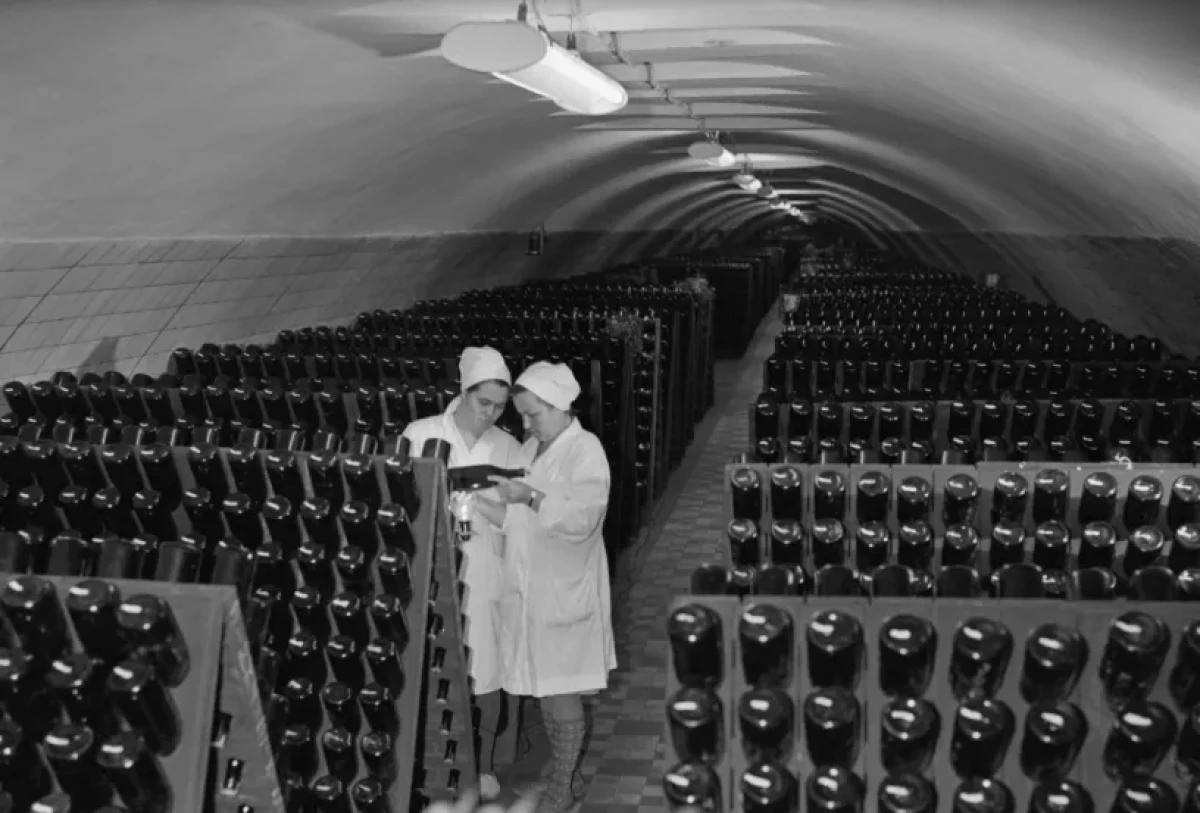
It was then that Frolov-Bagreyev made the main discovery of his career. He developed the so-called continuous method of producing sparkling wine, which involved the use of connected fermentation vessels. The pressure in them approximately corresponded to the pressure inside a bottle of champagne. Unlike the traditional method of producing sparkling wine, which was then used worldwide, Frolov-Bagreyev's approach allowed for the regulation of temperature, the volume of yeast, water, and carbon dioxide in the vessels he created. This significantly accelerated production — the process was reduced from several years to a month. This technical revolution allowed for the mass production of sparkling wine and made it accessible, as the Soviet authorities wanted. Champagne became a national drink.
There was no question of what to name the new brand. In 1936, after numerous experiments and checks, the Politburo adopted a resolution "On the production of 'Soviet Champagne,' dessert, and table wines." The construction of wineries began across the country — naturally, under the supervision of Frolov-Bagreyev.
National drink
In the same 1936, Frolov-Bagreyev was sent on a business trip to Germany, France, and Italy. This trip abroad became his last, but he remained the main Soviet authority in winemaking for the rest of his life. While still heading the factory in Abrau-Dyurso, Frolov-Bagreyev simultaneously led the department of winemaking at the Krasnodar Institute of Special Technical Cultures and taught extensively. In 1942, he added the Order of Lenin and the Stalin Prize to his list of state awards. That same year, due to the threat of occupation of Krasnodar by German troops, Frolov-Bagreyev and his family were evacuated to Tbilisi, and then to Moscow. Since then, he remained in the capital. By the end of the 1940s, factories producing sparkling wines using the continuous method had opened in Gorky, Rostov-on-Don, Odessa, Tbilisi, Kharkov, Moscow, and Leningrad. And later in Riga!
The famous "Riga Champagne" (Rīgas šampanietis) has been produced since 1952. It was then that the Riga Champagne Wine Factory (now the Latvijas balzams enterprise) began the production of this popular sparkling drink. The current name and modern appearance of the brand were established in the market in 1993.
Frolov-Bagreyev continued to write many scientific works and experiment, trying to bring the level of "Soviet Champagne" closer to the French original. He and other connoisseurs understood that in terms of taste, the drink produced in mass production clearly lagged behind sparkling wines that were aged for years and produced in small quantities in Europe. But "Soviet Champagne" became the ideal drink for its time and its era.










Leave a comment