
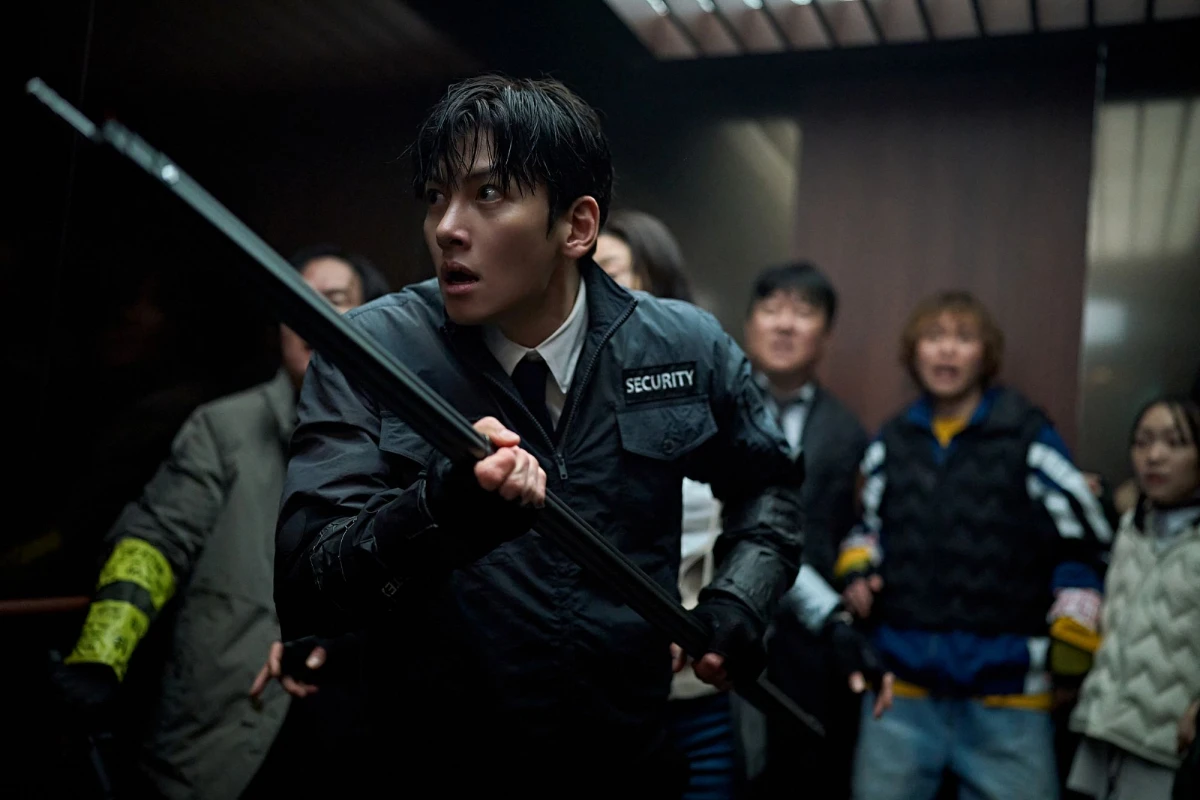
The concept of universal unity taken to the extreme turns utopia into dystopia.
One of the first messages from the latest Cannes Film Festival is the fantastic thriller "The Colony" by Yeon Sang-ho. The author of the cult duology "Train to Busan" has once again turned to his favorite theme of zombies. The film was shown in the non-competitive section of the Midnight Screenings on the French Riviera. As of now, "The Colony" is the highest-grossing film of the year in Korea.
Almost all the action of the film takes place inside a high-rise shopping mall. A conference is being held there, which the biotechnologist Kwon Se-jung (Korean star Jeon Ji-hyun) is brought to by her ex-husband to introduce her to the head of a company where the heroine could potentially work. The protagonist worries that Kwon Se-jung, known for her nonconformity, will be left in her homeland without close people after his emigration with his new family to the USA.
Of course, everything will go wrong. The CEO of the company becomes the first infected as a result of an attack by a biological terrorist (Koo Gye-hwan). He accuses the man of stealing his scientific ideas and injects him with a serum that instantly turns him into a bloodthirsty zombie. The virus begins to spread at lightning speed (of course, through bites), and the building is put under quarantine.
Several small groups of people, including Kwon Se-jung and her ex-husband, will try to save their lives and find the villain, who apparently is the antidote. The protagonist's professional knowledge will come in handy: the zombies resemble humans reduced to basic biological settings, guided solely by instincts. And they only obey the pack leader.
As in many films and series about emergencies, in "The Colony," many people, who have not yet formally become monsters, are also reduced to basic settings. The veneer of civilization often falls away when it comes to survival. In connection with "The Colony," it is hard not to recall "Squid Game." However, both in the series and in the film by Yeon Sang-ho, there are characters who maintain their "human face" until the end. Unfortunately, this does not always work to their advantage.
While watching "The Colony," it is interesting to observe one’s own emotions and thoughts. Is it worth risking one’s life for a stranger? And for a person of dubious moral qualities who has caused you much pain? Such moral dilemmas allow for a deeper immersion in what is happening.
In general, as is often the case in such works, people are no less frightening, and sometimes even more so, than the fantastic creatures. The monsters, however, are also quite well done by the creators of "The Colony." They constantly evolve: first crawling, then starting to walk, and eventually even seeming to mimic humans, physically grouping together in tighter clusters.
At the same time, the bodies of the monsters, merging into terrifying mesmerizing figures, rhyme with their internal processes. A novelty from Yeon Sang-ho and his co-author Choi Gyu-sok is the collective intelligence that unites all the zombies. The biological terrorist who orchestrated this nightmare has his own philosophy: he believes that humanity's main problem lies in imperfect communication. If everyone thinks alike, most problems will simply disappear.
As with the best of cinematic villains, there is a kernel of reason in the thoughts of the young genius scientist. But the concept of universal unity taken to the extreme turns utopia into dystopia. And is universal equality possible in a situation where everyone must act the same? Someone must make decisions, after all. What about free will? And why does the appearance of democracy turn into totalitarianism?
Similar questions are posed in his new series "One of Many" by the author of "Breaking Bad" Vince Gilligan. In it, humanity is also struck by a virus that causes people to lose their individuality and acquire a single collective mind. They become benevolent, happy, and non-aggressive. "One of Many" and "The Colony" are like twin antipodes. It is quite clear that a sterile world supposedly free of violence is equivalent to a bloody, brutal world, because there is no freedom, nor true unity among people, in either. Real closeness and mutual assistance in such a universe is a miracle more remarkable than a fantastic virus. But still, sometimes this miracle happens.











Leave a comment