
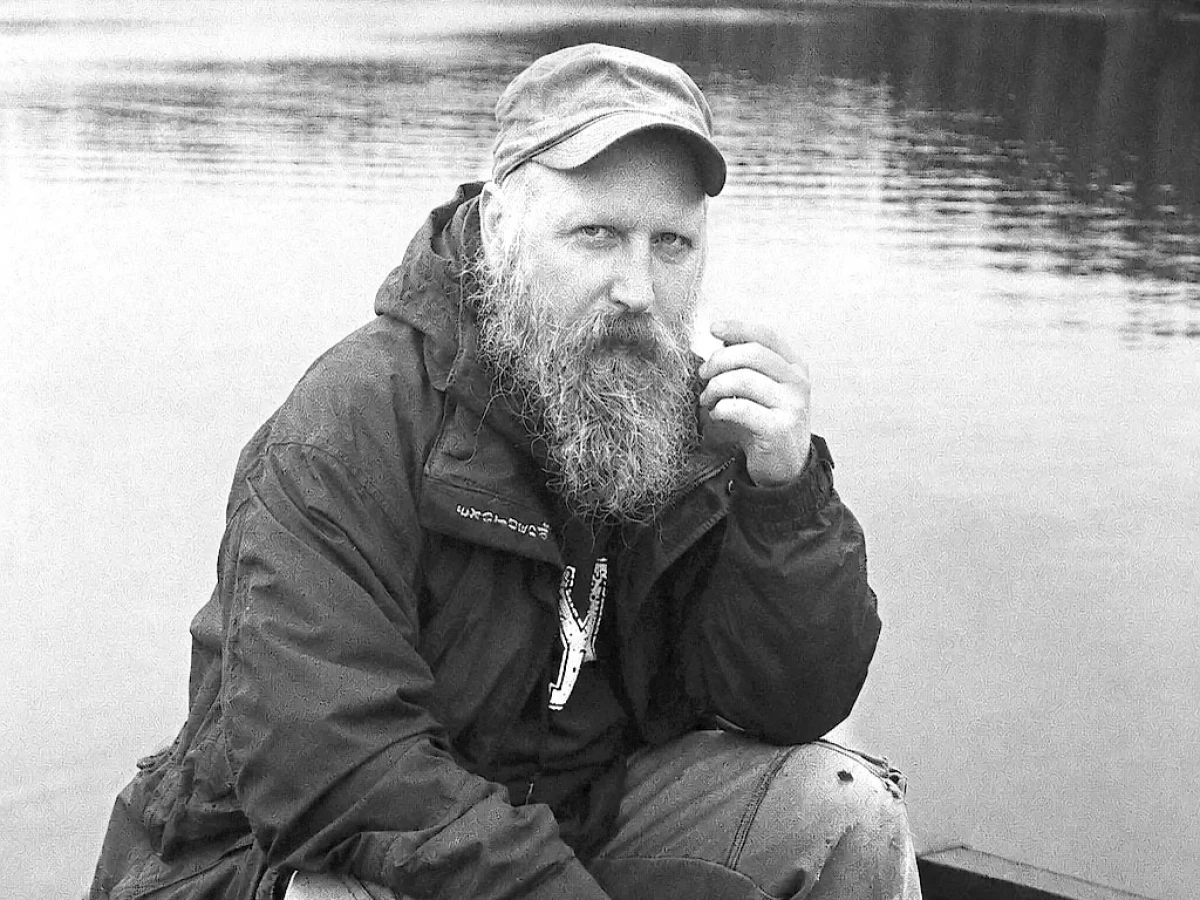
He considered his famous great-great-grandfather a man of the world.
He could have spent his whole life in the archives, justifying his surname. Instead, he drove a tram through the center of St. Petersburg while the city lost its title as the tram capital of the world. Then he joined the monastic fleet on Valaam: starting as a dishwasher and stableman, he is now a captain-mechanic. In childhood, he played Kolya Krasotkin in the film "Boys" – and forever remained a "living participant" in that conversation about the Karamazovs. Today he is the bassist of the band "Ptitsa Si" (ranging from urban folk to psychedelic art rock), a father of four children, and a keeper of quiet family memories – without pretense, without fees, and without the desire to "monetize kinship." Alexei Dostoevsky does not pose as a descendant of a classic. He simply carries his surname and takes responsibility for it in his own way: through labor, water, music, and long evenings of reading aloud.
– Alexei Dmitrievich, you are the great-great-grandson of Fyodor Mikhailovich, yet your professional life is connected to the sea: you have been working as a captain-mechanic on a vessel in Valaam for many years. How did it happen that a descendant of a great writer chose the fleet for himself? Was it a conscious step or a coincidence?
– The step was quite conscious; it was just a push from a friend. He invited me to join his ship as a sailor on Valaam, and I accepted the offer. Before that, I worked as a tram driver in St. Petersburg – driving trams on routes 14, 28, and 90. I loved that job. But by the time I left in 2003, there was not a single route left from my park. They were closing down the lines, removing the tracks, and St. Petersburg ceased to be the tram capital of the world. Besides, this job is more suited for a phlegmatic person, while for me, every shift was like a battle – the revenue plan, regularity, conductors. Although the traffic back then was nothing like it is now – participants are much more polite now, and most follow the rules. I am also accustomed to water: my childhood and early youth were spent under sail. A single-handed dinghy – first at the sports school of the yacht club, then at the Central Yacht Club. But my sports career, unfortunately, ended sadly in 1991. Now there are no slips left from which to launch hulls into the water.
– You call yourself a "proletarian to the bone," noting that your father, a tram driver, mastered 22 working professions throughout his life. For you, is this image of a "working person" a conscious position, a kind of opposite to the image of a "nobleman of literature," or is it just an honest description of reality?
– The nobility of the Dostoevskys was earned – by Fyodor Mikhailovich's father, a doctor in the Borodino Infantry Regiment, and later a doctor at the Mariinsky Hospital for the Poor. The writer himself was a great worker, and his son was not a lazy landowner either. Although I never met my grandfather – he died in 1968, and I was born in 1975 – I know he was also a worker. A veteran, a holder of orders, he went through the entire war in motorcycle reconnaissance, surviving at the Nevsky Piglet. So this is not a pose but a family truth: all the Dostoevskys I know from stories and documents worked with their hands and minds. Not noble tenderness, but peasant tenacity.
– In childhood, you played Kolya Krasotkin in the film "Boys." By the way, the film made it to the top ten at the Russian Film Festival in Japan. How do you remember those shoots today? What was the experience like to take on the role of a character of your own great ancestor at such a young age?
– Yes, this is my only role in feature films. I think the image turned out well – I literally became one with the character. I was just like that back then, I loved to show off (laughs). Unfortunately, the film was released in a time of obscurity, in 1990, and there was no wide release. The directors blessed me to represent this film, and I gladly hold screenings, traveling if invited, as a descendant and a living participant. A few years ago, I visited Optina Monastery, where part of the material was filmed back in '89. Of course, a lot has changed in 35 years – at that time, monastic life in the monastery had just resumed, but it felt like I returned to my childhood. In Alyosha Karamazov's speech to the boys, it is precisely about this. I dream of visiting Yelets – that’s where the main filming took place; I haven’t been to that city since then.
– You bear a strong resemblance to your great-great-grandfather. How do you feel about that? Do passersby recognize you on the streets and at gatherings?
– I grew my beard when I started going bald; otherwise, I would have looked like an egg. But now it’s even fashionable (smiles). Passersby, thank God, don’t recognize me; I am not a media personality, and I don’t show my passport to anyone.
– It is said that your daughter Anna had a teacher at school with a great sense of humor, who, in response to forgotten notebooks, would say: "The glory of your great ancestor has fallen and shattered at your feet." This is a wonderful everyday example. Did your own school life create any difficulties with your surname, or did it open up opportunities?
– I would argue with that teacher. The glory of Fyodor Mikhailovich does not fade, even if all the Annas in the world forget their notebooks at home. Our class teacher once told me: "A smart head, but given to a fool." I understand her quite well now. When I grew a little older, I realized: trying to even slightly compare myself to the genius of the writer is ridiculous and foolish. I tried to explain this to those who had inflated expectations of me because of my surname. But that was during the learning period. Now the surname brings joy in meeting caring people.
Dostoevsky, Pushkin, and the Living Russian Language
– Not long before our interview was published, there was Russian Language Day, celebrated on June 6, the birthday of Pushkin. Fyodor Mikhailovich, as is known, idolized Pushkin. What does Pushkin mean to you, a person who not only reads classics but also plays in a folk band and works with the living word?
– For Fyodor Mikhailovich, everything started with Pushkin. He and his older brother Mikhail, on their way from Moscow to St. Petersburg to enroll in the Military Engineering School, swore to each other in memory of the poet not to abandon the artistic word – both had already made timid attempts at that time. It was the year of Pushkin's death. There is even a phrase, I don’t remember which brother said it: if it weren’t for mourning for their mother, he would have asked for permission to mourn for Pushkin. Pushkin also marks the end of the writer's life – I mean the famous Pushkin speech. For me, Pushkin is indeed "our everything," and I emphasize the word "our." Dostoevsky is universal, but only a Russian person can understand Pushkin – he is so inherently Russian. But that’s my opinion; it can be disputed. In general, I’m not very into poetry; I read prose much more, and I have plenty of favorite writers. Among poets, I really like Blok, Tyutchev, and Fet. Perhaps it’s because my memory for verses is worse – I was beaten into cramming in school (laughs).
– You are a philologist by education, studied at the Department of English Philology at Herzen State Pedagogical University, but did not work in the specialty. I’m curious how your personal reading journey related to the school curriculum? You have mentioned several times that you were fascinated by Jack London in school. Did you have your own, different from the teachers', ideas about native literature back then?
– University and school are very different forms of education. Age, firstly, and the approach is completely different: no one pulls you by the ears. I studied at an English school, they taught well, and I tried hard – that’s how I got into the profile. I was already interested in the music of another language at that time. But I never considered language and teaching as a profession for myself. In the end, I successfully dropped out of Herzen University. A little later, I thought about studying to become a sound engineer, but it didn’t work out.
– You once accurately called Dostoevsky's "The Writer's Diary" the "first blog," which essentially became a prototype of modern personal media. If we imagine that Fyodor Mikhailovich lived today, what do you think he would do – run a Telegram channel, participate in heated discussions, or immerse himself in a multi-volume novel?
– It’s hard for me to imagine that. I am against "time travelers." This genre is far from me. Pulling any person out of their time, and Dostoevsky is primarily about his time, seems foolish and unhistorical to me. And I have great respect and love for history.
– You say that the work of Dostoevsky that resonates with you the most is "The Idiot" – it "lies on your heart." Is there a work by Pushkin that you reread more often than others, and why? What in Pushkin's word today particularly resonates with your feeling of life?
– I reread "The Idiot" more often than other books by Fyodor Mikhailovich, but I wouldn’t say it’s my favorite work. Apparently, the questions I ask myself more often are there. And when I work through "The Possessed" and "The Brothers Karamazov." As for Alexander Sergeyevich – I recently stumbled upon an analysis of "Eugene Onegin" in the "Digital History" online, and I reread it with completely different eyes. But that’s just by the way. Honestly, it’s difficult: after all, they have different air, space, and time. I can’t summarize it in two words; I probably won’t be able to, and I won’t try. After all, reading is a rather sacred thing for me than a professional one.
Music, Children, and Life in Valaam
– You are the bassist of the band "Ptitsa Si." The band has existed since 1991, playing in the genre "from urban folk to psychedelic art rock." Please tell us how this musical project came about. And do you see any connection between your passion and family tradition – after all, there were many talented people in the Dostoevsky family?
– The project emerged without my participation; I joined the band with a friend only in 1994. But we have been together for many years, even though my friend passed away later. We have quite a few parallel projects, sometimes involving the same musicians, which is why it’s not always possible to define the genre. Talent is hardly a tradition; after all, one is born with it and then nurtures it. Many Dostoevskys were definitely talented – it’s evident from the lines of the brothers; they were outstanding people. There were musicians as well.
– It is said that you met your wife Natalia thanks to music: you rehearsed together, and she initially didn’t believe your surname, asking to see your passport. How did relationships in a family where both are creative people develop? And all four of your children (Anna, Vera, Maria, and Fyodor), as I understand, are also learning music. Is this a conscious upbringing or just the atmosphere at home?
– Yes, that’s what they say. That’s how it was – at a wedding of a mutual friend. The flute was a completely new instrument for me; Natalia played it brilliantly, and she is bright herself, I got fascinated, and after a while, I realized: I didn’t need anyone else; we are on the same wavelength. That’s how we live with music – not in the sense of earning money, but we just can’t help but sound. And we made the children sound; now they are grateful to us for that.
– You have been working in Valaam for many years, sailing on Lake Ladoga on the vessel "Vasily Fokin." It’s a rather harsh but very beautiful life. What keeps you there: a conscious retreat from the urban hustle and bustle, a desire for silence and solitude, or is it just how fate has unfolded, and you don’t want to change anything?
– All together and each separately. As for fate – hardly; I make decisions for myself. There was an opportunity to change, but I didn’t. I think I did the right thing. In general, I try not to regret anything. Except for definitely bad deeds – sometimes, you can’t fix them, and all that’s left is to sigh.
– In one interview, you said: "The more I study the family of Fyodor Mikhailovich, the easier it is for me to understand myself, my traits." You really engage in family history, study archives, and know about other, lesser-known Dostoevskys (for example, Doctor Alexander or scientist Andrei Andreevich). Can this be called a full-fledged "scientific work" that you conduct as an independent researcher?
– No, it’s more for myself. I don’t publish any scientific works, but it helps me see a more complete picture, which I try to describe at meetings, of course, with my own emotional assessment. Our Dostoevsky scholars help me a lot; I don’t take bread from them.
A Look into the Future and Simple Truths
– You are raising four children. In a world where there are more and more screens and short videos, how do you instill in them an interest in reading, in large texts, in that very Russian classical literature associated with your surname?
– We’ve already raised them; they have all grown up, now they are quite whole, independent personalities. In childhood, we read a lot to them aloud, then they read themselves – the taste for reading has been instilled. Reading is generally an amazing thing: you are given much more as a co-author than in theater or cinema, for example. There, it’s hard to add anything to what has already been shown, to color it in feelings, but here you can do a lot together with the writer. That’s what we tried to make them understand.
– If you had the opportunity to ask Fyodor Mikhailovich one personal, non-academic question, what would you ask him?
– There are such questions; maybe I will ask them someday, but definitely not in public (smiles).






Leave a comment