
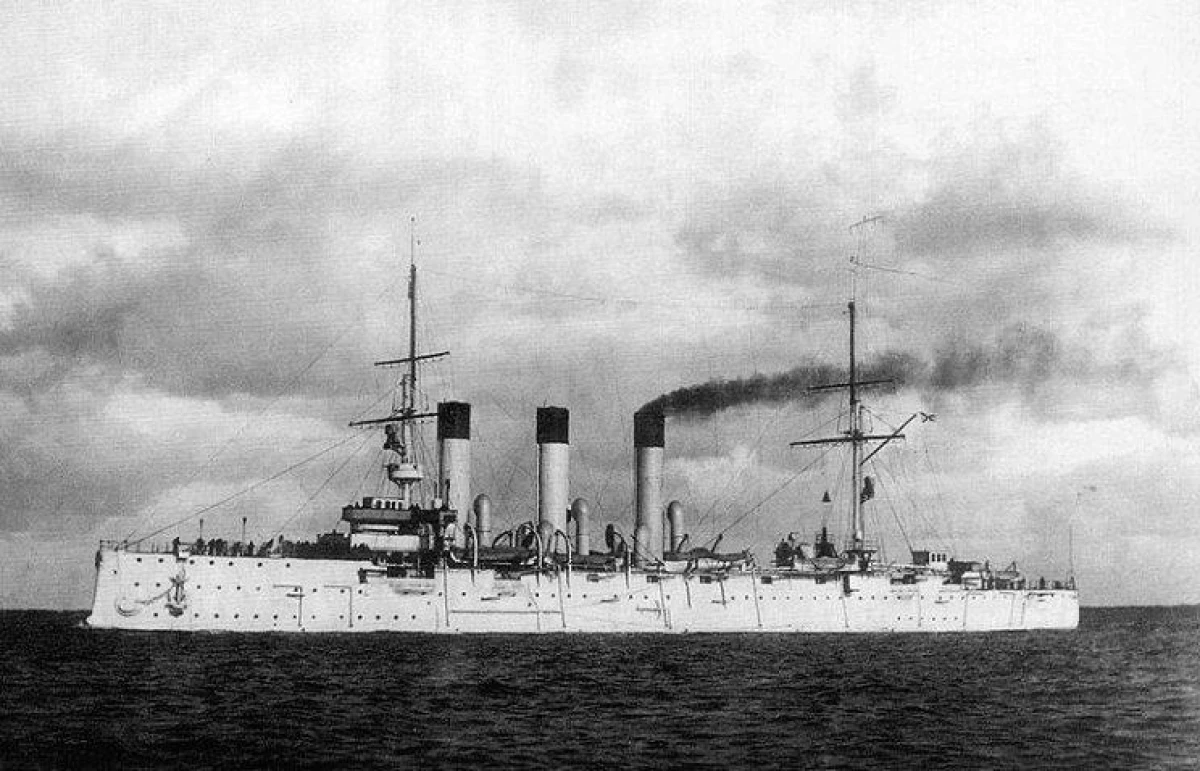
The iconic 'Aurora' had a rather unheroic beginning.
The cruiser, which did not win a single naval battle but was saved from destruction each time by incredible circumstances. According to legend, Emperor Nicholas II chose the name 'Aurora' for the new cruiser from eleven proposed names. Among the names were 'Naiad', 'Psyche', 'Juno', 'Neptune', and even the Slavic centaur god 'Polkan'!
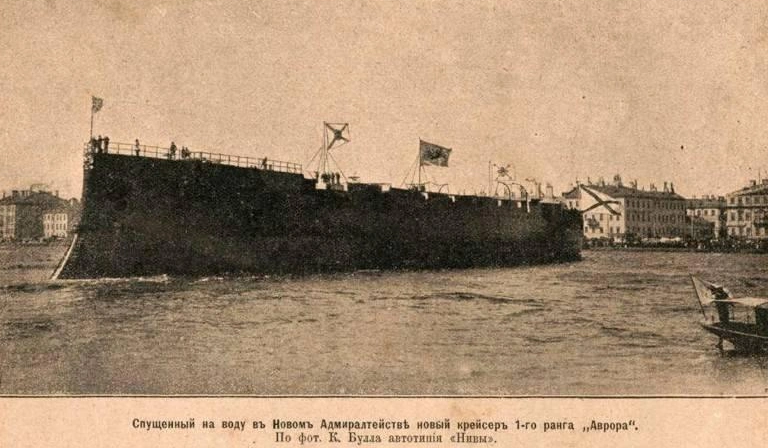
In the presence of the imperial couple, under the salvos of the artillery salute from the warships standing on the Neva, the cruiser was launched from the slipway of the New Admiralty, which we know today as the 'Admiralty Shipyards'.
The ship became the third in a series of fast cruisers intended to be 'destroyers of maritime trade' of the potential opponents of the Russian Empire, which at that time, depending on the political situation, were either Great Britain or Germany.
Laid down in 1897 by the Naval Ministry, the cruisers of the same design with ancient names 'Pallada', 'Diana', and 'Aurora' were dubbed 'the goddesses of the Russian fleet' by the press of those years, while sharp-tongued sailors immediately rephrased it to 'goddesses of domestic production'.
The main weapon of the cruiser became the 152-mm rapid-fire guns of the French engineer Gustave Canet's system. In 1891, Canet's gun, capable of firing 10 shots per minute at a distance of up to 11 kilometers, was considered modern, but by the time of the construction of the 'sister goddesses', it seriously lagged behind the combat capabilities of new guns of the same caliber. The cruiser was protected by a so-called carapace, a convex armored deck made of 38-mm steel plates in the horizontal part, gradually thickening to 63.5 mm towards the sides.
There was only one armored deck, but it was located low inside the hull, approximately at the waterline, to prevent flooding of the underwater part of the hull after hits from shells. This armor scheme lightened the weight of the ship and protected the cruiser’s engine room but left the superstructure unprotected. However, the main protection of the 'Aurora' was considered to be its high maximum speed for those times of 19 knots (about 37 km/h — Ed. note), achieved by three 'triple expansion' steam engines with a power of 11,000 horsepower, rotating three propellers. The steam engines were supplied with 24 coal-fired steam boilers.
While the cruisers were being built, repeatedly rebuilt, and tested, both the naval strategy and the potential enemy changed. All the fleets of the leading world powers adopted the ideas of American Admiral Mahan, a proponent of a general naval battle, denying the 'pirate' operations of fast cruisers on 'sea routes'.
And the potential enemy for Russia became rapidly developing Japan, which aimed for dominance in the Far Eastern region. By the beginning of the Russo-Japanese War, the first two 'goddesses', 'Pallada' and 'Diana', had been transferred to the Pacific Ocean and joined the Port Arthur squadron. 'Aurora', delayed in eliminating unfinished work before 'acceptance into the treasury', did not manage to reach the Far East by the beginning of the great war. The beginning of the war with Japan caught the cruiser 'Aurora' in the African port of Djibouti, where the sailors received orders to return to Russia.
Upon returning to Kronstadt, the crew of the 'Aurora' began repairs and modernization of the cruiser, which became part of the 2nd Pacific Squadron. The ship's communication systems, gun sights, and fire control devices were modernized.
The crew also partially changed. The commander of the cruiser became Captain Evgeny Yegoryev. On October 2, 1904, the cruiser 'Aurora' went to sea as part of the 2nd Pacific Squadron.
The main task of the squadron, commanded by Vice Admiral Zinovy Rozhestvensky, was to break through to the besieged Port Arthur, connect with the 1st Pacific Squadron, and jointly destroy the Japanese fleet.
'We will crawl on ships that can move in calm no further than 1500 miles; we will rack our brains on how to step over with them stations (coal refueling points — Ed. note) 2000 and 2300 miles long,' wrote Zinovy Rozhestvensky in one of his letters to his wife. The crew of the 'Aurora' included 19 officers, two doctors, the ship's priest Father Anastasius, 11 conductors, and 538 lower ranks (technicians and sailors — Ed. note).
They faced a difficult 7-month journey across three oceans.
Misfortunes began to pursue the cruiser almost immediately after its departure. First, in the North Sea, the transport 'Kamchatka', which was supposed to be escorted by 'Aurora', fell behind the squadron.
The squadron commander sent the cruiser to search for the lost transport. In the Dogger Bank area, in thick fog, 'Kamchatka' mistook English fishing vessels for Japanese destroyers, opened fire on them, and alarmed the entire squadron.
Admiral Rozhestvensky, receiving a radiogram from 'Kamchatka' stating 'Attacked by enemy destroyers from all directions, requesting assistance', ordered to sound the battle alarm and turned the squadron to assist the transport. Upon discovering in the fog the English fishing trawlers fleeing from the 'Kamchatka', which was firing in all directions, Rozhestvensky ordered to open fire on them. A few minutes later, on the flagship battleship 'Prince Suvorov', they figured out the situation, but it was already too late: the squadron opened fire on the fishermen from all guns. Rozhestvensky signaled to cease fire, and the shooting began to subside. But then 'Aurora' burst onto the 'battlefield'. Not seeing the signals of its flagship in the darkness, 'Aurora' turned on its battle searchlights and opened fire on the 'enemy'.
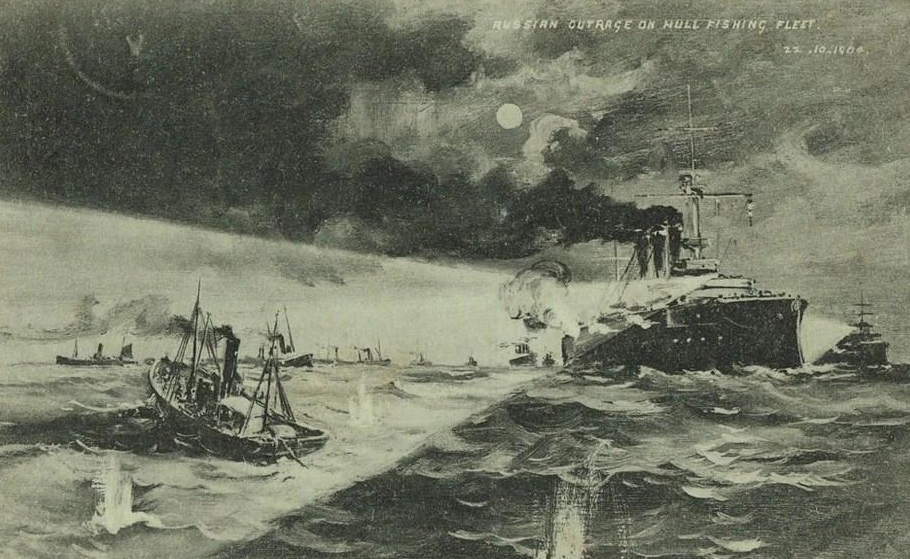
The battleships mistook the 'Aurora', which was attacking the fishermen, for a Japanese cruiser and opened fire on it.
While they were figuring things out, 'Aurora' was hit by five shells, several sailors were wounded, and the ship's priest Father Anastasius Rukin, who rushed onto the deck, lost his left arm due to the explosion of one of the shells. He could not be saved.
Thus, the ship's priest of the cruiser 'Aurora' became the first victim of the inglorious campaign of Admiral Rozhestvensky's squadron.
In total, during the battle of the 2nd Pacific Squadron with the English fishermen, our ships fired about 500 shells, sank one fishing seiner, and damaged five.
Two English fishermen were killed, many were wounded. Outraged world press called Rozhestvensky's squadron 'the fleet of madmen', and the battle with the fishermen caused serious diplomatic complications and became known as the 'Hull Incident'. As a result of the international investigation, Russia had to pay the English 65,000 pounds sterling as compensation. A huge sum of money for those times. Perhaps that is why, according to the memoirs of the battalion (storekeeper — Ed. note) of the battleship 'Orel' sailor Alexei Novikov, the author of the novel 'Tsushima', the admiral Rozhestvensky, known for his strong maritime language, nicknamed the cruiser 'the under-the-fence girl'.








Leave a comment