
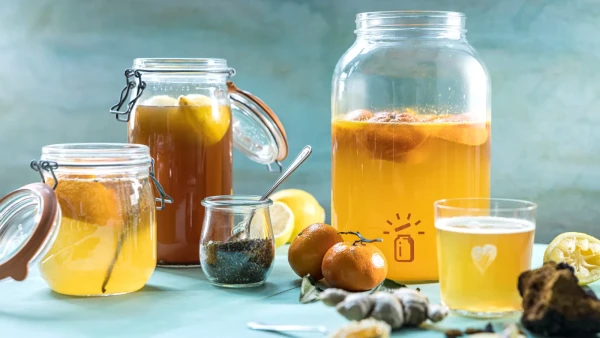
After 1–2 weeks, a vinegar smell should appear.
The stylish drink called kombucha became popular a few years ago. Young people started purchasing this unusual Chinese product, often unaware that it is an analogue of tea fungus.
However, there are no actual fungi in the product. This name refers to a symbiotic colony of bacteria and yeast (SCOBY), which produces beneficial bacteria and B vitamins during the fermentation of sweet tea.
The history of the drink spans over 2,000 years. It originally appeared in China, then spread to Japan and Russia, and later to Europe, where it became popular in the early 20th century.
Today, kombucha is in demand due to its low sugar content compared to regular sweet sodas and its probiotic properties. Annual sales of this drink are estimated at around $500 million.
To make kombucha at home, it is necessary to grow the tea fungus. This can be done in two ways. If you choose the simpler route, you can buy a ready-made fungus, place it in a clean sterilized jar, and pour sweet cold tea over it.
However, a much more interesting option is to grow the tea fungus yourself. To do this, you need to:
First, brew strong tea. Add 6 teaspoons of tea and 7 tablespoons of sugar to 0.5 liters of boiling water.
Let the resulting mixture steep for 20 minutes.
After that, strain the drink and cool it, then pour it into a sterilized jar.
Cover the mouth of the vessel with cheesecloth. Leave the jar at room temperature.
After 1–2 weeks, the drink should develop a vinegar smell. This will be a sign of successful fermentation. A film will form on the surface — the future tea fungus. When the film grows to a thickness of 2 millimeters, carefully replace the liquid with fresh sweet tea without damaging the fungus.
Fermentation begins when the tea fungus is placed in sweet tea. After five days, you will have basic kombucha ready for consumption.
The finished kombucha is poured into bottles, cooled for several hours in the refrigerator, and consumed. The fungus for the next batch is placed in a new brew.
For variety, you can add fruits, berries, spices, herbs, juices, and jams (for example, ginger with orange, cinnamon with cherry, thyme with jam).
After adding the ingredients, the bottles are sealed and left for two days in a warm, dark place for secondary fermentation, during which the fungus is not needed.
It is worth noting that different teas can be used for fermentation: green, oolong, pu-erh, and others — the fungus works well in any sweet solutions.















Leave a comment