
It seems that a waterfall is just water falling from a height. But in reality, this phenomenon remains a subject of scientific research and hides many unexpected details. From strict criteria for a "real" waterfall to a giant hidden underwater — here are four non-trivial facts that will make you look at them differently.
Not All Falling Water is a Waterfall
From a scientific point of view, a waterfall is a more or less vertical flow of water cascading over the edge of an eroded cliff.
For a flow to be considered a waterfall, it must:
- have a height of more than 1.5 meters;
- cascade over an eroded edge;
- be fed by a body of water that is replenished at least once a year by rain or meltwater.
If water simply flows over an uneroded rock, it is no longer a waterfall.
Waterfalls Can Form on Their Own
Modern research has shown that a waterfall does not always appear due to external cataclysms.
A river gradually erodes soft rocks (such as limestone or shale), leaving behind harder ones — granite or basalt. When the soft layer is completely eroded, a height difference is formed, and the water begins to fall, creating a natural waterfall without the involvement of catastrophic events.
The Largest Waterfall is Underwater
The largest waterfall on the planet is hidden beneath the surface of the water — in the Denmark Strait between Iceland and Greenland.
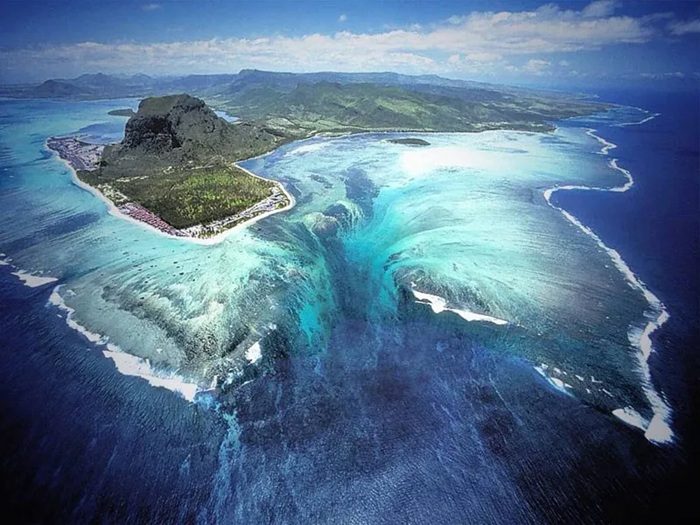
The so-called Denmark waterfall is formed due to differences in temperature and density of water masses. Cold waters sink down through underwater "troughs" and spill over their edges.
Its height reaches approximately 11,500 feet (over 3.5 kilometers), making it the largest waterfall on Earth — even though it can only be seen in scientific diagrams and models.
Waterfall as the Engine of the Industrial Revolution
The industrial revolution is usually associated with the steam engine. However, in the United States, the power of water played an important role.
The Great Falls waterfall in the city of Paterson became a key source of hydroelectric power for the first American factories.
The idea of an industrial city was promoted by Alexander Hamilton. Thanks to the energy of the waterfall, cotton, paper, silk, munitions, and railroad equipment production quickly developed here.
Thus, a natural phenomenon became the foundation of one of the centers of American industrialization.















Leave a comment