
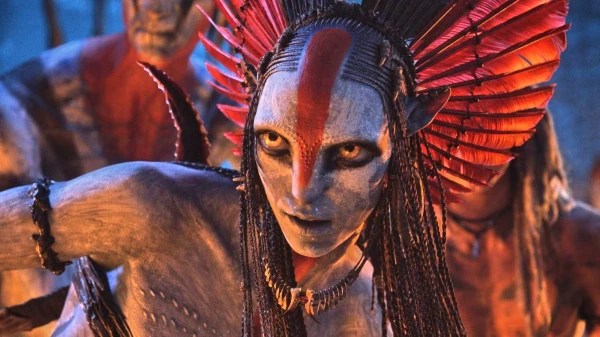
‘Avatar: Flame and Ash’ (Avatar: Fire and Ash). Directed by James Cameron, starring Sam Worthington, Zoe Saldana, Stephen Lang, Una Chaplin. USA, 2025.
"They cut down the sacred tree!"
James Cameron has always been known and respected as a technical innovator and a highly successful businessman, making the highest-grossing films of all time – but for some reason, no one has ever talked about him as a great ideological visionary. Meanwhile, it was Cameron who created and maintained the most convincing screen images of strong women (Sarah Connor from the ‘Terminator’ series and Lieutenant Ripley, who owes much to the sequel of ‘Alien’) long before hordes of cardboard, unconvincing female Jedi, Wonder Women, and other ballerinas changed the gender of the once-boyish action genre.
Thus, the first ‘Avatar’ came out nine years before Greta Thunberg's UN hysteria and eleven years before the decolonization festival named after George Floyd. Perhaps that is why it did not acquire sacred significance for either eco-activists or decolonizers – although in terms of clarity and persuasiveness, this tale of noble savages living in harmony with nature and resisting the invasion of militarist capitalists surpassed all ideological proclamations combined.
It is hard to forget how the ten-year-old daughter of friends, watching ‘Avatar 1’ in her room (note, on an ordinary TV and without any 3D), ran out in tears: "They cut down the sacred tree!".
And it is even harder to forget oneself, around the same age, watching on an even smaller screen in the 1001st pirate re-recording of ‘Terminator 1’: the temperature of the cooling blood in the veins was surely no higher than that of multiplex visitors.
A tale is a lie, but there is a hint in it
Cameron's main strength, the secret of his fabulous business success, has always been not so much in technical tricks as in the ability to tell a simple, captivating, universal story.
But the ideology in relation to the plot has always been secondary for this director. It has invariably been present – pacifist in the ‘Terminator’ films, especially the second, leftist in ‘Titanic’, ecological and anti-colonial in ‘Avatar’ – but as a moral in a fairy tale, not as a way to build an audience into columns.
There is no reason to doubt that Cameron himself has always sincerely disliked war, violence against nature, and small peoples – and he never missed an opportunity to read the audience the appropriate instruction. But his main task was still to captivate and entertain, not to brainwash. That is why the director's leftist fables – up to and including the first ‘Avatar’ – remained remarkably coherent, clear, and comprehensible. Unlike the hastily glued, falling apart on the go, but impeccable in terms of racial and gender diversity, woke creations of younger generations.
The three-body problem
However, making a storyteller, moralist, and businessman coexist harmoniously in one person is something like the three-body problem (known to Russians as the saying about eating, sitting, and remaining). And it is, as physicists assert, unsolvable. The excellent storyteller in Cameron was ultimately killed not by a leftist moralist, but by a greedy capitalist. The transformation of ‘Avatar’ into an oversized franchise was as logical as it was a fateful move. After the third installment, this can be said with confidence.
‘The Way of Water’ differed much more from its immediate predecessor than ‘Terminator: Judgment Day’. In ‘Avatar 2’, there was no clever reversal of the previous scheme – like turning the cyborg Schwarzenegger from a deadly threat into a protector. There was no independent parable – and indeed, no finished plot at all. The narrative frankly went into a second round and shamelessly cut off mid-sentence, obliging the audience to show up for the next installment.
Well, they showed up. Ahead, if we are to believe the promises (and why not believe them if the billion-dollar box office of ‘Flame and Ash’ surpassed expectations as early as January?), there are at least two more visits.
We’ve been there, we know
The second ‘Avatar’ introduced us to a new tribe of Na’vi – the water-dwelling ones. In the third, fire worshippers from a volcano appear, led by the digitized granddaughter of Charlie Chaplin. To keep us from getting too bored, they even made them evil and disconnected from the mother planet.
But there is again no genuine novelty – neither in plot nor in meaning. There is also none visually or technically – the most important trump card of the first film. The second did not produce the same shock effect – when you leave the cinema as if not into the real world, but rather, from a bright, full reality into some dull dream – but at least offered an unexplored experience of water procedures. Now neither flights nor dives are particularly surprising or captivating: we’ve seen it. The action repeats itself, like in a video game. Meanwhile, the characters are schematic, the dialogues are helpless, and the session stretches for almost three and a half hours.
In the absence of a finished story, the threequel carries no clear moral of its own – the audience has to come up with it themselves. A progressive relocant, for instance, sees in ‘Flame and Ash’ a critique of the father generation (Trump-Putin, of course), guilty of wars and enmity, and a hope for ideologically equipped children.
But with no less justification, one could say: the moral here is that good films should crash and burn at the box office and not spawn sequels.
Interesting Facts
-
The film lasts over 3 hours and 15 minutes, making it longer than the previous installments.
-
The budget exceeds $400 million, making it one of the most expensive films in history.
-
Cameron mentioned that his wife cried for almost 4 hours after watching it. He did not say why.















Leave a comment