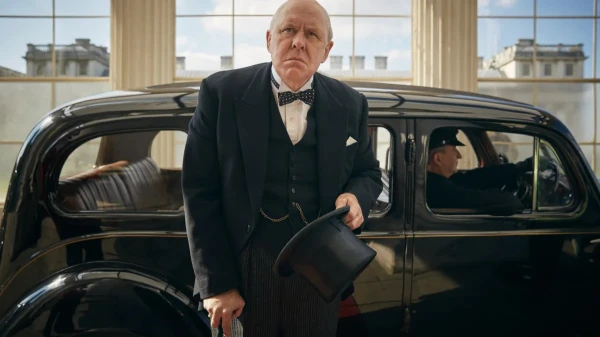
He is adept at complex, dual characters, with double meanings, flexible morals, and dark sides.
The American actor, famous for his role as Dick Solomon in the sitcom '3rd Rock from the Sun' and currently playing Albus Dumbledore in the new adaptation of 'Harry Potter,' is celebrating his 80th birthday. A multiple Oscar and Grammy nominee, and a winner of several Emmys, Golden Globes, and Tonys, John Lithgow is one of the artists whose influence on the entertainment industry is indelible.
He has tirelessly worked in musicals and plays, appeared on television and in films since 1973, established himself as a children's author, mocked dictators while admiring their tyranny, and still has no plans to stop. "My wife says I always need to have some project. I’m kind of a 'projectophile,'" he jokes.
A friendly alien, a caricatured tyrant, an intriguer, and a gray cardinal, a wolf in sheep's clothing: let's recall Lithgow's creative journey.
He has often humorously mentioned that he absorbed Shakespeare "with his mother's milk": when you grow up in a family with actress Sarah Jane and theater producer Arthur Lithgow, who runs a theater group performing all the plays of the English playwright, this happens. At seven, John Lithgow played Mustard Seed in a production of 'A Midsummer Night's Dream.' "My first great role," he recalls with a laugh.
When you read Lithgow's biography, there’s nothing to latch onto. No scandals, no falls into the abyss before a rapid rise. Just incredible hard work, paradoxical diligence, stable KPIs, enviable productivity. And unusual family connections. For example, with writer Thomas Pynchon and Clint Eastwood in some distant relation.
He graduated from high school in Princeton, studied at Harvard College in a history and English literature course, where he also began acting in theater. He earned a Bachelor of Arts degree with honors, then entered the London Academy of Music and Dramatic Art, tying his life to the theater. Simultaneously, he worked on film projects (his debut was 'The Deal, or The Blues of the Lost Bag with Forty Bricks on the Way from Berkeley to Boston,' 1972), and at 28 he performed on Broadway, receiving his first Tony nomination for a supporting role in David Storey's 'The Changing Room' in 1973. Ten years later, he received two Oscar nominations for his work in 'The World According to Garp' (with Robin Williams) and 'Terms of Endearment' (with Jack Nicholson). An impeccable reputation in the film community. The voice of Master Yoda in the radio production of 'Star Wars.' Episodes in 'The Twilight Zone' and 'Amazing Stories' — super-popular television anthologies. Theatrical collaboration with Meryl Streep. Work in the 1984 musical 'The Lords of the Underworld,' where he played a cantankerous priest trying to ban dancing for the youth.
As for 'nasty' characters — they fit Lithgow like a glove. His impressive height (190 cm), round and flat face, on which eyes, nose, and a sharp line of mouth are compactly arranged, naturally create a contrast in the perception of the actor on screen. Simply put, with such an appearance, he could guard the buildings of a psychiatric clinic or run a chain of car washes in Detroit. But Lithgow's inexhaustible sense of humor and unwavering moral compass allow him to approach not only his roles but also himself with irony.
Starting with 'Raising Cain' by Brian De Palma in 1992, the general line of Lithgow's film work was defined. These are complex, dual characters, with double meanings, flexible morals, and dark sides. Predators as they are. However, his true nature was revealed in characters like Dick Solomon from '3rd Rock from the Sun' or Jerry from 'How I Met Your Mother.' This is a childish, somewhat infantile, but responsible family man who can surprise those around him and himself.
"Oh my God! I’m magnificent!" exclaims Dick Solomon, the commander of the alien expedition that landed in Ohio and is forced to pretend to be ordinary people, immersing themselves in human culture. The sitcom '3rd Rock from the Sun,' which aired from 1996 to 2001 on NBC (in Russia, it even received an adaptation called 'Humanoids in Korolev' with Valery Garkalin, but it didn’t take off), became a bridge for Lithgow into the new millennium.
Where 'Shrek' awaited him. The work on the voiceover for the animated film, which later won an Oscar, lasted four years. John Lithgow was cast as the minor (in every sense) dictator Lord Farquaad. The actor had no idea that he was holding the script of a postmodern masterpiece — an animated film destined to change the fairy tale narrative for years to come. Moreover, for four consecutive years, he was periodically called in for re-recording, which was exhausting and left no clarity. What a surprise it was when Andrew Adamson and Vicky Jenson's film propelled DreamWorks Animation straight into competition with Pixar. In Farquaad, the key characteristics of villains in power converged, cleverly mocked by both the screenwriters and animators, and the actor whose voice he spoke: "Someone among you will perish, but I am ready to accept this sacrifice!"