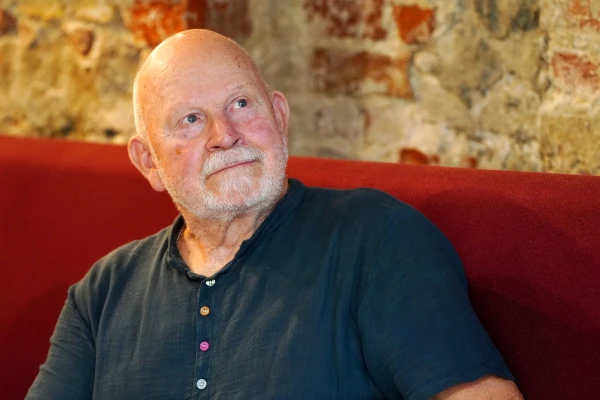
Peteris Vasks is the most famous classic composer of Latvia with worldwide recognition. On April 16, he celebrates his eightieth birthday.
Through Life with Bach
On this occasion - numerous concerts in Riga, Liepaja, Cesis, check the posters. That he is a global celebrity is no exaggeration.
Here’s a documented fact, told once by the musical director of the Klaipeda Musical Theatre - he arrived at a festival in Mexico, with tens of thousands of listeners in the square, and on the poster were two names - Bach and Vasks. Know our own!
European fame came to him with the collapse of the "Iron Curtain" in the early nineties. In 1996, he received the prestigious Herder Prize in Germany, which was often awarded to future Nobel laureates, and it is a pity that Alfred Nobel did not mention musicians in his will.
He is the holder of four Great Music Awards of Latvia, a long-time commander of the Order of the Three Stars (2001), as well as the Estonian Order of the White Star, 3rd class (2005). One of the first recipients of the Baltic Assembly Prize for Arts (1996), an honorary member of the Latvian Academy of Sciences (1994) and the Royal Swedish Academy of Music (2001), and an honorary professor at the Latvian Academy of Music.
In early April, the chapter of the orders, led by President Edgars Rinkēvičs, decided to award the classic the Order of the Commander of the Grand Cross of Recognition, which will be presented to the jubilarian on May 4 at the Riga Castle, on the 36th anniversary of the proclamation of the Declaration on the Restoration of the Independence of the Republic of Latvia.
Vasks gained worldwide fame thanks to the performance of his works by the great Riga native, violinist Gidon Kremer, and the American Kronos Quartet.
What Vasks Has in Common with Giuseppe Verdi
Although Peteris had a very difficult start. He was born in a small town in Kurzeme in 1946 to a Baptist minister's family. He graduated from the Emil Darzins Music School (where he later taught) and became a double bassist.
He tried to enroll in the Latvian Academy of Music (the conservatory) in the composition class. Can you imagine, he was not accepted - the Baptist past of his parents played a role. This inevitably brings to mind the story of how Giuseppe Verdi was once not accepted into the Milan Conservatory.
For ideological reasons, the future classic was forced to obtain his first higher education not in his homeland, but in neighboring Lithuania, where in 1970 he graduated from the State Conservatory of the Lithuanian SSR in Vilnius. He played double bass in the Lithuanian Philharmonic Orchestra (1966-69), then in the chamber orchestra of the Latvian Philharmonic (1969-70), in the orchestra of Latvian Radio and Television (1971-74), and then - three years in the Latvian Opera.
He is a follower of the music of contemporary innovators - Poles Krzysztof Penderecki and Witold Lutosławski. He adores the romanticism of Finnish genius Jean Sibelius. He loves nature. And this is not a legend, but a fact - in the seventies, Peteris went out to the shores of the Baltic Sea near Liepaja and began to greet the sea, the sun, the birds with his hands... The border service immediately arrived (this was the border of the USSR!) and interrogated the musician about what signals he was sending to Swedish ships? Fortunately, they let him go.
There is No Bad Weather in Nature
Currently, Vasks has three symphonies, choral works, masses, the legendary violin concerto "Distant Light" (1997, dedicated to Gidon Kremer), and works for organ.
And like any classic (Vivaldi, Tchaikovsky, Glazunov), he wrote "The Seasons," which is performed worldwide. The premiere took place on his seventieth birthday in his homeland in Rezekne. And this anniversary is connected with another charming story.
Vasks gathered his friends (including the author of these lines) in a bus and we went to Rezekne. To be frank, the weather was terrible: outside the window, wet snow was falling from the sky in mid-April, the winds were howling, and the Daugava was heaving due to the dirty gray ice floes. And Peteris looked at this element, standing in the aisle of the bus, and sincerely exclaimed: "This is magnificent! Magnificent!" For Vasks, nature truly has no bad weather, and he has often told me that he loves Latvia in any weather, even in slush. And by "slush," he means not only weather conditions but also political and economic ones.
In 2011, the Peteris Vasks Foundation was established in Latvia to promote the development of contemporary Latvian music; it supports many young musicians (among Peteris's students, by the way, is the now highly sought-after young composer Platon Buravitsky).
Alfred Schnittke Was in the Audience
In honor of the notable anniversary, there are many concerts of Peteris Vasks's music throughout Latvia. One of them was described by the chairman of the ANKOL named after Ita Kozakievich, professor, pianist, and one of the first performers of the living classic's music, Raffi Harajanyan.
"This is a concert of guests from Daugavpils - Gleb Belyaev and his students, including one from Africa," said Raffi Ispirovich. "The program is called 'Peteris Vasks and His Friends.' And I played - both solo and in a duet with Belyaev. The program is extraordinary, featuring the opuses of the jubilarian of the year - Vasks and Imants Zemzaris. Vasks was represented by 'landscape music': 'Landscape with Birds for Flute' and 'White Landscape' for piano. His 'Little Waltz' for two pianos was performed for the first time. We also played a variation on the theme of the Latgalian song 'Beyond the Lake, the White Birches,' which Vasks wrote in 1988 on the occasion of the twentieth anniversary of the Riga piano duo of Nora Novik and Raffi Harajanyan. I can add that Nora and I were the first to record his famous Message for foreign audiences, and we were the first in the world to perform Peteris's works in the early nineties, and at one concert of Vasks's music (which took place in West Berlin), only recently emigrated Alfred Schnittke came."
The Cat Went Missing in the Forest - A Reason for a Symphony?
During Easter, the classic was met in a huge queue stretching to the concert at St. John's Church in Old Riga. He stood with his people, although he was offered to skip the line, but it was a pleasant queue.
"I am probably naive. But I still do not lose confidence that music should speak of the beautiful. I would say that at the beginning of my music, a dark sky was mainly visible, but with small clearings on the horizon. Gradually, the sky became light blue. And only on the horizon does something dark loom, promising the emergence of clouds... It is necessary to show the negative. But that is not my sphere."
Vasks's sad humor is extremely warm. Although it is not without worries. Recently, in his house in Amatciems (an elite village near Cesis in nature, where actress Chulpan Khamatova lives with her family), Peteris had a minor drama. The cat went into the forest and disappeared. But after two weeks, it returned home and immediately caught a mouse in the garden and began to strangle it. Peteris rushed to help, but did not manage to save the living creature; the cat was quicker...
The Most Important Things Cannot Be Bought in a Department Store
But, nevertheless, he is a happy person because he knows the recipe for happiness.
"I don’t know how realistic this is for all of humanity, whether they will listen... But I believe that this is just the time to stop a little, to cease this eternal run for something - for money, for goods... It is not bad at all to stop and look around, to see what, in fact, surrounds a person?" says composer Vasks. "And a person is surrounded by other people, nature, and these are not banalities. You see, our life for many lately resembles some huge department store, where everyone rushes around, running and looking for something that is actually unnecessary. It should not be so, because the most important things in a department store you really cannot buy. One must understand that there are such concepts as the beauty of a person, nature. And that there is also such an important concept as 'soul,' can you imagine?"