
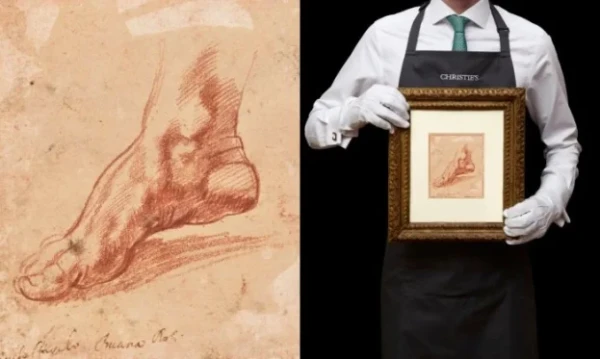
A rare chalk drawing of a foot, attributed to Michelangelo, was sold at a Christie’s auction for $27.2 million, becoming the most expensive work by the Renaissance master ever sold at auction.
A rare chalk drawing of a foot, attributed to the great sculptor and artist of the Renaissance, Michelangelo, was sold at a Christie’s auction in New York for an impressive sum of $27.2 million. This sale forever etched the work into history as the most expensive piece by the master ever presented at auction, confirming the unwavering value of his genius.
An Unexpected Discovery and a Long History
The fate of this small but significant work of art began not in the grand halls of galleries, but among personal belongings. In 2002, in Northern California, a modest drawing made with red chalk was discovered in an inheritance left by a grandmother. The owner, wishing to remain unnamed, reported that this family artifact had been in their lineage, according to them, "since the 1700s." Sensing the potential historical value of the find, the owner submitted the drawing for appraisal to specialists at the world-renowned auction house Christie’s last February. It was here, under the watchful eyes of experts, that it became clear that what they held was something much greater than just an old sketch.
A Discovery That Changes Art History
Christie’s officially confirmed that the sold lot is a sketch of a naked male foot, executed in red chalk. Experts attribute its authorship to Michelangelo Buonarroti himself, one of the titans of the Italian Renaissance. The size of the work is approximately 13 centimeters. Art historians believe that this drawing was made in the 16th century and served as a preparatory study for one of the figures immortalized in the frescoes of the Sistine Chapel. It is presumed that a man posed for the sculptor, whose foot was captured with such precision and expressiveness.
Michelangelo and His Contribution to the Sistine Chapel
The history of the Sistine Chapel is closely intertwined with the name of Michelangelo. It was he, primarily recognized as a sculptor, who accepted the commission from Pope Julius II in 1508 to paint the chapel's ceiling. The work took four years, from 1508 to 1512, and became one of the greatest achievements in the history of world painting. The subjects, drawn from the Old Testament, including the Creation of Adam, the Fall, and the Expulsion from Paradise, as well as scenes from the life of Noah, astonish with their scale, drama, and mastery of execution. Michelangelo not only created a monumental work but also introduced innovative approaches to depicting the human body, its anatomical accuracy, and emotional expressiveness.
A Record-Breaking Deal and Its Significance
The sale of the chalk sketch of the foot for $27.2 million was an unprecedented event. Until this moment, works by Michelangelo presented at auctions had not reached such high values, making this case truly historic. Such an amount underscores not only the artistic value of the drawing itself but also the enduring influence of Michelangelo's creativity on world culture. This sale once again drew attention to the artist's persona and his legacy, reminding us how even small, seemingly preparatory works can possess colossal historical and aesthetic significance.
The Value of the Renaissance
The Renaissance is a period in the history of European culture characterized by the revival of ancient traditions, the flourishing of visual arts, literature, science, and philosophy. The art of this time is marked by humanism, an interest in humanity as the center of the universe, and a pursuit of harmony, beauty, and perfection of forms. Renaissance masters such as Michelangelo, Leonardo da Vinci, and Raphael sought not only to depict reality but also to convey its ideal embodiment, achieving unparalleled mastery in this endeavor.
About the Sistine Chapel and Michelangelo
The Sistine Chapel, located in the Vatican, is part of the papal residence. It is famous not only for its architectural merits but also for the unique frescoes that adorn its walls and ceiling. The chapel gained particular fame from Michelangelo's works, executed on the ceiling and on the altar wall (the fresco "The Last Judgment").
Michelangelo Buonarroti (1475–1564) is one of the greatest Italian artists, sculptors, architects, and poets of the Renaissance. His work had a profound impact on the subsequent development of Western European art.
Famous Works of Michelangelo
Sculptures:
-
"David" (Florence) — a symbol of the Florentine Republic and human perfection.
-
"Pietà" (St. Peter's Basilica, Vatican) — depiction of the Virgin Mary mourning the deceased Christ.
-
"Moses" (Church of San Pietro in Vincoli, Rome) — part of the tomb of Pope Julius II.
Painting:
-
Frescoes of the Sistine Chapel (Vatican) — a grand cycle including "The Creation of Adam," "The Last Judgment," and many other compositions.
-
"Madonna and Child with the Young John the Baptist" (known as the "Manchester Madonna") — one of the rare easel painting masterpieces by the artist.
Architecture:
-
Design of the dome of St. Peter's Basilica in the Vatican, which had a tremendous influence on architecture.
-
Capitol Square in Rome — a model of Renaissance urban planning.
Michelangelo's work, even in the form of sketches, retains its genuine artistic power and historical value, continuing to inspire and astonish art lovers around the world.













Leave a comment