
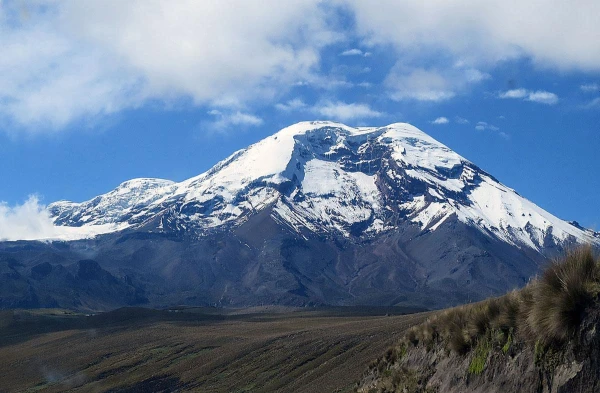
Chimborazo won over K2 due to the Earth's irregular shape.
The summit of Everest is considered the highest point on planet Earth, but in reality, it is a bit more complicated. Although Everest is indisputably the king of heights by many measures, it has a modest competitor in Ecuador that is actually closer to the stars and farther from the Earth's core.
As IFScience writes, this is Chimborazo, an inactive volcano in the Andes, with an elevation of 6,268 meters above sea level.
This is insignificantly low compared to other giant mountains, such as Everest (8,849 meters) or K2 (8,611 meters). In fact, Chimborazo is not even the highest mountain in this mountainous part of South America; it is the 37th highest mountain in the Andes.
However, the summit of Chimborazo is technically closer to the Sun due to the equatorial bulge of the Earth.
As IFScience explains, our planet is actually a flattened spheroid. As the Earth rotates, centrifugal force causes it to "bulge" at the center, making the planet thicker at the equator than at the poles.
Given this, Everest is at a disadvantage as it is located quite far from the equator, on the border between Nepal and China at 28° north latitude. On the other hand, Chimborazo is almost exactly on the equator, just 1° south latitude, very close to the "thickest" part of the globe. This also means that Chimborazo is the farthest point on Earth from the center of the planet.
So, to proudly say, "I am on top of the world!", it is not necessary to conquer Everest; there is a somewhat easier way. Climbing Everest typically requires a 10-day trek to base camp, six weeks of acclimatization, and a grueling seven to nine-day ascent to the summit. Meanwhile, climbing Chimborazo can be done in about two weeks, with the final ascent taking only one to two days after the climber acclimatizes to the altitude.















Leave a comment