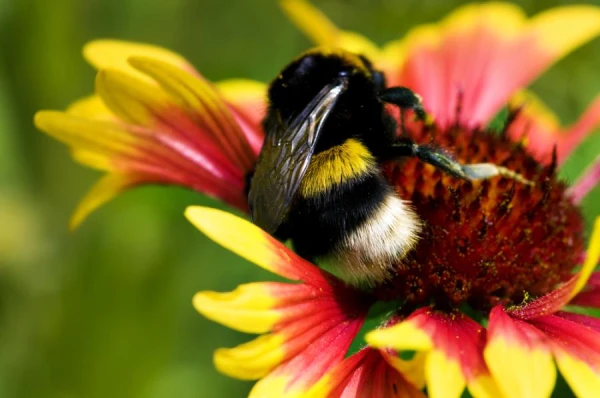
Biologists from the University of Bristol found that bumblebees assess flowers by their electric field in search of nectar.
Bumblebees have a positive charge generated by the movement of their wings and muscle contractions, while flowers typically have a negative charge. As they approach a plant, the insects are able to sense changes in the electromagnetic field around them. To confirm their observations, scientists conducted an experiment in which they trained bumblebees to collect nectar only from artificial flowers that possessed an electric charge. However, the question remained: how do bumblebees perceive electric charge?
Part of the answer to this question is contained in a new paper published in the Proceedings of the National Academy of Sciences. The research showed that under the influence of an electric field, the hairs on the bodies of bumblebees begin to vibrate. (Each of us has likely experienced something similar when combing our hair with a plastic comb: a charged comb attracts hair.)
The vibrations of the hairs activate neurons located at the hair roots, which send signals to the brain. The antennae of bumblebees also respond to the electric field, but the light and stiff hairs on their bodies move faster and deflect more strongly. Their movements are similar to the response of spider hairs and mosquito antennae to sound.
To measure the vibrations of the bumblebee hairs, scientists used a laser vibrometer that operates on the principle of the Doppler effect: the speed of the hair movement changes the frequency of the reflected light. Experiments showed that bumblebees can sense an electric field from about 10 cm away from a flower. Although this distance may seem insignificant, for a bumblebee, it is several times greater than the length of its body.
The ability to sense an electric field (electroreception) is not uncommon in nature. It is widespread among fish and aquatic mammals. For example, sharks use electroreceptors to locate prey. The authors of the study suggest that electroreception is also common among insects, as many of them have hairs similar to those of bumblebees.
Previously, biologists established that bees use their electric field for communication and orientation in the hive, gaining a charge from rubbing against the walls of the hive and the honeycomb.