
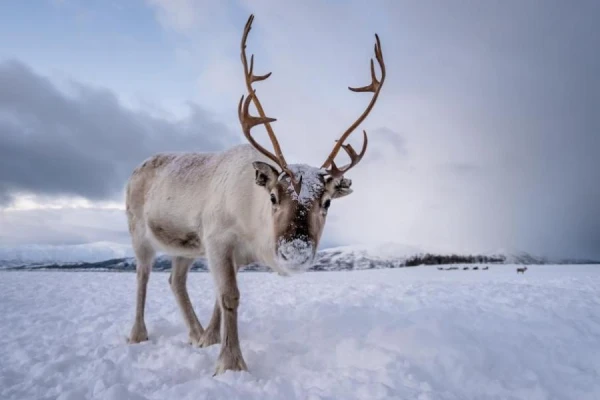
Reindeer, like other ruminants, spend a significant amount of time chewing food to aid its digestion in the stomach. They do this for so long that they are left with only a few hours for sleep. To meet their need for sleep, reindeer have adapted to sleep right while chewing!
For a long time, scientists have been interested in how reindeer maintain activity in the winter Arctic, while many other animals enter hibernation, and what allows them to be awake for almost 24 hours a day during the summer period. To investigate this question, a team of biologists from Norway and Switzerland conducted a study on the behavior of four female Eurasian tundra reindeer (Rangifer tarandus tarandus) over the course of a year, using non-invasive electroencephalography (EEG).
The observations took place in a controlled environment with regulated lighting and stable temperature, while the animals had unlimited access to food. As a result, it was found that reindeer slept approximately the same amount of time in different seasons. On average, they spent 5.4 hours a day in slow sleep, just under one hour in rapid sleep, and nearly 3 hours chewing food.
However, during the polar summer, sleep time was significantly reduced.
A Useful Skill
Next, the researchers analyzed the EEG data, looking for brain waves that occur in the slow phase of sleep, when recovery takes place. During the study, these waves were recorded when the reindeer were engaged in chewing. This was the first indication that these animals had learned to sleep while eating.
The second indication was that during chewing, the reindeer remained calm, often with their eyes closed.
In a state of wakefulness, the animals actively responded to the movements of their neighbors while eating, whereas in a state of sleep, they paid no attention to this and significantly reduced their physical activity.
Thus, this skill allows reindeer to remain active for as long as possible during the polar summer, when food becomes most available. As a result, they quickly gain weight and effectively prepare for the harsh winter conditions of the Arctic.









Leave a comment