
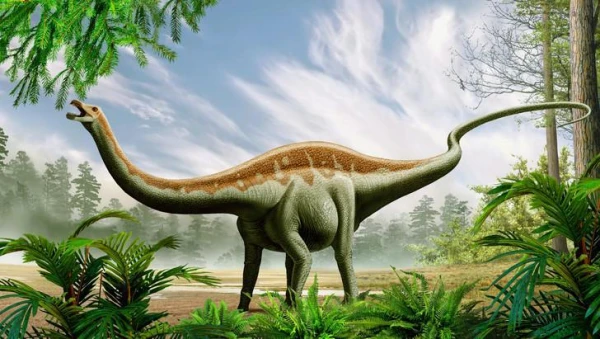
Some dinosaurs had serrated surfaces connecting the upper and lower parts of their vertebrae, which provided them with greater strength.
Surely, many of those who have ever looked at the skeleton of a Brontosaurus — whether in a book or a movie — have wondered how this reptile could support its weight. However, besides the Brontosaurus, there were other giants: Diplodocus, Brachiosaurus, Apatosaurus, and other members of the sauropod group, which reached nearly forty meters in length and weighed a hundred tons or more (although among sauropods there were also dwarf species, measuring only 5–6 meters). They were not aquatic creatures: if they had fully inhabited the water, it would have supported their mass. On land, however, all the weight rested on their own bones.
Clearly, through the process of natural selection, giant reptiles developed certain features that allowed them to cope with their own weight: these include a unique leg structure, a small head, and relatively light bones filled with air cavities. In an article published in Ameghiniana, paleontologists from the University of Michigan describe another anatomical feature that contributed to the sauropods becoming giants, namely — the special structure of their vertebrae.
As is known, dinosaurs (like mammals) have vertebrae consisting of two parts: the lower part — the vertebral body and the upper part, known as the arch; between them is an opening through which the spinal cord passes. In an adult animal, the vertebral arch is securely connected to the body, however, between them a cartilaginous layer remains for a certain period, in which new cells form. The time when both parts of the vertebra fuse varies depending on the species: in humans, this occurs at the age of 6–7 years, while in sauropods, the arch and body fused much later, when the reptile had already reached its adult length.
This could pose a serious problem for dinosaurs: the cartilaginous layer weakens the connection, and a large load on the spine could lead to the separation of both parts of the vertebra. However, in sauropods (at least in some of them), the contact between the vertebral arch and the body was serrated, which prevented their separation. Moreover, the degree of serration varied: in the skeleton of Spinophorosaurus nigerensis, which the authors of the article studied, the contact between the arch and the body in the cervical vertebrae closer to the head was relatively simple, but the closer the vertebra was to the shoulders, the more uneven and jagged the surface of the connection became. This is explained by the fact that the lower cervical vertebrae experienced greater loads than the upper ones.
In the future, researchers plan to study the vertebral bones of other dinosaurs, not only sauropods but also predators, including the well-known Tyrannosaurus rex, which weighed about 9 tons, which is also considerable. If similar serrated connections are found in other species, it would suggest that this feature was a common 'know-how' for most large prehistoric reptiles.











Leave a comment