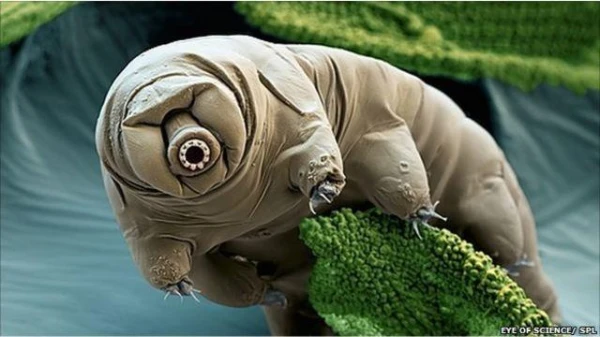
Finnish scientists have revealed for the first time the secrets of how tardigrades—remarkable creatures capable of surviving in the most extreme conditions—find their partners. Attractive scents from females play a key role in this process.
Male tardigrades are virtually indistinguishable from one another, which has long hindered researchers' understanding of their methods for finding mating partners. A hypothesis was previously proposed that these animals attract each other through specific chemical signals. Now, a team of scientists from the University of Jyväskylä in Finland has decided to test this hypothesis.
Searching for a Partner in an Aquatic Environment
In a new study published in The Journal of Experimental Biology, scientists conducted experiments with a species of tardigrade known as Macrobiotus polonicus.
They created an “arena” consisting of three chambers filled with water and placed tardigrades inside. One chamber contained a male, another a female, and the central chamber held a third tardigrade (either male or female). The researchers then recorded the behavior of the animal in the center.
After several hours of observation, the scientists noted that the males in the central chamber constantly tried to reach the female, ignoring the other male. The females, in turn, sensed the odors of both sexes but did not show the same persistence in approaching the males. The researchers suggest that it is the female tardigrade that emits a scent that attracts the male.
Searching for a Partner Outside Water
In the next experiment, the scientists aimed to determine whether tardigrades could follow a chemical trail in a non-aquatic environment. To do this, they filled the arena with agar, a jelly-like substance.
This time, neither males nor females were able to find the opposite sex; however, males frequently changed direction and approached females after random encounters with them. This indicates that the animals are capable of detecting chemical signals only in an aquatic environment.
Interestingly, researchers have previously discovered how these extremely slow and tiny creatures manage to cover large distances. It turns out they can “hitchhike” on snails.