
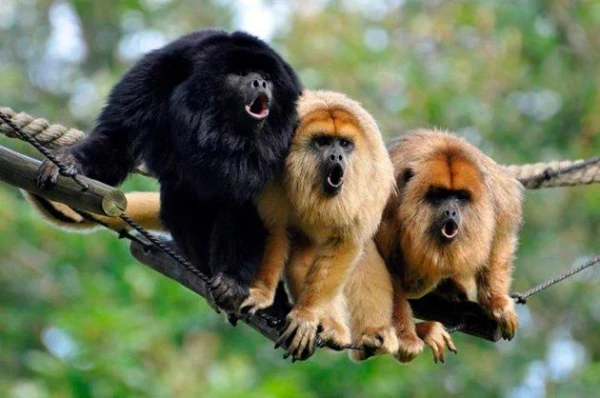
Although the anatomy of the throat and mouth of monkeys allows them to speak, the main obstacle to mastering speech is the imperfection of their brain.
It is known that many birds are capable of mimicking human speech, and some of them may indeed be able to talk. The most notable in this regard are African grey parrots, whose vocabulary can reach dozens of words.
Recent studies show that the structure of the bird brain is much more complex than previously thought, so it is not surprising that some feathered creatures, such as parrots, can master "speech tricks." However, we have a similar example of highly developed animals that are our closest relatives but cannot utter a word.
This refers to primates. The great Darwin pondered why monkeys are unable to speak, and according to his hypothesis, the reason lies in the brain: it differs from that of humans, and one of the differences is the inability to speak. However, later another explanation became popular: the vocal apparatus of primates is not adapted to reproduce human sounds, especially vowels, which is the reason for their muteness.
Nevertheless, the experiments of William Tecumseh Fitch and his colleagues from the University of Vienna and Princeton University challenge the "vocal-tract hypothesis." In their studies, the researchers trained a crab-eating macaque to sit on a special chair to record its throat using X-rays. During the experiment, the macaque ate, yawned, and made various sounds, and all these actions were recorded on video. Analysis of the recordings showed that the anatomy of the macaque's pharynx and larynx allows for the creation of "sound" configurations, of which there can be up to 99.
Can any speech sound be produced using these configurations? In an article in Science Advances, the authors claim that the larynx, tongue, and lips of macaques can "create" five different vowel sounds (in most human languages, there are no more than five). Using a special program that selects the most suitable vocal tract configurations for different sounds, a computer was able to "utter" the phrase "Will you marry me" — the sounds produced by the machine were similar to monkey-like, squeaky, and sharp, but individual words and the entire phrase turned out to be quite intelligible.
Thus, the anatomy of the organism allows macaques to master speech sounds. It should be emphasized that the 99 states of the throat, tongue, and lips that the researchers worked with are not artificial constructs, but quite real configurations compatible with the anatomy of the vocal apparatus, similar to that of other monkeys, including apes. So why then do they not succeed? The reason is likely that primates, except for humans, cannot control their voice — their brains are simply not wired for it.
In fact, this is not the first case where monkeys have been found to have, so to speak, a "theoretical" ability for human speech. In 2012, researchers from Princeton University published the results of observations of rhesus macaques: in an article in Developmental Science, it was stated that the facial expressions of rhesus monkeys and the movements of the speech apparatus in humans develop similarly, which may indicate that speech could have originated from monkey mimicry.
In 2013, Tor Bergman from the University of Michigan described in Current Biology how Ethiopian geladas are capable of imitating human speech. It is known that their calls resemble human voices, and Bergman was able to determine what mechanism underlies this imitation: it turned out that the monkeys uniquely use facial movements to break the sounds they produce into fragments that resemble human, albeit indistinct, murmuring.
Similar studies have been conducted with orangutans. On the other hand, when it comes to neurobiological differences between humans and monkeys, it is often mentioned that in humans, the FOXP1 and FOXP2 genes work more closely with each other — it is these genes that largely determine the ability to speak and understand foreign speech. Thus, if we want to understand how humans acquired speech during evolution, the answer should be sought not in the anatomy of the throat but in the molecular-genetic mechanisms that determine the development of the nervous system.














Leave a comment