
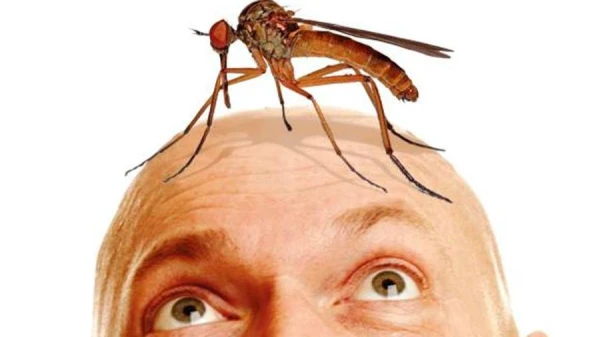
Mosquitoes use receptors that respond to decreases in temperature to find food.
Mosquitoes detect humans through smell and sight: we leave a trail of carbon dioxide and various body odors, and they are also capable of seeing us. However, at long distances, they rely on smell and sight, and when they get within a few centimeters, another tracking system — thermal — is activated.
Thermoreceptors in mosquitoes are located at the tips of their antennae. It was previously believed that these receptors simply measure the temperature of the environment. However, last year, researchers from Brandeis University published a paper in the journal Neuron, claiming that flies have a more complex arrangement: their thermoreceptors detect changes in temperature, with some responding to increases and others to decreases. Both types of receptors are so sensitive that they can detect temperature changes to a hundredth of a degree. Mosquitoes, being the closest evolutionary relatives of flies, also possess similar receptors.
One might assume that when a mosquito is pursuing a human, it relies on receptors that detect warming and heads towards areas where the temperature is higher. However, new experiments have demonstrated that this is not the case. Researchers disabled the gene in mosquitoes responsible for the receptor protein IR21a, which senses decreases in temperature. Then, mutant and normal mosquitoes were placed in a box with a warming wall, simulating human temperature, which also emitted a wave of carbon dioxide, mimicking human breathing.
Normal mosquitoes, when approaching the wall, clustered in areas where the temperature was similar to that of humans, while the mutants showed no interest in the warm zone. In another experiment, mosquitoes were offered two blood samples: one at room temperature and the other heated to palm temperature. Again, mutant mosquitoes showed no particular interest in the heated blood. The results of these experiments were published in the journal Science.
Thus, mosquitoes are directed towards heated areas by cells that sense decreases in temperature. At first glance, this may seem strange, but only at first glance: imagine a mosquito approaching a human, but suddenly getting off course (for example, the person takes a step to the side). In this case, the cooling receptors will immediately inform the mosquito that it is not moving in the right direction; one could say that the thermal navigation of mosquitoes works in reverse.
When a mosquito selects a specific spot to land and begin feeding, the same receptors assist again — there are greater chances of drinking blood in warm areas. Understanding the role of thermoreception in a mosquito's search for food could lead to the development of new methods to repel or deceive them, as it is important to remember that mosquitoes not only bite but also carry dangerous diseases such as malaria and yellow fever.














Leave a comment