
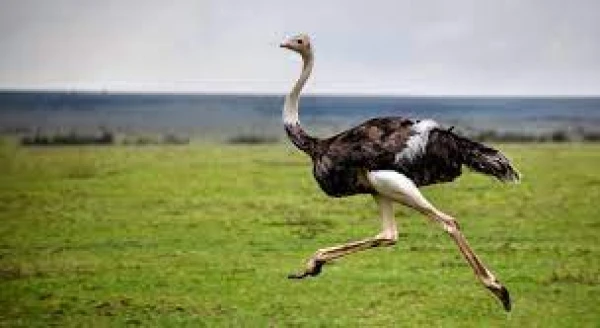
The ostrich is one of the most remarkable creatures inhabiting our planet. The ability of these birds to adapt has allowed them to survive and even thrive for thousands of years despite the threat from the most dangerous predators. The ostrich is far more complex than it may seem at first glance.
Before humans became a serious threat, ostriches could be found in Asia, Africa, and the Arabian Peninsula. Today, their range is limited to the forests and savannas of Africa south of the Sahara.
This is a bird you don’t want to encounter in a dark alley: ostriches can weigh up to 145 kilograms and reach nearly three meters in height, a significant portion of which is due to their powerful legs. They are a meter taller than the emu, the second tallest bird, which reaches two meters, and heavier than the cassowary, the second heaviest bird, by almost 90 kilograms.
The eyes of an ostrich are not only the largest among all birds but also the largest among all land animals! Each eye has a diameter of about 5 centimeters, comparable to the size of a billiard ball and even exceeding the size of the bird's brain.
Ostriches are the fastest bipedal creatures on Earth. They can reach a maximum speed of up to 70 km/h, but what is even more impressive is their endurance: an ostrich can run at a speed of 48 km/h for 16 kilometers, making it one of the best long-distance runners.
Ostriches use their wings as rudders for maneuvering when moving at high speeds. When turning or zigzagging while running, they rely on their wings to maintain balance and control.













Leave a comment