
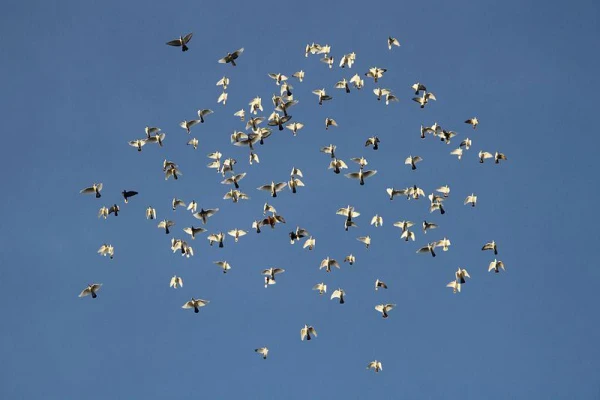
During sleep, the brains of birds reproduce impressions gained during wakefulness and strive to cleanse themselves of accumulated molecules.
The two phases of sleep — rapid and slow — were first discovered in mammals, and later, during sleep studies in other animals, it was found that similar phases are present in reptiles, fish, and possibly in spiders and octopuses. However, there are still certain doubts regarding whether spiders, octopuses, and fish sleep in the same sense as mammals, with two phases. Nevertheless, in birds, alongside mammals, both rapid and slow sleep are clearly observed.
It is believed that during rapid sleep, or REM sleep, the brain experiences dreams, reproducing events that have occurred to the individual in real life. In fact, dreams can also occur during slow sleep, but overall there is quite convincing evidence that the sleeping brain processes recent events. Slow sleep plays an important role in a number of physiological processes. In particular, during this phase, the brain actively gets rid of molecular waste, including unnecessary proteins that can accumulate and lead to neurodegenerative diseases. The removal of waste from the brain occurs through a special glymphatic system, which collects it in the cerebrospinal fluid, which then drains into the brain's ventricles.
Researchers from the Max Planck Institute for Biological Intelligence, along with colleagues from other research institutions in Germany and France, used functional magnetic resonance imaging (fMRI) and infrared cameras to observe sleeping pigeons. (The birds were specially trained to sleep without paying attention to the surrounding equipment.) In a paper published in the journal Nature Communications, it is noted that the processes occurring in the brains of birds during rapid and slow sleep are similar to those observed in mammals. During rapid sleep, the area of the brain responsible for visual information processing was actively working in pigeons, including regions that analyze the environment during flight. Areas responsible for body perception were also activated, especially those receiving signals from the wings. This created the impression that the pigeons were dreaming of flying.
Additionally, during rapid sleep, the amygdala, which is responsible for processing emotions, was actively functioning in birds, and the pupils under closed eyelids constricted. In pigeons, the pupils constrict during courtship displays and in conflict situations, suggesting that the birds were dreaming of emotional scenes of this kind.
Overall, during rapid sleep, the brains of birds demonstrated higher activity than those of mammals. However, this activity has a downside: as soon as the pigeons entered rapid sleep, there was a sharp decrease in the influx of fresh cerebrospinal fluid from the ventricles into the brain tissue, and this fluid aids in the removal of waste from the brain. Nevertheless, when the brain began to actively dream, a lot of blood flowed into it. Blood vessels dilated, facilitating the movement of cerebrospinal fluid in the surrounding brain tissues. The phase of rapid sleep in birds is shorter than in mammals and occurs more frequently throughout sleep. Frequent constrictions and dilations of blood vessels likely compensate for some delay in the circulation of cerebrospinal fluid. In any case, birds do not seem to experience serious problems with brain cleansing.
It is known that the structure of bird brains is significantly different from that of mammals. Nevertheless, this makes it even more interesting that the physiology of sleep in birds and mammals has much in common. Perhaps comparing the dream phases in the brains of birds and mammals will help us better understand how our dreams arise.













Leave a comment