
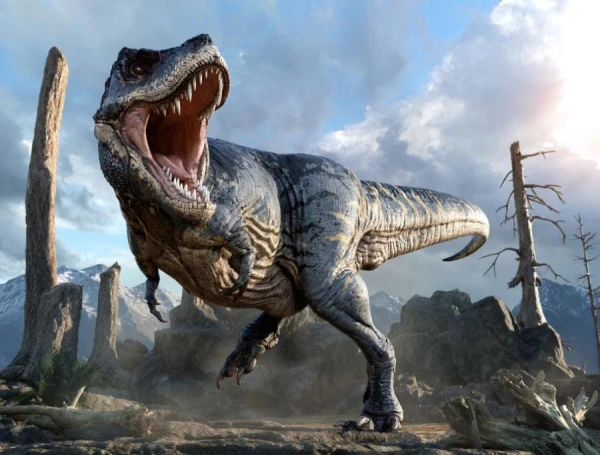
Researchers from McGill University (Canada) have developed an innovative method that allows for the determination of toxic gas emissions into the atmosphere during volcanic eruptions that occurred tens of millions of years ago. This approach was applied to study one of the largest volcanic formations on the planet — the Deccan Traps in India. Analysis of magmatic rocks showed that about 65–66 million years ago, large-scale volcanic eruptions led to climate changes that likely contributed to the gradual extinction of dinosaurs and many other species.
The Deccan Traps are an extensive magmatic plateau with a staircase-like topography (from the Swedish word trappa — staircase), located on the Deccan Plateau in central and western India. This formation resulted from a remarkable and prolonged volcanic eruption at the end of the Cretaceous period (60–68 million years ago). At that time, lava flows covered 1.5 million square kilometers of the Indian subcontinent. Over time, the area of the magmatic province decreased to 500,000 square kilometers.
A group of scientists collected samples of trap rocks for laboratory analysis using a new technology that the authors compare to the “pasta method.” When pasta is boiled in salted water, a small amount of salt remains in it: by analyzing the spice content in the finished dish, one can determine what its original concentration in the water was.
Similarly, some elements after volcanic eruptions get trapped in minerals as they cool. The new method allows for the initial determination of sulfur and fluorine content in the Deccan trap rocks, and then calculates the total amount of these gases released during the eruption.
“The method for assessing sulfur and fluorine emissions is a complex combination of chemical processes and experiments. Discovering clues in ancient rock samples has been a real achievement. In fact, the new method has allowed us to decode the volcanic history,” says Professor Don Baker from McGill University.
The Horrors of Volcanic Winter
The researchers found that 200 years before the extinction of the dinosaurs, critical concentrations of sulfur and fluorine were released into the atmosphere from the eruption of a million cubic kilometers of rock in this region. These emissions were sufficient to create a phenomenon known as volcanic winter — a global temperature decrease on the planet.
“Climate conditions were extremely unstable, with recurring volcanic winters that could last for decades leading up to the extinction. This instability created difficulties for all plants and animals, setting the stage for the extinction of the dinosaurs,” comments Don Baker, a professor in the Department of Earth and Planetary Sciences at McGill University.
The authors of the study believe they have explained such a significant event in the planet's history as the mass extinction of species, including giant reptiles, which ultimately paved the way for the emergence of mammals and the evolution of humans.
New data complement the findings of a previous study that showed that dinosaur diversity slowly but steadily declined over the two million years leading up to the catastrophe. The number of reptile species decreased. Now we can understand why the Earth at that time bore no resemblance to a tropical paradise: with recurring volcanic winters, millennia of eruptions, fields of lava, and ash in the air. Gases from the traps of magmatic minerals likely seeped into the atmosphere for hundreds of years before the Chicxulub meteorite delivered the final blow.















Leave a comment