
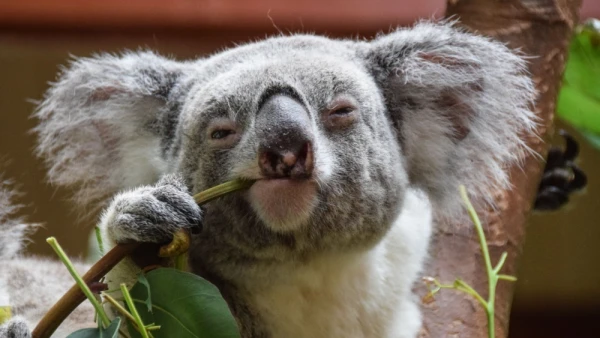
Biologists explained it through convergent evolution.
Scientists have found that koalas possess unique patterns that are almost indistinguishable from human fingerprints. From the outside, koalas have nothing in common with humans. They sleep for hours clinging to eucalyptus trees and patiently chew leaves. However, upon closer inspection, biologists discovered grooves twisted into intricate spirals at the tips of their fingers. It turns out these patterns are almost a complete analogue of our fingerprints, writes Earth.com.
Interestingly, koalas are among the rare animals that were on the brink of extinction, but humans have timely begun to restore their population. Other marsupials live in Australia. Previously, we wrote about why so many unusual species ended up on one continent.
How is it possible that an animal whose evolutionary path diverged from ours over 100 million years ago has such a unique trait? This small discovery has prompted experts to reconsider conventional views on evolution and the purpose of these patterns.
For a long time, it was believed that the main function of fingerprints is to improve grip. Allegedly, it is the grooves that help us hold tools firmly and climb surfaces. However, biologist Roland Ennos proved that the situation is more complex. His research showed that a ribbed surface can even reduce friction.
Later studies revealed another important function — moisture management. When we touch something, sweat is evenly distributed across these grooves through the pores. This prevents our fingers from becoming either too dry or overly slippery.
"This dual mechanism of moisture control gave primates an evolutionary advantage," explained researcher Mike Adams. "It endowed them with the abilities to manipulate objects and move in ways that are unavailable to other animals."
But that's not all. It turned out that fingerprints also act as enhancers of touch. Physicists discovered that the grooves amplify vibrations when we run our fingers over a rough surface. These microscopic signals reach the nerve endings, allowing us to distinguish the smallest irregularities.
Biologist Maciej Henneberg from the University of Adelaide (Australia), while studying koalas, made an unexpected discovery. He found intricate loops and swirls on their paws. The patterns were so similar to human ones that, theoretically, they could be confused under a microscope.
Why do koalas even have such fingerprints? The answer lies in a phenomenon that biologists call convergent evolution. This occurs when unrelated species, living in similar conditions, independently acquire similar traits. A classic example is the streamlined body shape of sharks and dolphins, perfectly adapted for fast swimming.
Henneberg suggested that fingerprints evolved in koalas so they could carefully climb thin branches of eucalyptus trees and pluck tender leaves. The friction and special sensitivity provided by the grooves help these animals maintain balance and perform delicate movements.
Interestingly, koalas' closest relatives — wombats and kangaroos — do not have such patterns. This confirms that such an adaptation arose specifically in koalas as a response to their unique lifestyle.










Leave a comment