
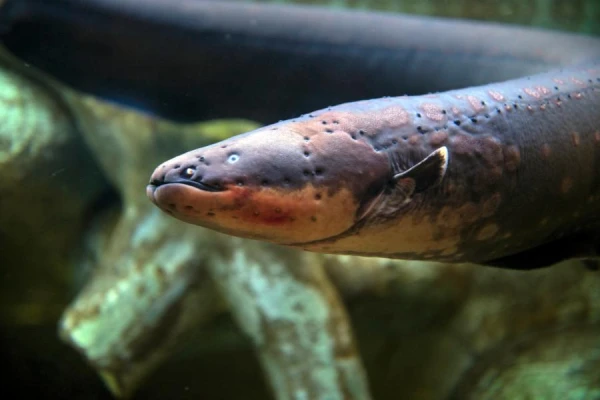
During hunting, the electric eel first forces its prey to reveal itself and then paralyzes it.
Information about electric fish has been known to humans since ancient times: even in Ancient Egypt, electric rays were used to treat epilepsy, the anatomy of the electric eel inspired Alessandro Volta to create his famous batteries, and Michael Faraday, known as the "father of electricity," used this eel in his scientific experiments.
Modern biologists are aware of the capabilities of these fish (the nearly two-meter eel can generate 600 volts). Furthermore, it has become known which genes are responsible for this unique trait: this summer, a group of geneticists from the University of Wisconsin-Madison (USA) published a study with the complete genome sequence of the electric eel. The purpose of its "electrical abilities" has also become clear: they are necessary for hunting, spatial orientation, and protection from predators. However, one question remained unclear — how exactly do the fish use their electric shocks and what strategy do they employ.
zoologist Kenneth Catania from Vanderbilt University (USA), observing electric eels in a specially created aquarium, noticed that the fish can discharge their battery in three different ways. The first method is low-voltage impulses intended for spatial orientation. The second is a sequence of two to three high-voltage impulses lasting several milliseconds. Finally, the third method is a relatively long burst of high-voltage and high-frequency discharges.
When the eel attacks, it sends a multitude of volts at a high frequency to its prey (the third method). Three to four milliseconds of such exposure is enough to paralyze the prey, which allows us to assert that the eel uses remote electric shock. The frequency of its discharges significantly exceeds that of artificial devices: for example, a remote Taser delivers 19 impulses per second, while the eel delivers a staggering 400. After paralyzing its prey, the eel must quickly seize it, otherwise the catch may recover and escape.
In an article published in the journal Science, Kenneth Catania notes that the "living electric shocker" acts similarly to an artificial one, causing strong involuntary muscle contractions. The mechanism of action was established during an experiment when a fish with a damaged spinal cord was placed in the aquarium with the eel; an electrically permeable barrier was between them. The fish could not control its muscles, but they contracted in response to external electrical impulses (the eel was provoked to discharge by tossing worms as food). However, when a nerve-paralyzing toxin curare was introduced to the fish with a damaged spinal cord, the electricity from the eel had no effect on it. This confirms that the target of the electric discharges was indeed the motor neurons controlling the muscles.
However, all this happens when the eel has already identified its prey. But what if the prey is hiding? It cannot be detected by the movement of water. Moreover, the eel hunts at night and cannot boast of good vision. To find its prey, it uses discharges of the second type: short sequences of two to three high-voltage impulses. Such a discharge mimics the signal of motor neurons, causing all the muscles of the potential prey to contract. The eel seems to command it to reveal itself: a muscle spasm runs through the body of the prey, it begins to twitch, and the eel picks up the water vibrations and understands where the catch is hiding. In a similar experiment with a fish with a damaged spinal cord, it was separated from the eel by an electrically impermeable barrier, yet the eel could still sense the water waves from it. Simultaneously, the fish was connected to a stimulator, so its muscles contracted at the experimenter's will. It turned out that if the eel emitted short "detection pulses" and simultaneously the fish was made to twitch, the eel would attack it. If the fish did not respond, the eel naturally did not react — it simply did not know where it was.
Thus, the electric eel demonstrates a rather complex hunting strategy. By periodically sending "pseudo-muscle" discharges into the external environment, it forces hidden prey to reveal themselves, then swims to the source of the water vibrations and delivers a different discharge that paralyzes the catch. In other words, the eel gains control over the muscles of the prey, commanding them to move or freeze at the right moment.













Leave a comment