
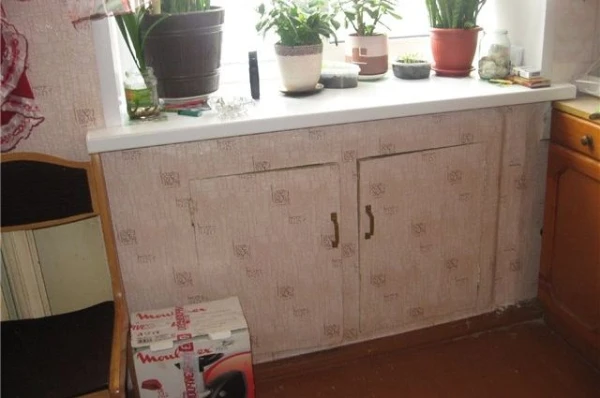
In pre-war and post-war buildings, niches in kitchens that were used for food storage can still be found.
Due to the fact that the thickness of the outer wall was half a brick and had a constantly open external opening, such "refrigerators" under the windowsill allowed for good preservation of perishable products during the winter months.
"Such niches appeared in the first standard houses. This is not only a Khrushchyovka innovation; a similar solution can also be found in Stalin-era buildings. A special technology was devised to help people in their daily lives. Due to the design solution, the wall under the window was thinner and had special grilles to allow cold air to pass through. This can be considered a precursor to refrigerators. The niche had a special ventilation system. There was nothing supernatural about it, just access to cold outdoor air," says architect Ruslan KIRNICHANSKY.
Thus, these boxes became a nice bonus for those who moved into new apartments from dilapidated wooden houses or communal apartments with all their belongings but did not know where and how to keep food fresh longer. "At that time, houses were rented with finishing. A person receiving an apartment order could move in and live in the apartment on the same day.
Accordingly, builders tried to maximize comfort. In the niche with doors, a person could store food, milk, and even meat. This solution found its fans, and the experiment was recognized as truly successful. Later, the construction of houses with built-in refrigerators under the kitchen window was discontinued due to impracticality. Firstly, it was difficult to ensure such a panel for mass production. In the first five-story buildings, the goal was to create economical housing to resettle people after the war and solve the social problem.
The second reason why such "refrigerators" were no longer used was the emergence of real refrigerators in the 1960s. Their production was established in the Soviet Union, but initially, having a refrigerator was a luxury. When they stopped building houses with such niches, people still could not come to terms with their absence. Special homemade steel boxes began to be installed on the windows. They were made to replace the beloved "refrigerators" under the windows, which were actually not very practical but allowed for energy savings," says Kirnichansky.












Leave a comment