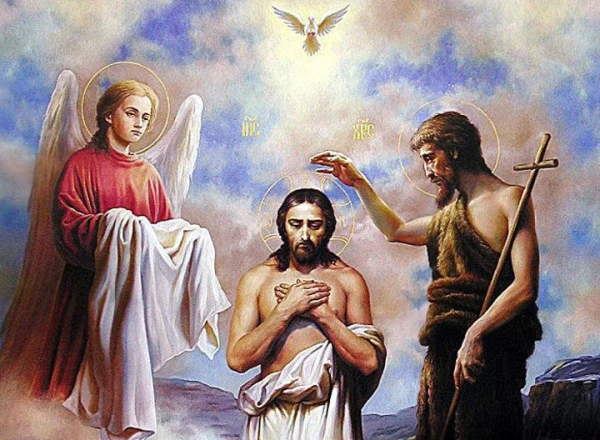
On January 19, Orthodox Christians celebrate the most important holiday – the Baptism of the Lord, also known as Holy Theophany. On this day, solemn liturgies are held in churches, dedicated to the event that became significant in the history of Orthodoxy. About two thousand years ago, John the Baptist baptized the Savior – Jesus Christ – in the waters of the Jordan.
The Baptism of the Lord, or Theophany, is one of the key twelve feasts with deep historical roots and established traditions.
The Baptism of the Lord: Historical Context
This great Orthodox holiday is dedicated to the sacrament of Baptism. The word "baptism" translates from Greek as "immersion in water."
In the Gospel of Matthew, it is described that this sacrament was first performed by John the Baptist, who called the people of Judea to repentance. During the Baptism, John helped people cleanse themselves of sins and impurities.
At the Jordan River, where the Jews performed ablutions, the prophet John the Baptist found himself during his wanderings in the desert. Preaching about repentance, he began to baptize people in the water.
Jesus, who, according to tradition, was about 30 years old at that time, also came to the river. After his baptism, a miracle occurred: from the opened heavens, the Holy Spirit descended upon Jesus in the form of a dove. A voice from heaven proclaimed Jesus as His Son.
"This is My beloved Son, in whom I am well pleased," John the Baptist heard. This phrase, familiar to every Christian, explains the second name of the holiday – Theophany.
Traditions of Celebrating the Baptism of the Lord
On the day of Theophany, which has a fixed date, solemn services are held in churches. The celebration begins the evening before, on the Eve of the Baptism. During this time, the blessing of water or the sanctification of water takes place, starting in the morning of January 18 and concluding on the day of Baptism – January 19.
Another vivid event that begins on January 18 is the Baptismal bathing, reminiscent of the baptism in the Jordan River. For this, special holes are cut in water bodies or baptismal fonts are set up.
It is believed that bathing in the Jordan contributes to the purification of the soul and the strengthening of the body. Immersion in the font is done at will; no one is forced, as it is not for everyone.
The main expectation from believers on the holiday of the Baptism of the Lord is participation in the festive service, which concludes with confession, communion, and receiving holy water.
On the eve of Theophany, believers observe a fast. The fast is short – only one day, but strict.
Food can be consumed after the morning, when the candle is brought out following the liturgy, and the first rite of baptism with holy water takes place.
What is the Baptismal Water Called
The Baptismal water is called agiasma. In Greek, it means "sanctity." It is believed that it heals not only the body but also the soul.
The Baptismal water can be used throughout the year. There is no need to collect it in large quantities. Priests assert that even drops of agiasma are enough to achieve the desired effect when added to regular drinking water.
Holy water is traditionally sprinkled in living and office spaces, as well as applied to sick areas of the body. This water is given to drink to those who have not been allowed to partake in communion. The Baptismal water can be stored and used until the next holiday of Theophany.
What Our Ancestors Did on the Baptism of the Lord
Although one may not want to sin, it would be wrong to bypass the topic of Baptismal divinations. Pagan motives intertwined with Christian traditions so closely that they could not be eradicated even over many centuries. The Orthodox Church does not approve of this, trying to explain to parishioners that believing in divinations is wrong, as they are from the devil, but stubborn individuals could not be convinced.
Thus, in ancient times, on the eve of the Baptism of the Lord, girls would divine, striving to see their betrothed. By the way, divinations were prohibited the next day.
One of the Baptismal divinations was related to predicting marriage. If girls, going out in the evening, saw a young man behind the gate, they would begin to prepare for the wedding. If it was an old man, they knew that the year would be prosperous, but there would be no wedding. On the night of Theophany, one could make a wish while looking at the stars.
Vladimir Zhukovsky vividly and figuratively described Baptismal divinations in his ballad "Svetlana": "Once on a Baptismal evening // The girls divined:// They threw a shoe over the gate, // Taking it off their foot."
From the work of the Russian writer, it is evident that divinations were associated with snow – they listened to it, with feeding birds "counting" grains, and with melted wax, which was poured into water.
However, the main tradition throughout the ages remained visiting the church. In prayers addressed to Jesus Christ, our ancestors asked for a good harvest, health for their loved ones, and help for their children.
The Baptism of the Lord: Folk Signs
The holiday of Baptism is associated with the Baptismal frosts, which already freeze the ground the day before. However, after Theophany, the weather usually changes its character.
"Whether it cracks or not, the water Baptism has passed," our ancestors said, hinting that soon the frosts would begin to wane. Signs associated with the Baptism were considered the most reliable.
Nevertheless, frost on the Baptism was always desired. It was associated with the future grain harvest. A good harvest was indicated by fog and snow falling in flakes from the sky.
Another Baptismal sign was related to the heavens. People knew: if blue clouds float across the sky at noon, it also foretells an abundance of wheat in the summer.
It is believed that prophetic dreams occur on the night of Baptism. However, it is not advisable to share them, especially the good ones. If you tell them, nothing will come true.
The Baptism of the Lord: What Not to Do
There were many prohibitions associated with this twelve-feast holiday. Mentions of this can also be found in the works of Russian writers.
The main ones concerned holy water. Our ancestors knew: it is forbidden to place containers with water on the floor, otherwise one may fall ill. The Baptismal water was kept under icons. On Theophany, it was forbidden to:
Engage in divination and rituals. The prohibition extended to the day following the Baptism. It was believed that violators could fall ill.
Collect a lot of Baptismal water. Blessed water is a spiritual treasure that should be cherished.
Lend money. This could lead to ruin and poverty.
Refuse alms. Such people will feel need.
Envy, gossip, wish misfortune to others. All negativity will return threefold.
Before Theophany and on the day of Baptism, it was forbidden to take anything out of the house. Our ancestors believed that this could lead to the loss of happiness and luck.
It was strictly forbidden to quarrel. Family disputes and discord with relatives or friends could make the whole year sad, full of conflicts and tears.