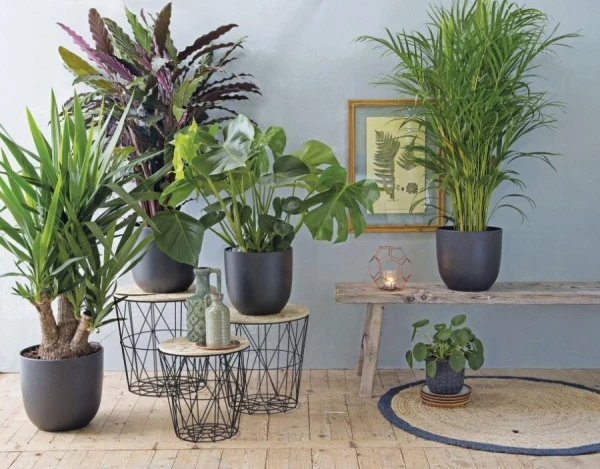
A list of plants suitable for low-light conditions.
In fact, the term "plants for north windows" is not entirely accurate. Here is a list of plants that do not require much light. They can be successfully grown both on the windowsills of north-facing windows and in the depths of well-lit rooms.
1. Pelargonium or Geranium
Pelargonium is a versatile flower: it can be used as a houseplant as well as for landscaping flower beds, balconies, and terraces. Its care is minimal, and prolonged flowering ensures long-lasting decorativeness.
The most common species in indoor gardening is the garden pelargonium or zonal pelargonium (Pelargonium x hortorum), which is a result of several hybridizations. It blooms well on north windows but can stretch and bloom poorly if overcrowded. When freely arranged on a windowsill, there are no problems with flowering.
It can also be grown on east and west-facing windows.
2. Ferns: Adiantum, Asplenium, Blechnum, Davallia, Dicksonia, Polypodium, Nephrolepis, Platycerium, Pteris
Ferns seem to be created by nature itself for decorating north windows and rooms with insufficient lighting.
The most popular and resilient in indoor environments is Nephrolepis. The leaves of mature specimens can reach lengths of 1–1.5 m and beautifully cascade over the edges of pots. It grows well both on windows and in the depths of rooms.
3. Palms: Areca, Washingtonia, Caryota, Livistona, Rhapis, Date Palm, Chamaedorea
The most popular for offices and living rooms are the Date Palm, Livistona, and Chamaedorea. All of them thrive in indoor and greenhouse conditions, require minimal care (watering, fertilizing, misting), and special efforts.
Features of growing palms in indoor conditions
4. Aspidistra
This shade-tolerant and easy-care plant is used in floristry. In general, that’s all that can be said about aspidistra.
Aspidistra, or "family of friends," is a popular houseplant among florists.
This unpretentious plant is used for landscaping offices and apartments: it grows well, occupying the entire area of the container. Hence its folk name "family of friends."
5. Dracaena and Yucca
Both yucca and dracaena grow well and reach large sizes in indoor conditions — up to 1.5–2 m in height. These original plants look great in compositions with shorter cultures: ferns, Soleirolia, Peperomia, and Chlorophytum.
Both species grow better in good lighting but can tolerate partial shade. In insufficient light, variegated forms often turn green, losing their characteristic leaf coloration.
6. Saxifraga stolonifera
This perennial, unpretentious herbaceous plant has a rosette of leaves at the base, reaching heights of 10–15 cm. It is quite shade-tolerant but grows better in bright or shaded places.
Saxifraga is usually grown in hanging pots or tall containers. The Tricolor variety is especially beautiful: it has leaves with uneven edges in pink and white.
7. Maranta
This is a classic of the Soviet windowsill. Maranta is kept in warm rooms, in light partial shade. It is also suitable for hydroponic cultivation.
8. Monstera and Philodendron
These large evergreen plants with big leathery leaves (especially Monstera, which can reach ceiling height and occupy the entire allotted space) are not demanding in terms of lighting.
Monstera and philodendrons can grow in both light and partial shade, and even in dark places, but not in direct sunlight.
9. Aglaonema
This perennial rhizomatous plant with leathery decorative leaves can be grown both in the depths of the room and on a north window. A wide variety of cultivars with different leaf colors and bush sizes are available for sale.
10. Pilea
Perennial plants with thin stems, diverse in leaf shape and color, and small, minimally decorative flowers. Pilea is most often used in indoor culture and as ground cover plants for winter gardens. A moderately bright, somewhat shaded, but warm place is chosen for placement.
Pileas are also suitable for hydroponic cultivation.