
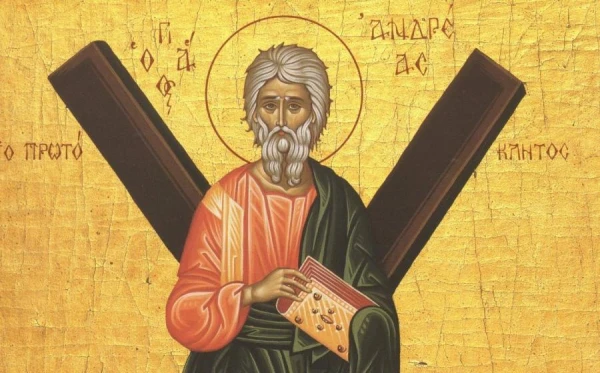
On December 13, the memory of Andrew the First-Called is commemorated in Orthodox churches. This holy apostle, known as the enlightener, is one of the twelve beloved disciples of Jesus Christ. In the folk calendar, this day is called Andrew's Day. In ancient times, on Andrew's Day, our ancestors listened to the sounds of water, believing that it could tell many interesting things.
Apostle Andrew the First-Called
According to the Bible, Andrew and his brother Simon were born in Bethsaida. This town, located on the shore of the Sea of Galilee, was home to fishermen. Andrew and Simon's father was also engaged in fishing.
The sons followed in their father's footsteps, but Andrew, still a teenager, realized that fishing was not his calling. Even then, he dreamed of serving Jesus Christ.
One day, after hearing the prophetic words of John the Baptist, he approached him and expressed his desire to become his disciple. Soon after, he asked for baptism. When Andrew was baptized in the Jordan River, he saw the Almighty.
According to traditions, Christ descended from heaven in the form of a dove. Believing in Jesus, Andrew followed him and later brought his brother Simon, whom Christ named Peter. Thus, Andrew became known as the First-Called.
After the Resurrection of Jesus Christ, his devoted disciples—the apostles—received the gift of healing people from serious ailments and preaching in various languages. It is known that Andrew the First-Called spread Orthodoxy among the pagans. Crossing the Bosporus, he reached the places where Kyiv would later arise, and then Novgorod.
Andrew the First-Called completed his life in the village of Patras. Upon seeing the apostle, the local ruler—a pagan named Aegeas—ordered Andrew to be executed for his adherence to the teachings of Jesus and his call to this idolatry. The apostle was crucified, just like his Teacher.
Folk Calendar: Andrew's Day
The holiday dedicated to Saint Apostle Andrew the First-Called had various names. In some places, it was called Andrew's Day, in others—Andrew or Andrew's Night.
In ancient times, during this time, peasants listened to the sounds of water—not only from wells. On Andrew's Day, they went to bodies of water to understand what the rivers and lakes wanted to tell them.
If the waters were silent, it foretold that there would be no strong blizzards and frosts in winter. However, if there were noise and groans coming from the bodies of water, the ancestors felt sad.
They understood that the upcoming winter prepared trials that would not end with the conclusion of the winter season. Nature could present any surprises, including floods and hurricanes.
What Our Ancestors Did on Andrew's Day
Andrew's Day is a time for divination about suitors. Young women dreaming of marriage turned to Apostle Andrew the First-Called, asking for help in finding a worthy life partner who could become a good husband and father to future children. This did not prevent them from attending church and performing divination rituals that came from pagan traditions.
Apostle Andrew the First-Called is considered the patron of fishermen and sailors. Therefore, on the day of his memory, believers, in families that have representatives of these professions, definitely go to church to pray to the apostle and ask for protection for those who have chosen this difficult path.
On Andrew's Day, divination was done with bread. During dinner, young women secretly broke off a small piece, which they placed under their pillow before going to sleep. At this time, they would say, “Beloved, come to me for dinner.” It was believed that one could see their suitor in a dream. The main thing was to manage to see him, which not everyone succeeded in.
The people loved and honored Apostle Andrew the First-Called. Despite the fact that Andrew's Day falls during the Christmas fast, our ancestors laid abundant tables.
The main dish of such feasts was pies made from lean dough with cabbage, potatoes, and mushrooms. By this time, pickles and sauerkraut were ready. In general, no one suffered from hunger.
Andrew's Day: Folk Signs
Andrew's Day can tell a lot of interesting things about the weather. Elders said: if it snows on Andrew's Day, it will lie on the ground for 110 days. Clear frosty weather served as a harbinger of a good harvest.
Andrew's Day: What Not to Do
In ancient times, on Andrew's Day, men avoided heavy physical work. Women were forbidden to engage in handicrafts: sewing, knitting, weaving. It was believed that violators of these prohibitions could get hurt.
On Andrew's Day, our ancestors were afraid to go outside at night to avoid encountering evil spirits. Elders said that at this time danger lurked not only for people but also for domestic animals.
It was forbidden to swear. Woe to those who disobey. These people would face severe trials, poverty, and illness.
Despite the fact that feasts were held on Andrew's Day, guests were not invited into the house, even relatives. It was believed that at this time, under the guise of close people, evil spirits could enter the dwelling, bringing misfortune.












Leave a comment