
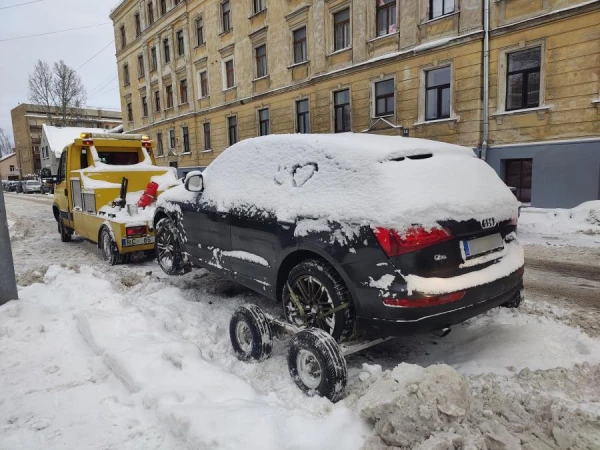
Recommendations for drivers on 'reviving' a frozen car.
Automobile mechanic Artyom Polyakov warns that it is not advisable to start cars in frost without necessity, as this creates significant stress on the equipment. However, if a trip is unavoidable, the expert advises on how to start the engine correctly. For example, to increase reliability, it is worth 'preheating' the spark plugs: after you drive into the yard, let the engine run at high RPM for 20-30 seconds, in simpler terms, give it some gas.
On a frosty morning, when the car is completely cold, it is recommended to turn on the high beams for 10-15 seconds before starting the engine.
“This will help warm up the battery and prepare it to deliver current during the start,” notes the mechanic.
After that, you should turn off the headlights and turn the ignition key, but do not start the engine immediately — the car needs time to 'wake up'. When all the electronics and instruments begin to operate normally, you need to press the clutch on a manual transmission, and on an automatic, press the brakes, and carefully turn the key to start.
“If the car does not 'catch', then after three engine sounds, you can understand that it is not worth continuing the attempts. Otherwise, there is a risk of completely discharging the battery, flooding the spark plugs, or burning the clutch,” warns Artyom.
Between starting attempts, you should take breaks of about a minute, and the number of attempts should not exceed three.
When the engine is just a little short of starting, it is recommended to press the gas pedal and gently rev the engine — this may help the car start. However, Artyom Polyakov does not advise using this method frequently, only in emergencies, otherwise it may lead to unpleasant consequences, such as blown seals.
Many drivers use remote start in winter. Its undeniable advantage is that you do not have to leave the warm apartment and wait 10-20 minutes before you can go about your business. However, starting the car with remote start in severe frost can lead to flooding the spark plugs. Therefore, the mechanic recommends maintaining a comfortable engine temperature by setting the remote start to activate at a temperature of -20 degrees Celsius.
Preparation for Frost
To ensure that the car starts without problems in severe frost, it is necessary to prepare it for the cold in advance. Therefore, if you have not yet changed the oil in the engine, it is time to go to the service station. According to the mechanic, it is better to use 'synthetic' oil with the appropriate viscosity in winter, for example, 0w-40, which is suitable for temperatures down to -40 degrees, or 5w-40, which is designed for cold down to -35 degrees. Other fluids in the car should also be ready for frost.
“If there is 'summer' oil left in the engine, this can lead to poor engine performance, the appearance of carbon deposits, and other unpleasant issues,” says Artyom.
A key factor for successfully starting a car in frost is functioning spark plugs.
“In frost, spark plugs can become flooded with gasoline, and then they will either need to be replaced or cleaned from carbon deposits. The reasons for this can be the operating conditions of the engine the day before, low battery charge, engine wear, loss of viscosity of the motor oil, as well as malfunctions in the ignition system or simply outdated spark plugs that have not been replaced on time,” explains Artyom.
Another way to help your car survive severe cold is to purchase a special blanket and cover the engine with it. The expert claims that this will help maintain the working temperature of the car a little longer than usual, but it does not provide a 100% guarantee of a successful start.














Leave a comment