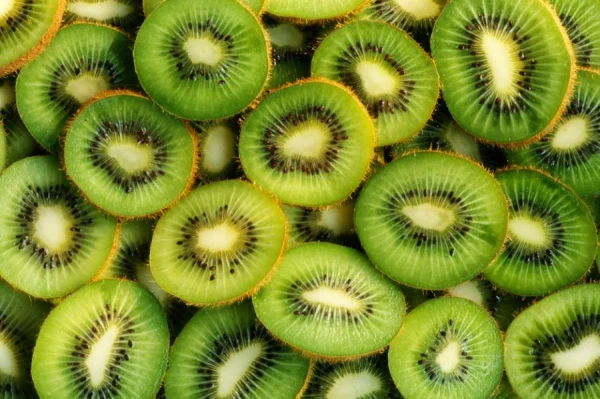
Researchers from New Zealand, analyzing the properties of fruits and their impact on the human body, concluded that people with a vitamin C deficiency should add kiwis to their diet.
Exotic fruits, originating from China, are mistakenly considered fruits. In fact, they are large berries. Previously, in the Middle Kingdom, they were called “monkey peaches.” At that time, the fuzzy fruits were not distinguished by taste and were not popular.
Kiwis gained their popularity thanks to New Zealand breeders who worked on improving the plant and changing its taste qualities. Scientists, impressed by these changes, decided to change the name as well. The fuzzy fruits became known as kiwis, in honor of the small bird that inhabits New Zealand and is its national symbol.
These exotics from the genus Actinidia, which can still be considered fruits, have a refined taste reminiscent of a cocktail of oranges, pineapples, bananas, and strawberries. However, the value of the fruits from the Middle Kingdom lies not only in their unusual taste but also in their composition. Kiwis are very beneficial.
Researchers studying the work of breeders have established that the fruits, which are also called “Chinese gooseberries” in their homeland, contain a significant amount of vitamin C. This powerful antioxidant protects cells from damage and prevents oxidative processes that contribute to heart disease and accelerate the aging of the body.
Kiwis are also rich in vitamins E and K, minerals such as copper, potassium, magnesium, pectin, as well as soluble and insoluble fiber. The unique enzyme actinidin aids in the breakdown of proteins and the effective absorption of food.
Experiments dedicated to the beneficial properties of kiwis have been conducted since the middle of the last century. One of the latest studies, conducted by the New Zealand research institute Plant & Food Research, focused on vitamin C and its effects on the body during the virus and cold season.
And what was established? It turned out that just two small fruits or one large fruit weighing 100 grams completely cover the daily requirement for vitamin C. Moreover, kiwis have an effect on the body comparable to that of dietary supplements, as reported by scientists in the publication MDPI.