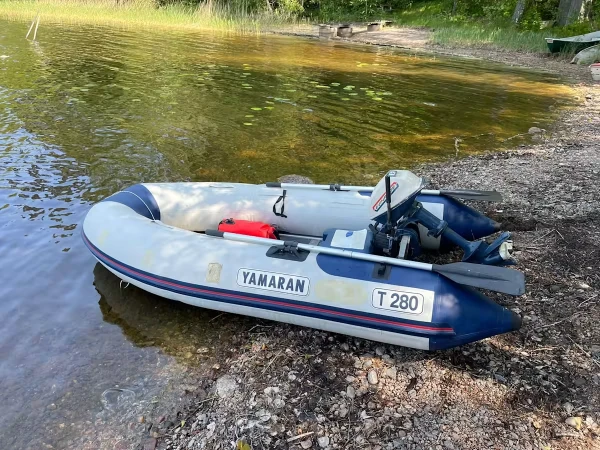
Did not drown at sea - but ended up in prison.
This story began in June 2023, when two Russians – 28-year-old Pavel Kuzmichev and his 42-year-old uncle Otto Mayer – crossed the Gulf of Finland in a small rubber boat in search of asylum in Finland. Two years later, Kuzmichev was returned to Russia by the Migration Service (Migri), where he ended up in prison.
The escape from the risk of being drafted into the Russian army, as well as from the tense and repressive political situation in the Russian Federation, was carefully planned for a year. Initially, Mayer and Kuzmichev prepared a yacht for a journey across the Atlantic to the United States, but they could not leave the port of Primorsk unnoticed. The men had to abandon the yacht on Sommers Island and continue their journey in a rubber boat.
On a small motorized rubber boat, the fugitives covered about 60 kilometers to Kotka.
"We were lucky – there was a calm. But closer to Kotka, the weather began to deteriorate, and the transom to which the boat motor is attached started to come off. At one point, there was a real threat of sinking," Otto recalls in an interview with Yle News.
Upon reaching the Finnish shore, they contacted the police to request asylum. After a preliminary interview, they were sent to the refugee center in Joutseno.
Over time, the paths of Pavel Kuzmichev and his uncle gradually diverged. Kuzmichev moved to Savonlinna, where he attended language courses. Mayer, living in Imatra, occasionally called him.
"In one of the conversations, he said: I’m doing well, I know what to talk about in the interview."
In September 2025, an unexpected event occurred: Kuzmichev was deported back to Russia. The circumstances of the deportation remain unclear. According to Mayer, Finnish authorities took him to Narva and handed him over to Russian border guards at the border with the Russian Federation.
Shortly after crossing the Estonian-Russian border, Kuzmichev was detained. He was placed in pre-trial detention center No. 3 in Vyborg.
"Pavel did not tell anyone about his affairs and the decision of Migri. I learned that he was denied and did not appeal only when Pavel was already in the pre-trial detention center in Vyborg."
Since August 2023, Kuzmichev and Mayer have been placed on the federal wanted list in Russia. A criminal case was initiated against them under the article on illegal border crossing in a group by prior agreement, which carries a penalty of up to five years in prison.
According to Mayer, Kuzmichev was transferred from the pre-trial detention center to a psychiatric hospital for examination. He said that at that moment his nephew was in poor condition, refusing to eat and was on IV drips. He was then transferred to the 'Kresty' pre-trial detention center in St. Petersburg. In mid-December, contact with him was lost.
Currently, Kuzmichev is again in pre-trial detention center No. 3 in Vyborg. Mayer notes that his nephew has lost a lot of weight and is in a depressed state.
Journalist Yulia Selikhova from the independent Russian publication 'Vyorstka' managed to find Kuzmichev. He responded to her letter. The response was published on the publication's Instagram:
"Hello Yulia, this is Pavel. Thank you for finding me. Tears flow from my eyes as I read your letter. It’s been five months of my imprisonment in jail, and I am currently being charged with crossing the border as part of a group. There will be a trial in February, and I have a state-appointed lawyer. I have lost a lot of weight and had a nervous breakdown. In these terrible times, it’s hard to stay optimistic, but I’m trying to hold on. With respect and gratitude, Pavel. 16.1.2026."
The Migration Service is aware of the risks associated with returning individuals to Russia.
The fact that deportees may face criminal prosecution is also confirmed by updates made last fall to the Migri report on Russia. Decisions on asylum issues are based precisely on information about the country of origin (maatieto).
This document also cites cases where Russians were sentenced to various prison terms for illegal border crossing. Among them are those who were denied by Finnish authorities. It also notes that citizens returned to Russia are regularly subjected to questioning at the border, and their phones, banking apps, and social media accounts may be checked.