The former head of state was found guilty of complicity in the activities of an armed anti-government group.
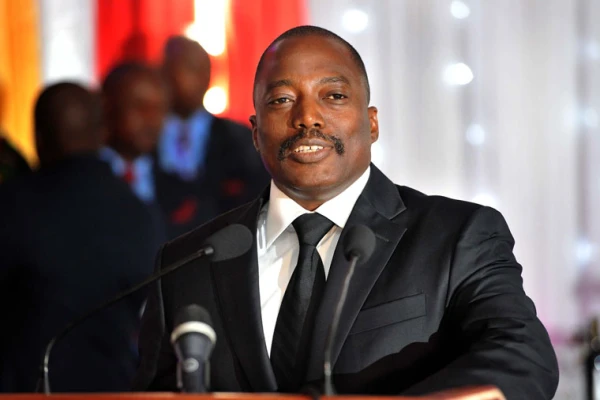
The former president of the Democratic Republic of the Congo (DRC), Joseph Kabila, was sentenced in absentia to death for "war crimes" and "treason." The 54-year-old Kabila served as the president of the Democratic Republic of the Congo from 2001 to 2019. What did he do?
Kabila was accused of "war crimes," "treason," and "organizing a rebel movement" for alleged connections with the political-military alliance AFC/M23. According to the prosecution, the former president was one of the initiators of the Alliance of the Congo River (AFC), the political wing of M23. The former president was found guilty of complicity in the activities of an armed anti-government group supported by Rwanda.
The sentence can be called historic, as Joseph Kabila became the first Congolese president to be convicted by a military court. For nearly four hours, the judges of the Supreme Military Court justified their decision. They detailed all stages of the investigation as well as all charges against Kabila. The court not only sentenced Joseph Kabila to death in absentia but also ordered the former president to pay compensation: over $33 billion to the state of Congo, the provinces of North and South Kivu, and to victim assistance associations. Representatives of the former president condemned the process.
Civil plaintiffs demanded the resumption of the investigation. They promised to present new evidence, including witness testimonies that were supposed to confirm the former president's alleged financial connections with the AFC/M23 group. However, the witnesses did not appear at the last hearing. The decision had to be made based on already known data to the investigation and the court: public statements by Joseph Kabila and his entourage, as well as the testimony of a witness who, according to the prosecution, is close to the leadership of AFC/M23.
The trial of the former president was conducted in absentia. Kabila himself rejected the accusations and called them politically motivated. The whereabouts of the former president are currently unknown: he left the DRC in 2023, and it was reported that he resided in South Africa; however, in the spring of 2025, Kabila appeared in the DRC — in Goma, the capital of North Kivu province, which is controlled by M23.
M23 Group
North Kivu is an area in the eastern Democratic Republic of the Congo, located on the border with Rwanda and Uganda. Conflicts in the region have periodically flared up for over 30 years, resulting in clashes between rebel groups and central authorities.
In 1994, Tutsis fled from Rwanda, where genocide began, to the DRC (formerly Zaire). After the power changed in Rwanda and the Tutsis took control of the country, Hutus, fearing repression from the new government for their involvement in the genocide, fled to Congo. Armed groups began to form among the refugees, claiming their goal was to protect their fellow tribesmen.
The groups gained influence and at a certain point took control of the smuggling of minerals. North Kivu is rich in gold, cobalt, tungsten, and other minerals. Many territories are de facto controlled by rebel groups, which thus establish control over the extraction and supply of mineral resources. Mainly, supplies go through Rwanda.
Rebels have repeatedly clashed with the authorities of the Democratic Republic of the Congo. In 2004, Tutsis accused the Congolese government of supporting Hutu groups, which they claimed were preparing a new genocide, and launched a rebellion in North Kivu. The conflict continued until 2009, when a peace agreement was signed: the groups agreed to disarm in exchange for political representation in parliament and the inclusion of their fighters in the army.
Another conflict erupted in 2012-2013. At that time, the authorities of the DRC and international observers noted that the Rwandan authorities were de facto commanding M23 military operations. The Rwandan side denied involvement in the conflict.
It is believed that M23 experienced a rapid resurgence at the end of 2021, with its numbers estimated at around three thousand. A new wave of violence began in the winter of 2025 when the armed group M23 announced that it had captured major cities — Goma and Bukavu.
<iframe width="560" height="315" src="https://www.youtube.com/embed/Fqai4U_9ElI?si=IzcsJtVTc-JGGb7m" title="YouTube video player" frameborder="0" allow="accelerometer; autoplay; clipboard-write; encrypted-media; gyroscope; picture-in-picture; web-share" referrerpolicy="strict-origin-when-cross-origin" allowfullscreen></iframe>