
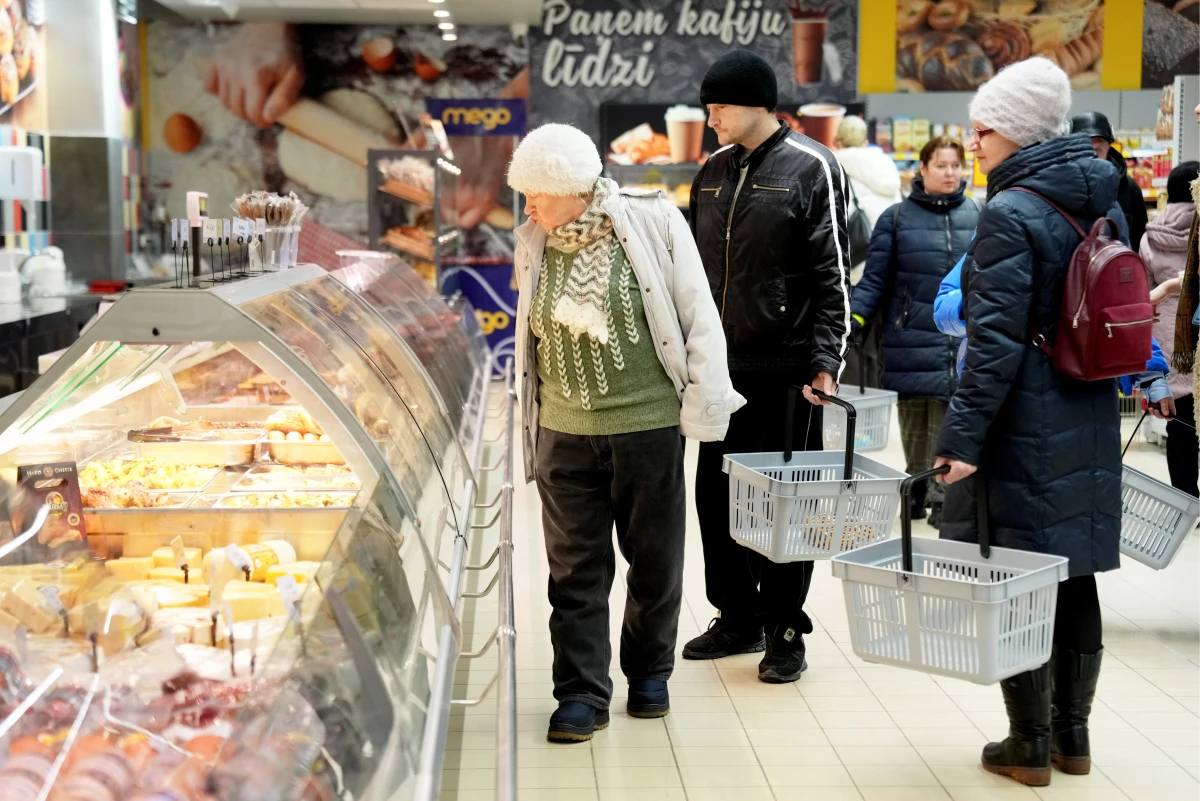
Latvians spend up to 30% of their household budget on food, local statistics calculated. "The decrease in real turnover in grocery retail stores may indicate a decline in the purchasing power of the population," the Ministry of Economics states.
The ministry of Minister Viktor Valainis (Union of Greens and Farmers) has been accepting various memorandums for several years, holding meetings with leaders of food retail, and otherwise "addressing identified problematic issues in the industry." In practice, this translates into total inventories, primarily of alcoholic products — as well as the introduction of mandatory labeling of the country of origin of goods...
Five Years of Inflation Sprint
According to economists, we are facing a relatively recent phenomenon. Back in 2019, food prices in Latvia were 6.6% lower than the EU average. In turn, in the Baltic region, food in Lithuania was 12.5% cheaper than in Latvia, while in Estonia, food prices were on average 2.1% higher.
"Under the influence of economic, geopolitical, and other factors in recent years, the situation has changed dramatically," the Ministry of Economics states. "As Eurostat data shows, the level of food prices in Latvia is now one of the highest in the EU."
By 2023, our prices were 6% higher than the EU average, exceeding the levels of several high-income countries (Belgium, Germany, Italy, Spain, the Netherlands). It is worth noting that compared to neighbors, Latvia's relative position has generally remained the same; in Lithuania, the level of food prices is still slightly lower than in Latvia (by 2.5%), while in Estonia it is 0.8% higher.
Income and Expenses
At the same time, the expenses of residents of Latvia on food, relative to household incomes, were about 20% higher than those of residents of Lithuania and Estonia. According to Eurostat data, for residents of Latvia, the price burden on food is one of the highest in the EU – the level of food prices in Latvia is 6% higher than the EU average, while incomes are only 60% of the average figure.
However, paradoxically, this has not brought significant profits to local trade: despite an absolute increase in figures by almost 27% from 2021 to 2024, real turnover fell by 7%. Accordingly, the number of grocery stores decreased by 11% from 2020 to 2024, and the number of employees decreased by 7%.
One might assume that at least local producers remained in the black — after all, with a sharp reduction in supplies of highly competitive products from Russia and Belarus, Latvian farmers came to the forefront. However, in the conditions of "oligopoly" (as stated in the Ministry of Economics document), the choice of large retail chains often becomes products from neighboring EU countries, which are more advantageous in price.









Leave a comment