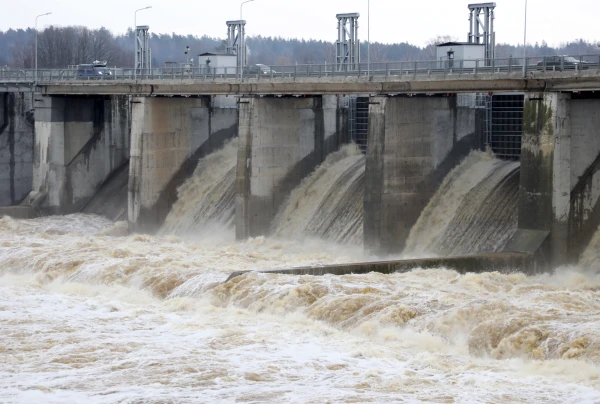
Hydropower plants are an important asset in electricity production in Latvia, and their operation depends on water inflow.
There was once a project envisioned to supplement the Daugava Hydropower Plant cascade with new stations, and the possibility of its implementation exists, but this would require flooding areas, which society would not support. Such conclusions were voiced during a discussion on the significance of hydropower for Latvia and its future possibilities, organized by the publication "Dienas Bizness" in collaboration with the Latvian Environmental Protection Fund as part of the "Green Energy = Competitive Latvia" series.
Latvia is the only country in the Baltics that produces a significant amount of electricity using water - mainly thanks to the Daugava Hydropower Plant cascade, which includes the Pļaviņas, Kegums, and Riga hydropower plants. In addition to this cascade, there are more than 140 small hydropower plants operating in the country.
The amount of electricity generated at hydropower plants varies depending on the year. According to AS "Augstsprieguma tīkls", the lowest amount produced in the last 10 years was in 2015 - 1.75 terawatt-hours, while the highest was in 2017, when 4.36 terawatt-hours were produced. On average, the share of electricity generated at hydropower plants in the total production volume in Latvia regularly exceeds 51%. According to AS "Augstsprieguma tīkls", in general, in 2025, the share of renewable electricity in the total production volume in Latvia was 72.78%.
"Electricity generated at hydropower plants has been one of the most stable base resources for several decades," emphasized the Minister of Climate and Energy, Kaspars Melņiks.
He noted that the state relies on these generating capacities in the future as well. "If in 2017 the volume of electricity production at Latvian hydropower plants was record-breaking, other sectors, such as agriculture, faced flooding of fields and its consequences in the same year," the minister noted. According to him, the volume of water inflow, that is, meteorological conditions, is the key factor for the operation of hydropower plants.
From an economic efficiency perspective, Latvia could follow the example of Scandinavia, where hydropower reservoirs accumulate water for electricity production for an entire month. This allows Scandinavian hydropower plants to produce electricity much more stably; however, in Latvia, this is hindered by the terrain, so existing opportunities need to be utilized.