
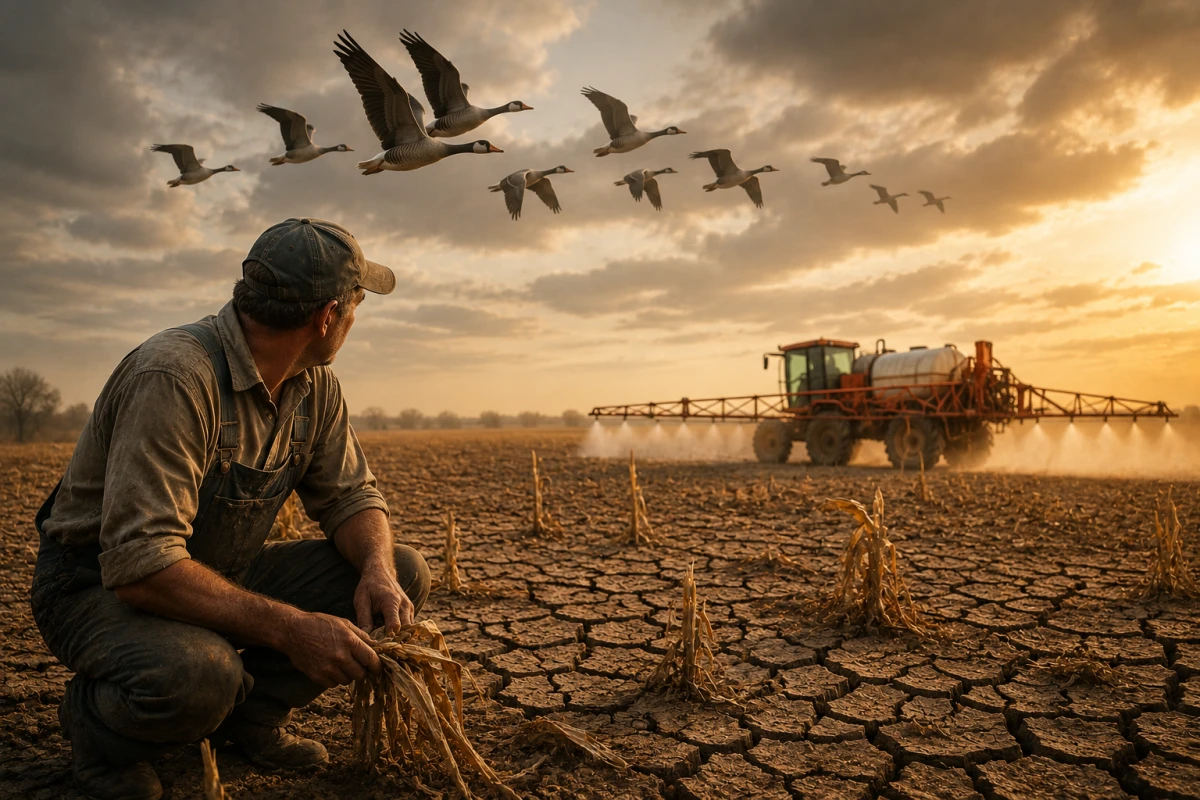
Latvian farmers are increasingly concerned about the prolonged drought and sharp temperature fluctuations that hinder crop development. In some areas of Zemgale, the soil has already begun to crack, and plants are experiencing a deficit of moisture and nutrients.
Despite the fact that winter crops in Latvia have generally survived the winter well, this spring is proving to be a serious test for agriculture.
Farmers and specialists acknowledge that the main problem now remains the lack of moisture. There has been too little precipitation in recent weeks, and the cold April, nighttime frosts, and strong winds have further dried out the soil.
As a result, plant development is slowing down, and crops are beginning to change color.
Girts Ozols, a representative of the "Latraps" cooperative, reported that sharp temperature fluctuations are particularly negatively affecting the crops, creating additional stress for the plants.
According to him, winter rapeseed has already begun to bloom, and winter wheat has entered an important phase of yield formation, but it is still too early to make predictions.
In Zemgale, the situation is becoming particularly alarming. Andris Skudra, a consultant at the Latvian Center for Rural Consultations and Education, noted that the clay soils in the region have already begun to crack.
Due to the drought, it is becoming more difficult for plants to absorb nutrients. This is manifested in the yellowing of the lower leaves and signs of potassium deficiency.
What is important to understand is that for farmers, at least one substantial rainfall is critically important right now. Specialists say that about 20 millimeters of precipitation per day is needed to improve the situation — especially in Zemgale and Kurzeme.
At the same time, the weather problems coincide with a difficult economic situation in the sector. Farmers complain about low grain prices, high costs of fertilizers, fuel, and transportation expenses.
According to Ozols, the increase in raw material costs by 30–60% will be fully felt in the next season. This creates uncertainty even regarding the upcoming autumn sowing campaign.
An additional problem this spring has been birds. Geese, cranes, and swans are causing particularly significant damage to the crops.
Farmers report that geese have unusually lingered in the fields this year, destroying crops of beans, peas, and grains. Some farms set up sound cannons and scarecrows in advance, but this did not completely solve the problem.
The "Farmers' Union" notes that cranes can reach seeds even from a depth of several centimeters, and birds can now be seen in almost every field.
Against this backdrop, many agricultural producers continue to work under conditions of constant uncertainty — some fieldwork has to be postponed to late evening due to strong winds and the need to protect pollinators.
Farmers hope that the weather will stabilize and that the geopolitical situation will allow for at least a partial reduction in costs by the beginning of the next season.








Leave a comment