Southern regions traditionally have a more developed labor market.
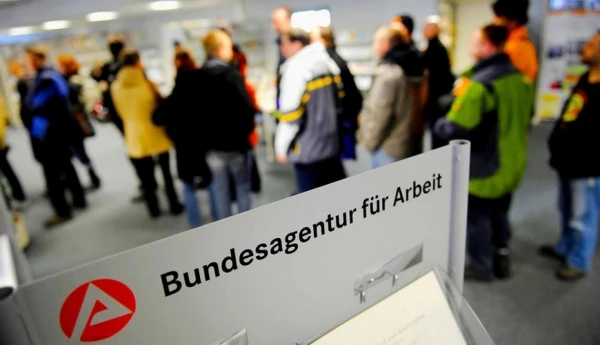
In Germany, 3.085 million unemployed people have been registered. This is the highest figure in the last 12 years. The Federal Employment Agency explains the increase in the number of unemployed by seasonal fluctuations.
In January, the number of unemployed in Germany exceeded three million, reaching the highest level in nearly 12 years. According to the Federal Employment Agency (Bundesagentur für Arbeit, BA), this figure currently stands at 3.085 million people.
Compared to December 2025, the number of unemployed has increased by 177,000 people, and in annual comparison, by 92,000. The unemployment rate has risen by 0.4 percentage points to 6.6%. The number of unemployed was only higher in February 2014, when it was about 3.138 million people.
As reported by the head of the Federal Employment Agency, Andrea Nahles, the increase in the number of unemployed is due to seasonal factors. In January, the unemployment rate usually always rises, as many temporary employment contracts expire at the end of the year, and employment decreases in weather-dependent sectors such as construction, agriculture, and tourism.
The crisis associated with measures to combat the pandemic has hit the German labor market hard. Lockdowns in the spring and winter of 2020 plunged a healthy economy into an artificial coma, from which it has not yet been able to recover in 2025.
It is impossible to expect the Germans to present statistics that are simple and transparent. There are many nuances in the methodology for counting the unemployed. Those excluded from the job-seeking count include, for example:
- recipients of benefits who are on sick leave;
- those with minimal employment of "1 euro per hour";
- those undergoing retraining;
- people over 58;
- partially employed individuals.
According to the Kiel Institute for the World Economy (IfW), unemployment in Germany is expected to be at 5.9% in 2026. Experts have improved their growth rate estimates, which is related to the government's plans to increase public spending.
By the end of 2025, the situation in the German labor market has only worsened — the average unemployment rate reached 6.2%.
Companies have become noticeably more cautious in hiring. On average, the Federal Employment Agency (BA) recorded 632,000 job vacancies, which is 62,000 fewer than a year earlier.
Andrea Nahles noted that in 2025, the labor market developed worse than the previous year, although by the end of the year, the first signs of stabilization appeared. At the same time, only a slight increase in employment is expected in 2026.
Demographic and structural changes are putting additional pressure on the labor market. For the first time, the potential number of the working-age population is expected to decrease by about 40,000 people. Previously, employment growth was largely supported by the influx of foreign workers compensating for the shortage of local labor. In the future, this resource may significantly diminish.
The labor market is developing unevenly. Employment growth continues in the service sector, education, and healthcare. In contrast, industry continues to lose jobs, and this trend is expected to persist.
Despite some signs of stabilization, the high unemployment rate, reduction in job vacancies, and demographic factors make the prospects for 2026 cautious.
Among young people, unemployment is higher than average. In the category under 25 years old, the unemployment rate in 2025 is recorded at an average of 6.4%. In 2024, it was 6.7%. In other European countries, young graduates from universities and secondary educational institutions are most at risk. In Europe, the number of unemployed young professionals reaches 25%.
The average unemployment rate among youth in East Germany is 8.0%, which is significantly higher than in West Germany 35 years after reunification. In the former West Germany, this figure during the reviewed period was 5.0% (as of December 2025). Unemployment among young people aged 15 to 25 is particularly high in Berlin and Saxony-Anhalt. A similar picture is observed across federal states. The number of unemployed in Germany is distributed unevenly. Good employment figures are seen in the south — in Bavaria and Baden-Württemberg. The situation is worse in the former GDR, Bremen, and Berlin.
Germans themselves prefer to move from the east of the country to the south. Here, career prospects are better, average salaries are higher, and the infrastructure looks more prosperous. Southern Germany is jokingly referred to by Germans as the Speckgürtel of the country — the fat reserves on the waist.
The shortage of personnel affects hiring policies. Successful companies strive to retain employees, increasing the salary fund.
Due to the lack of labor, firms prefer to keep workers on contracts, even if the economic situation dictates layoffs. The number of dismissals by employers is at a minimum level for the last 30 years.
Now the main task of the HR department is not to search for new employees, but to motivate and retain those hired. Losing a key specialist in conditions of personnel shortages is equivalent to a disaster for business.
German managers are building programs to unlock the potential of subordinates. Internal transitions and promotions are occurring more intensively.
As for hiring, planning to fill vacancies begins long before the actual opening of the position. Recruiters scour social networks and resume sites in search of talent.
The situation creates new opportunities for working immigrants. In March 2020, a new law on labor migration was adopted, expanding employers' opportunities to hire foreigners. However, qualified professionals who can immediately solve high-level tasks are in demand.
In the 20th century, the unemployment rate in Germany reached or exceeded 3 million people mainly during the Great Depression (late 1920s - early 1930s), as well as in the mid-1920s. Critical figures (over 6 million) were recorded around 1932–1933, while already in February 1929, the number of unemployed was 3.5 million.
February 1929: At the beginning of the crisis, unemployment reached 3.5 million people.
1930–1932: The number of unemployed rapidly grew, exceeding 6 million by the beginning of 1933.
Mid-1920s: In 1926, despite economic growth, the number of unemployed reached 2.2 million, and at certain moments — more than 3 million.
After 1933 and until the end of the 1930s, unemployment in Nazi Germany was virtually eliminated.