
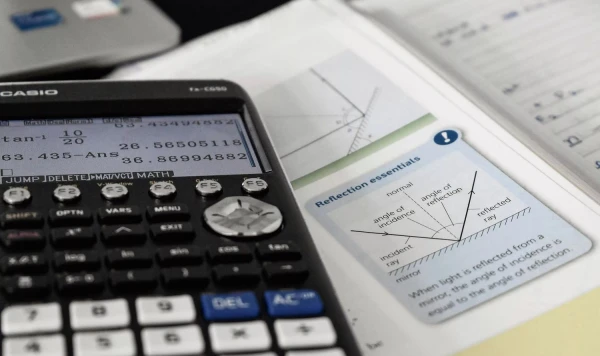
These devices are especially relevant in regions with unstable power supply and unreliable internet connectivity.
Calculators remain a sought-after device in many countries around the world, thanks to their reliability and predictability. They always provide accurate results and, unlike chatbots, are not prone to "hallucinations" or calculation errors.
The management of the Japanese company Casio acknowledges that the demand for personal calculators for business tasks has indeed decreased, as their functions have largely been taken over by smartphone applications and web browsers. However, the calculator market continues to exist as a whole.
In the fiscal year ending in March 2025, Casio sold 39 million general and scientific calculators in one hundred countries worldwide. In comparison, sales reached 45 million devices in 2019–2020, and during the COVID-19 pandemic, they fell to 31 million. These figures show that a device invented more than half a century ago still finds its buyers.
Calculators are especially relevant in regions with unstable power supply and unreliable internet connectivity — in such conditions, a specialized tool, carefully optimized for performing mathematical operations, becomes indispensable. Furthermore, calculators are significantly cheaper than smartphones or laptops. They can operate on regular batteries or solar panels, making them a practical solution for developing countries.
An important advantage remains tactile feedback — physical buttons allow for quick and error-free number entry. Calculators do not require an operating system to boot, are not dependent on software updates, and perform their tasks instantly. For many users, especially in the educational sector, they remain a familiar and proven tool that has not changed since school years. Even in the era of widespread digitalization, a simple calculator continues to demonstrate its value as a specialized yet simple and extremely reliable device.
In 1957, Casio released one of the first mass-produced calculators, the 14-A. It performed four arithmetic operations on 14-digit decimal numbers. The design used relays, weighed 140 kg, and was made in the form of a table with a computing unit, keyboard, and display, consuming 300 watts during operation. The programmable calculator on discrete semiconductors HP 9100A. In 1961, the first mass-produced fully electronic calculator ANITA MK VIII with an 11-digit indicator on gas discharge lamps, a full keyboard for number input, and ten keys for entering multipliers began production in the UK. In the USSR, the first domestic mass-produced electronic calculator "Vega" was released in 1964, and in the USA, the mass-produced fully transistorized calculator FRIDEN 130 appeared in the same year.
Semiconductor calculators quickly became more complex. In 1965, Wang Laboratories released the Wang LOCI-2 calculator, which could compute logarithms, Casio introduced the first calculator with built-in memory "Casio 001" (dimensions 37×48×25 cm, weight 17 kg), and Olivetti released "Programma 101" — the first calculator that could save a program and perform calculations based on it multiple times. In 1967, Casio introduced its desktop programmable calculator AL-1000, while in the USSR, the production of "EDVM-P" — a calculator for calculating transcendental functions — began.












Leave a comment